AI Lead Qualification Automation: Score and Route Leads Automatically
A practitioner’s guide to scoring inbound leads for fit and intent, routing them in seconds, and keeping a human in the loop on the ones that matter.
The 60-second answer
- AI lead qualification automation captures every inbound lead, enriches it, scores it for fit (does it match your ideal customer) and intent (is it ready to buy), then routes it to the right next action in seconds rather than hours.
- The reliable design is a hybrid: deterministic rules for the hard ICP gates, an LLM with structured JSON output to read the free-text message and grade intent, and a human gate on high-value or low-confidence leads. Pure rules miss nuance; a pure model score you cannot explain is a liability.
- Speed is the whole point. Harvard Business Review found firms that contact a web lead within an hour are roughly seven times likelier to qualify it than those that wait even one hour longer, so the scoring and routing must finish fast enough to act inside that window.
Why manual lead triage quietly loses revenue
Manual lead triage fails in two ways at once: it is too slow, and it is inconsistent. Both are expensive, and neither shows up on a dashboard until a quarter is already behind.
Take speed first. When a form is submitted, a clock starts. Harvard Business Review’s study of online sales leads, drawn from Dr. James Oldroyd’s lead-response research, reported that companies which tried to reach a prospect within an hour were nearly seven times as likely to have a meaningful conversation with a decision-maker as those that waited just one hour longer. The same research found the odds of even reaching a lead collapse as the first response slips from a few minutes to half an hour. A human checking a shared inbox a few times a day cannot win that race; the lead has already replied to a faster competitor.
Then there is consistency. Two salespeople reading the same form weight it differently depending on the day and their pipeline pressure. One treats a free Gmail address as disqualifying; another chases it for a week. None of this is written down, so it cannot be measured, improved, or trusted. The result is a triage process that is both a bottleneck and a coin flip.
Automation fixes the mechanics of both problems. It reacts the instant a lead arrives, applies the same definition of “good” every time, and records why it made each call so you can audit and tune it. The aim is not to remove judgment, but to make the routine instant and consistent so your team spends its judgment on the leads that deserve it.
The signals that actually qualify a lead
A score is only as good as its inputs. Qualification draws on three families of signal: what the lead tells you (form fields), what you can look up (enrichment), and how they behave (engagement). The art is mapping each signal to either fit or intent, because they answer different questions. Fit asks “is this the kind of customer we want?” Intent asks “are they ready to act now?” A perfect-fit company with zero intent is a nurture, not a call.
| Signal | Source | Why it matters / weight |
|---|---|---|
| Company size / revenue | Form field, or enrichment from the email domain (Clearbit, Apollo, ZoomInfo). | Core fit gate. Below or above your serviceable band, weight it to disqualify regardless of enthusiasm. |
| Job title / seniority | Form field, email signature, or enrichment from a data provider. | Fit. Decision authority predicts whether a deal can actually close, not just chat. |
| Business vs free email | Domain check on the submitted email (block list of free providers). | Data quality and fit. A free domain is not fatal, but it lowers confidence and often flags consumers or students. |
| Message / stated use case | Free-text form field, parsed by an LLM. | Strongest intent signal. “We need this live by Q3” outweighs almost everything else. |
| Pages viewed / pricing visit | Analytics or CRM tracking tied to the contact (e.g. HubSpot). | Intent. A pricing-page visit before a demo request is a buying motion, not idle research. |
| Source / campaign | UTM parameters, referrer, ad click ID. | Fit and quality. A referral or branded-search lead usually converts better than a cold display click. |
| Geography / language | IP geolocation or an explicit form field. | Serviceability gate. Outside the regions or languages you support, route to a polite decline, not sales. |
Notice that most rows draw on more than one source. Enrichment is what lets a three-field form behave like a ten-field one: the prospect types a work email, and you infer company size, industry, and headcount without a wall of boxes. Shorter forms convert better, so enriching after capture beats demanding the data up front.
Rules-based vs AI scoring vs hybrid
There are three ways to turn those signals into a score. Rules-based scoring assigns fixed points per condition. AI or LLM scoring reads the lead holistically and grades it. Hybrid uses each for what it is good at. The deciding factor is how much of your qualification logic is clean structured data versus messy free text and judgment.
| Dimension | Rules-based | AI / LLM scoring | Hybrid |
|---|---|---|---|
| How it decides | Fixed points per condition, summed to a threshold. | A model reads all signals and grades fit, intent, and quality. | Rules enforce hard gates; the model grades the nuanced, free-text part. |
| Best when | Criteria are crisp and structured (size, region, title). | The signal lives in unstructured text or varies case by case. | You have both, which is almost every real business. |
| Explainability | Total — you can point to the exact points that fired. | Lower unless you force the model to return its reasons. | High — rules are transparent and the model returns evidence. |
| Maintenance | Grows brittle; every edge case becomes another rule. | Prompt and examples to tune, plus drift to watch. | Rules stay small; the model absorbs the long tail. |
| Free text | Cannot read it without keyword hacks. | Native strength — this is the whole reason to use it. | Model handles the message; rules handle the fields. |
| Cost / latency | Near-zero, instant. | A token cost and a second or two per lead. | One model call only when a lead clears the cheap gates. |
| Main risk | Misses nuance; rejects good non-standard leads. | Over-trusted scores, bias, and hard-to-audit decisions. | More moving parts to build and monitor. |
HubSpot’s own scoring tool mirrors this split: it separates fit scores (firmographic) from engagement scores (behaviour), and now offers an AI-built variant alongside manual rules. For a small business the practical answer is hybrid. Keep a short list of deterministic gates that should never be left to a model — region you cannot serve, sizes you do not sell to, obvious spam — and let an LLM grade everything subtler, especially the free-text message where real intent hides.
Using an LLM to score with structured output
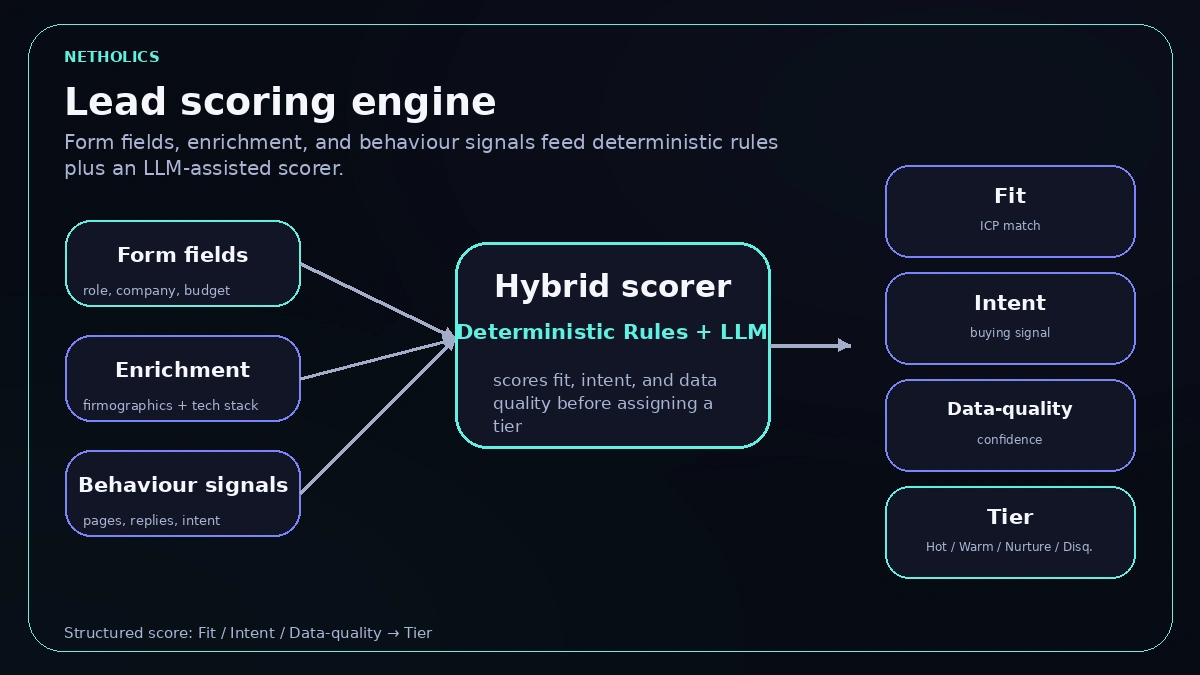
The mistake that sinks most LLM-scoring attempts is asking the model for free text. “Tell me about this lead” gives you a paragraph you cannot route on. The fix is structured output: constrain the model to return JSON that matches a schema, so every lead comes back as the same machine-readable object. Both OpenAI’s Structured Outputs and Anthropic’s structured-output and strict tool-use features guarantee the response conforms to the schema, which means no parse errors downstream. Score the lead on separate axes rather than one opaque number, and require the model to return its evidence and a confidence flag — that is what makes the result auditable and lets you tune one axis without disturbing the others.
# n8n -> LLM lead scoring, returned as strict JSON (no free text)

SYSTEM:
You score inbound B2B leads for an automation agency.
Use ONLY the supplied fields. If a field is missing, mark it unknown
and never invent data. Grade fit and intent separately. Return JSON only.

RESPONSE SCHEMA (enforced via response_format / strict tool use):
{
  "fit_score":      0 to 40,   # ICP: company size, industry, seniority
  "intent_score":   0 to 40,   # buying signals in message, pages, timing
  "data_quality":   0 to 20,   # completeness + business email
  "total":          0 to 100,  # fit + intent + data_quality
  "tier":           "hot" | "warm" | "nurture" | "disqualify",
  "reasons":        ["short, evidence-based, cite the field"],
  "missing_fields": ["..."],
  "confidence":     "high" | "medium" | "low",
  "review_required": true | false  # true for high ACV or low confidence
}
With every lead now arriving as that object, routing becomes a few transparent branches instead of human interpretation. Keep the routing itself in plain logic so it is easy to audit and change, and let the model’s tier and review_required flags drive it:
# Routing (n8n Switch / IF nodes), evaluated top to bottom
if lead.review_required or lead.confidence == "low":
    queue_for_human_review(lead)          # never auto-disqualify these
elif lead.tier == "hot":
    notify_sales(slack, sms); create_crm_task(due="5 min")
elif lead.tier == "warm":
    enroll_sequence("warm-nurture-14d")
elif lead.tier == "nurture":
    enroll_sequence("education-drip")
else:
    tag(lead, "disqualified"); suppress_from_sales()
Two rules keep this honest. First, the model never gets the last word on a disqualify when confidence is low or value is high — those go to a person. Second, the prompt forbids invented data, because a model that guesses a missing company size will hand you a confident, wrong score. Building this kind of reliable, tool-using behaviour is the core of practical AI agent development.
The qualification flow end to end
Routing logic and deduplication
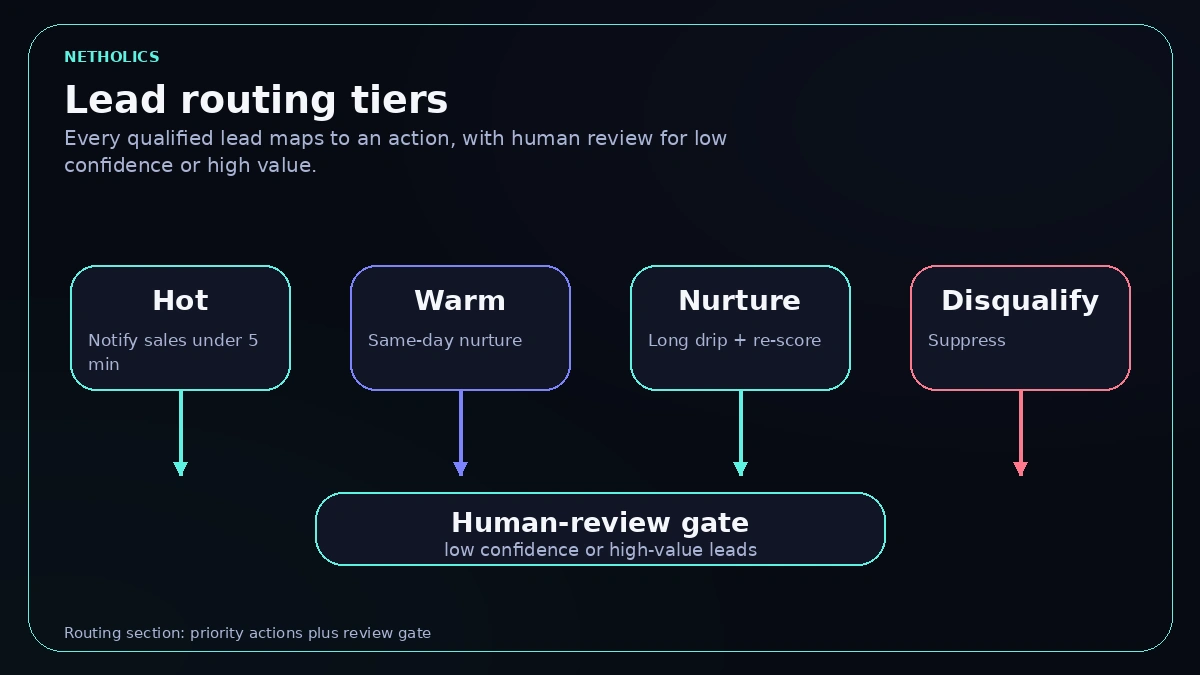
Scoring without routing is just a tidy spreadsheet. The point of the score is to trigger the right action at the right speed, so define a small set of tiers, attach a concrete action and a response-time target to each, and let the automation act the instant a lead is scored.
| Tier | Trigger | Action | Target response (SLA) |
|---|---|---|---|
| Hot | High fit and high intent (e.g. total 80+), business email, clear use case. | Notify sales by Slack and SMS, create a task, optionally offer instant booking. | Under 5 minutes. |
| Warm | Good fit, softer intent — researching, no urgency stated. | Enrol in a short nurture sequence; flag for sales follow-up within a day. | Same business day. |
| Nurture | Fit unclear or early-stage; could mature later. | Add to a long education drip; re-score on the next engagement. | Automated, ongoing. |
| Disqualify | Out of region, wrong segment, spam, or competitor. | Tag, suppress from sales, send a polite decline if appropriate. | Instant, no human time. |
Deduplication has to happen before scoring and routing, or you create chaos: two records for one buyer, two reps calling the same person, a corrupted CRM. The moment a lead lands, match it against existing contacts on email first, then on a normalised company domain plus name. If it is a known contact, append the new activity and re-score rather than duplicating; if it is a new contact at a known company, link it to the account. This is where support automation and sales automation should share one source of truth instead of two diverging ones.
A build runbook
Here is the order that gets a working, defensible system live without boiling the ocean. Each step produces something you can test before moving on.
- Define your ICP and disqualifiers first. Write down, in plain language, what a great customer looks like and the hard gates that should always reject a lead. This document is the spec for both your rules and your LLM prompt; skip it and you are scoring against a vibe.
- Capture every lead into one pipe. Send all form submissions, chat handoffs, and inbound emails to a single webhook in your automation platform so nothing is triaged in a person’s head. Stamp each with source and timestamp on arrival.
- Enrich and deduplicate. Resolve the email domain to firmographics, check business-vs-free email, then match against the CRM to merge or link before anything else runs. Garbage or duplicate data in means a garbage score out.
- Score with rules, then the LLM. Run the cheap deterministic gates first (region, segment, spam). Only leads that survive get the model call that grades fit, intent, and quality and returns the structured JSON. This keeps token cost proportional to real leads.
- Set routing tiers and SLAs. Map total score and tier to the hot / warm / nurture / disqualify actions, and attach a response-time target to each so the system is accountable, not just busy.
- Add the human-review gate. Divert low-confidence, high-value, or borderline-disqualify leads to a person before any irreversible action. Make approving or overriding a one-click step, and capture the override as training signal.
- Instrument everything. Log the score, the reasons, the tier, the response time, and the eventual outcome on every lead. If you cannot measure it after launch, you cannot prove it works or tune it.
- Review and tune on a cadence. Each month, sample disqualified and lost-but-high-score leads, compare scores to real outcomes, and adjust the gates, weights, and prompt. Treat the scoring model as a living asset, not a one-time setup.
None of this requires a heavyweight platform. A small business can run the whole flow on n8n connected to its existing CRM — exactly the kind of bounded, high-ROI project an automation roadmap should sequence early, because the payback is fast and the surface area is contained.
Worked example: an inbound demo request
Walk a single lead through the whole pipeline to see how the pieces combine. A demo-request form is submitted at 9:02 on a Tuesday:
- Name: Dana Ruiz Email: [email protected]
- Message: “We run 40 trucks and manage dispatch in spreadsheets. Need to automate order intake and status updates before peak season in Q3. Who can scope this?”
- Captured silently: source = referral, pricing page visited twice in the last day.
Intake. The webhook receives the submission, stamps it 09:02:14 and source = referral. Enrich. The domain northgate-logistics.com resolves to a ~120-person logistics firm; the email is a business domain; no existing CRM record matches, so a new contact is created and linked to a new account. Rules gate. Region is serviceable, segment is in target, not spam — it passes. LLM score. The model reads the message and returns: fit_score 34 (right size and industry, but title unknown), intent_score 38 (explicit deadline, stated pain, “who can scope this” is a buying question), data_quality 16 (business email, title missing), total 88, tier "hot", confidence "high", reasons ["Q3 deadline stated", "pricing page visited twice", "explicit ask to scope"], review_required false.
Route. Total 88 with high intent lands in the hot tier. The system posts to the sales Slack channel, sends an SMS to the rep on duty, creates a CRM task due in five minutes, and offers Dana an instant booking link in the auto-reply. A rep calls at 9:06 — four minutes after submission, inside the window the HBR research says matters most. On the manual path this form might have sat in a shared inbox until after lunch, by which point Dana may have booked with whoever answered first. The automation did not replace the salesperson’s judgment; it made sure the right lead reached them while it was still hot, with the reasons already summarised so the rep opened the call informed.
Don’t over-trust the score
A score is a prediction, not a verdict, and treating it as a verdict is the most common way these systems do damage. The failure mode is silent: the model confidently disqualifies a great lead over an unusual signal, no human ever sees it, and you never learn what you lost. Guardrails keep that from happening.
Keep a human on the consequential edges. Auto-acting on hot and warm leads is fine — the worst case is an extra follow-up. Auto-disqualifying is where you lose money you will never see, so route low-confidence and high-value leads to a person before suppression. The same human-in-the-loop discipline that governs customer-facing automation applies here: automate the reversible, gate the irreversible.
Watch for bias. A model that learns from past wins can encode whatever bias was in that history — penalising regions, company types, or name patterns that correlate with, but do not cause, poor fit. Because the model returns its reasons, you can audit them: if a disqualify reason is “free email domain” rather than a genuine fit problem, that is a rule to reconsider. Sample decisions across segments and check the logic is defensible.
Insist on explainability. This is why the schema forces a reasons array and a confidence level. A bare score of 88 is not actionable; “88 because of a stated Q3 deadline and two pricing-page visits” tells the rep how to open the call and tells you whether the model reasoned correctly. The NIST AI Risk Management Framework treats this kind of transparency and human oversight as core to trustworthy AI, and for lead routing it is also just good operations: a decision you cannot explain is one you cannot improve.
Measuring whether it actually works
Qualification automation earns its keep on four numbers, and you need a baseline of each from the manual process before launch so the comparison is honest.
- Speed-to-lead. Median and worst-case time from submission to first human contact for hot leads. This is the metric most tightly tied to revenue, and the one automation moves fastest — minutes instead of hours.
- Conversion lift by tier. Do hot leads convert at a meaningfully higher rate than warm, and warm than nurture? If the tiers do not separate on real outcomes, your scoring is decorative and needs retuning.
- SLA adherence. The percentage of hot leads actually contacted inside the target window. A great score that no one acts on quickly is wasted, so measure the action, not just the routing.
- False-disqualify rate. Sample disqualified leads and check how many were genuinely good. This is your safety metric; a creeping false-disqualify rate is the early warning that the model is mis-scoring before it shows up in pipeline.
Track the cheap signals weekly so you can intervene, and reconcile conversion and revenue quarterly so you can decide. Done well, this loop is what turns a one-off build into a system that gets sharper every month and a measurable input to your wider digital growth system.
Frequently Asked Questions
Q: What is AI lead qualification automation?
It is a workflow that captures every inbound lead, enriches it with data you can look up, scores it for fit (does it match your ideal customer) and intent (is it ready to buy), and routes it to the right action in seconds. AI is used mainly to read the messy parts — the free-text message and behavioural signals — and to return a structured, explainable score that deterministic rules and routing logic can act on consistently.
Q: Should I use rules-based or AI lead scoring?
For most businesses, both — a hybrid. Use deterministic rules for the crisp, hard gates such as region, company size, and obvious spam, because they are transparent and free. Use an LLM for the nuanced parts, especially grading intent from the lead’s message, where rules cannot follow. Pure rules miss good non-standard leads; a pure model score you cannot explain becomes a liability. Hybrid keeps the rule set small and lets the model handle the long tail.
Q: How does an LLM score a lead without giving inconsistent answers?
Force structured output. Instead of asking for free text, constrain the model to return JSON matching a fixed schema — separate fit, intent, and data-quality scores, a tier, a reasons array, and a confidence flag. OpenAI’s Structured Outputs and Anthropic’s structured-output and strict tool-use features guarantee the response conforms to the schema, so every lead comes back as the same machine-readable object with no parse errors. Tell the model to use only the supplied fields and never invent missing data.
Q: What data do I need to qualify a lead automatically?
Three families of signal. Form fields the lead gives you (email, message, use case), enrichment you look up from the email domain (company size, industry, seniority), and behaviour you observe (pages viewed, source, prior engagement). Map each to fit or intent. You do not need a long form — a short one plus enrichment usually converts better than demanding every field up front, because the work email lets you infer the firmographics silently.
Q: How do I route hot, warm, and unqualified leads?
Define a few tiers, each with a concrete action and a response-time target. Hot leads (high fit and intent) trigger an immediate sales notification by Slack or SMS and a task due in minutes. Warm leads enter a short nurture and a same-day follow-up flag. Nurture leads go to a long education drip and get re-scored on later engagement. Disqualified leads are tagged, suppressed from sales, and optionally sent a polite decline — instantly, with no human time spent.
Q: How do I keep a human check on high-value leads?
Add a review gate before any irreversible action. Auto-acting on hot and warm leads is low-risk, but auto-disqualifying is where you silently lose revenue, so route low-confidence, high-value, and borderline-disqualify leads to a person first. Make approve or override a one-click step and capture the override as a signal to tune the model. The principle is simple: automate the reversible, gate the irreversible.
Q: How fast should a hot lead be contacted?
As close to immediately as you can manage; aim for under five minutes. Harvard Business Review’s study of online sales leads found firms contacting a prospect within an hour were about seven times likelier to qualify them than those waiting just one hour longer, and the same lead-response research found the odds of even reaching a lead drop sharply between a five-minute and a thirty-minute response. The whole reason to automate scoring and routing is to act inside that window.
Q: How do I measure whether lead qualification automation is working?
Baseline the manual process first, then track four numbers: speed-to-lead (time to first human contact for hot leads), conversion lift by tier (hot should convert better than warm, warm better than nurture), SLA adherence (the share of hot leads actually contacted in the target window), and the false-disqualify rate (sampled good leads that were wrongly rejected). Watch the fast signals weekly and reconcile conversion and revenue quarterly.
Verified Sources
Qualify and route leads faster with Netholics
If leads are sitting in an inbox while competitors call first, we can map your ICP, build the scoring-and-routing flow in your CRM, and put a human gate where it counts. Start with an audit of how leads move today.