Online Business Marketing Services: What a Growth Stack Should Include in 2026
The most effective online business marketing services are no longer a disconnected list of SEO, social posts, ads, and email. They work as a measurable growth stack: attract the right traffic, convert it, follow up automatically, and report what actually moves revenue.
The 60-second answer
- Online business marketing services should connect traffic, conversion, follow-up, and reporting — not sell isolated tactics.
- The minimum modern stack is SEO/content, conversion pages, CRM capture, email or message follow-up, analytics, and a simple operating cadence.
- AI is most useful when it improves production speed, lead routing, personalization, QA, and reporting. The safer pattern is AI prepares, scores, drafts, or summarizes; a human approves public claims and high-stakes messages.
- The best first project is usually not “more content” or “more ads.” It is finding the biggest leak in the funnel and fixing that first.
- If a provider cannot explain what metric each service changes, you are buying activity instead of a growth system.
- Netholics builds this as connected infrastructure: content, conversion pages, CRM handoffs, AI-assisted workflows, and reporting loops.
Why online business marketing services need a growth-stack model
Most businesses still buy online marketing as separate line items: SEO from one vendor, social posts from another, ads from a freelancer, email from an internal assistant, and reporting from whoever remembers to open analytics. That model creates activity, but it rarely creates a system.
A better way to evaluate online business marketing services is to ask one question: does this service connect to the next step in the customer journey? Search traffic should land on pages built to convert. Form fills should enter a CRM. New leads should receive relevant follow-up. Sales and marketing should be able to see which pages, campaigns, and automations produced pipeline.
That is the difference between buying marketing tasks and building a digital growth system. The tasks still matter, but they are only valuable when they connect. Netholics’ bias is to ship the connective tissue first: the page, the form, the CRM handoff, the follow-up workflow, and the dashboard that shows what changed.
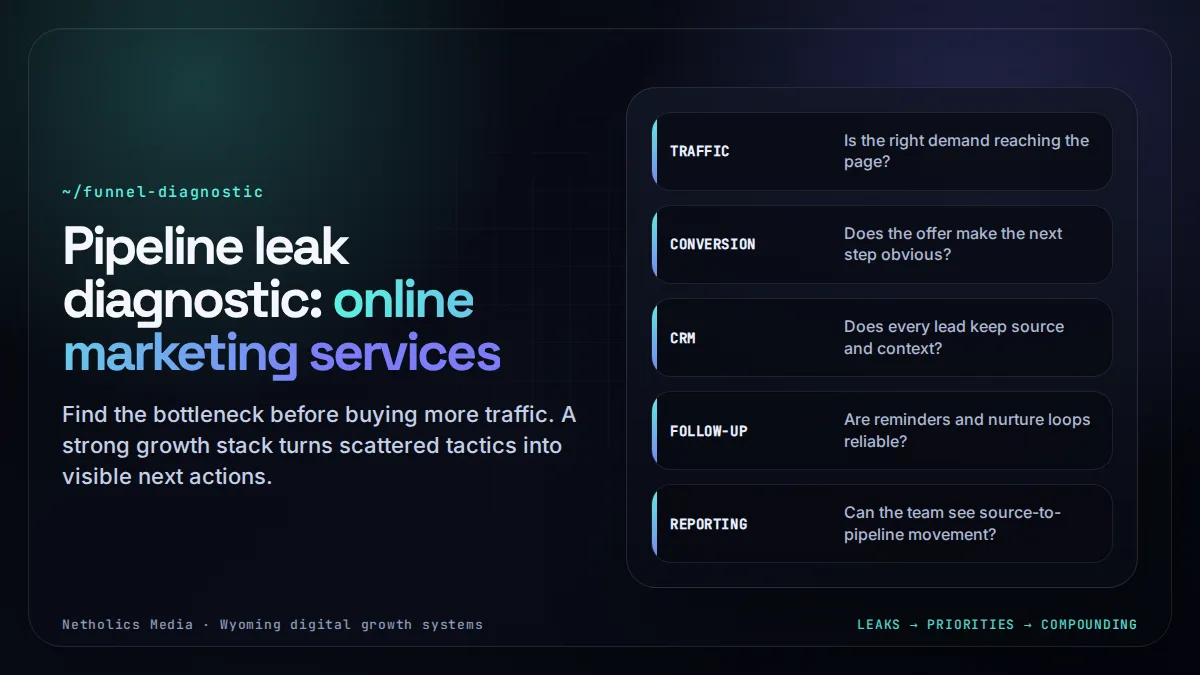
What online business marketing services should include
The exact stack depends on the business model, but most small and mid-sized companies need six layers before they need anything exotic.
1. Search and content that answers buyer questions
SEO is not just rankings. It is the discipline of publishing pages that answer real customer questions and make the next step obvious. That includes SEO content automation when the workflow has quality gates instead of auto-publishing noise. For a service business, that means service pages, comparison content, buyer guides, FAQ sections, and articles that capture problems before the buyer is ready to talk to sales.
2. Conversion pages that explain the offer clearly
Traffic is wasted when the landing page is vague. A good conversion page explains who the offer is for, what problem it solves, what the process looks like, what proof exists, and what the visitor should do next. The page should not need a salesperson standing next to it to make sense.
3. CRM capture and clean lead routing
Every serious online marketing stack needs a reliable path from form fill to follow-up. That can be simple: website form, CRM record, lead source, notification, owner assignment, and next action. Without that, marketing attribution and sales follow-up both turn into guesswork.
4. Email, SMS, or message follow-up
Most visitors do not buy on the first interaction. Follow-up should educate, qualify, remind, and route — without spamming. The right workflow depends on the offer: a high-ticket service needs trust-building and consultation prompts; ecommerce needs cart recovery and post-purchase flows; local services need speed-to-lead and reminders.
5. Analytics and reporting people actually use
Reporting should show what changed, not just what happened. Useful dashboards answer: where did leads come from, which pages contributed, what converted, what stalled, and what should be fixed next month?
6. Automation that removes repetitive handoffs
Automation should make the growth stack more reliable: enrich a lead, route a form, summarize a call, create a task, sync a deal, trigger a review request, or alert a human when something breaks. This is where AI automation belongs: inside the operating system, not as a gimmick on top of it. It should not replace judgment where the risk is high.
The practical service map
| Service layer | What it does | Metric to watch |
|---|---|---|
| SEO and content | Captures problem-aware and solution-aware demand | Qualified organic visits, assisted leads |
| Conversion pages | Turns visitors into calls, forms, purchases, or audits | Conversion rate, CTA clicks, form starts |
| CRM and routing | Prevents lead leakage and preserves source context | Speed-to-lead, owner assignment, stale leads |
| Follow-up workflows | Educates and re-engages prospects after first touch | Reply rate, booked calls, recovered revenue |
| Analytics | Shows what to double down on and what to cut | Source-to-pipeline, page contribution, cost per lead |
| Automation | Removes manual handoffs and keeps the system consistent | Manual hours saved, error rate, workflow success rate |
Where AI belongs in an online marketing stack
AI can make online business marketing services faster and more useful, but only if it is wired into a process. The winning use cases are operational: generate first drafts, summarize sales calls, classify leads, personalize follow-up, identify content gaps, repurpose approved material, and flag broken workflows.
The weak use case is letting AI mass-publish generic content or auto-send risky customer messages. That creates brand, compliance, and quality problems. A safer pattern is human-in-the-loop automation: AI prepares, scores, drafts, or summarizes; a person approves the parts that affect the customer experience.
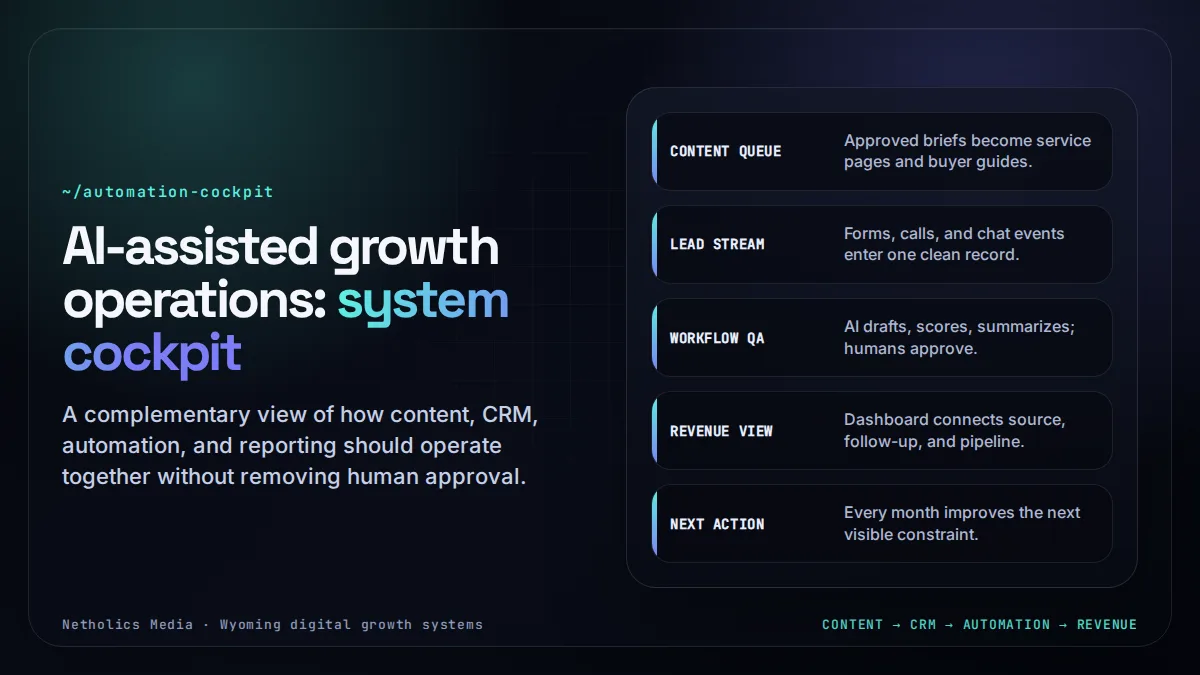
Automation readiness card
- High impact: lead routing, CRM cleanup, reporting, follow-up reminders, call summaries.
- Medium risk: AI-assisted email drafts, content briefs, social repurposing, audience segmentation.
- High risk: fully automated public claims, legal/financial advice, aggressive outbound, review responses without approval.
- Best first workflow: capture every website lead, enrich it with source/context, assign an owner, and create a follow-up task automatically.
- Do not automate yet: any step where bad data, hallucinated claims, or tone mistakes could damage trust.
How to prioritize what to build first
Do not start by asking which channel is trendy. Start by finding the leak.
- If nobody finds you, prioritize SEO/content and service pages.
- If people visit but do not convert, prioritize landing pages, offers, proof, and calls to action.
- If leads arrive but go cold, prioritize CRM routing and follow-up workflows.
- If you cannot tell what worked, prioritize analytics and reporting before adding spend.
- If the team is drowning in repetitive tasks, prioritize automation around handoffs, not public-facing AI.
The highest-return marketing project is usually the one that fixes the biggest bottleneck already visible in the business.
A simple 30-day rollout example
Imagine a B2B service business with decent traffic but inconsistent follow-up. The first month should not be a giant campaign. It should be a small connected system.
- Week 1: map the website forms, CTA paths, lead sources, and current response time.
- Week 2: tighten the primary service page and add clear next-step CTAs.
- Week 3: route every form fill into the CRM with source, page, service interest, and owner assignment.
- Week 4: add a follow-up workflow and a dashboard that shows new leads, response status, and source quality.
That is the Netholics approach in miniature: ship a measurable signal first, then improve the next bottleneck.
How to choose an online marketing services provider
A good online business marketing services provider should be able to connect every recommendation to a business outcome. If the conversation stays at the level of “we post three times a week” or “we optimize your site,” push harder. Ask what changes, how it is measured, and what happens after a lead arrives.
Questions worth asking
- Which part of our funnel is leaking the most right now?
- What metric will this service improve?
- How will leads move from the website into sales follow-up?
- What reporting will show whether the work is producing pipeline?
- Where should AI speed up the process, and where should humans stay in control?
- What can we ship in the first 30 days that creates a measurable signal?
The right partner will not sell every service at once. They will diagnose the stack, fix the biggest constraint, and then compound from there. If you call Netholics, the first question is not “which channel do you want?” — it is “where is the system leaking?”
What other experts say
Google Search Central frames search success around helping people and making content easy for search engines to understand — not gaming isolated ranking tricks. That supports the growth-stack view: useful pages, clear structure, and a strong next step matter more than disconnected SEO activity.
IBM’s business automation guidance describes automation as a way to handle repetitive business processes more consistently. For marketing, the same principle applies: automate handoffs, routing, reporting, and reminders before trying to automate strategic judgment.
Implementation checklist
- Write down the customer journey from first visit to closed deal or purchase.
- Identify the largest leak: traffic, conversion, follow-up, trust, or reporting.
- Make sure every important form and CTA records source/context in a CRM or lead sheet.
- Create one dashboard that shows leads, source, conversion, and follow-up status.
- Build one automation that removes a repetitive handoff.
- Review AI-generated content or messages before they go public.
- Revisit the stack monthly and improve the next bottleneck.
Frequently asked questions
Q: What are online business marketing services?
Online business marketing services are the digital activities that help a company attract, convert, follow up with, and retain customers online. In 2026, the useful version includes SEO/content, conversion pages, CRM capture, follow-up workflows, analytics, and automation.
Q: What is the difference between online marketing and digital growth systems?
Online marketing often describes the channels: SEO, social, ads, email, and content. A digital growth system connects those channels to conversion, CRM, automation, and reporting so the business can see and improve the full journey.
Q: Which online marketing service should a small business start with?
Start with the biggest leak. If people cannot find you, build SEO/content. If traffic does not convert, fix the offer and landing pages. If leads go cold, fix routing and follow-up. If nobody knows what works, fix analytics first.
Q: Should AI be part of online business marketing?
Yes, but it should be used carefully. AI is strongest for drafts, summaries, routing, reporting, personalization, and workflow support. Keep human approval for public claims, high-stakes customer messages, and strategic decisions.
Q: How do you measure whether online marketing services are working?
Measure movement through the stack: qualified traffic, conversion rate, form submissions, booked calls, source-to-pipeline, follow-up speed, and revenue contribution. Channel metrics matter only when they connect to business outcomes.
Q: Do social media management services count as online marketing?
Yes, but social posting alone is not a complete growth system. Social should connect to content strategy, lead capture, retargeting, email, CRM, and reporting if the goal is measurable growth.
Further reading / sources
- Google Search Central — SEO Starter Guide: https://developers.google.com/search/docs/fundamentals/seo-starter-guide
- IBM Think — Business process automation: https://www.ibm.com/think/topics/business-process-automation
Stop guessing where leads go. Build marketing that compounds.
Netholics designs online business marketing systems that connect content, conversion, CRM, automation, and reporting into one operating stack.