Digital Marketing Services for Small Business in 2026: The Practical Stack to Build First
Small businesses do not need every digital marketing service at once. They need a practical sequence: clarify the offer, capture demand, convert visitors, follow up quickly, automate repeatable handoffs, and measure what produces real opportunities.
The 60-second answer
- The best digital marketing services for a small business are the ones that fix the current bottleneck, not the ones that create the most activity.
- Most small businesses need offer clarity, search/content, conversion pages, lead capture, CRM or lead tracking, follow-up, analytics, and one or two automations.
- A small budget should prioritize compounding assets and leak prevention before broad ad spend.
- AI helps most when it supports repetitive work: briefs, repurposing, lead triage, summaries, reminders, and reporting.
- A practical plan is to ship one measurable improvement every month, then compound the system.
The right sequence for small-business digital marketing
Small businesses often buy digital marketing backwards. They start with channels because channels are easy to name: SEO, social, ads, email, websites. But the more important question is where the business is leaking opportunity right now.
If the offer is unclear, traffic will not fix it. If the landing page is weak, ads get expensive. If lead capture is unreliable, SEO gains disappear. If follow-up is slow, every channel underperforms. The right service sequence is the one that removes the current constraint.
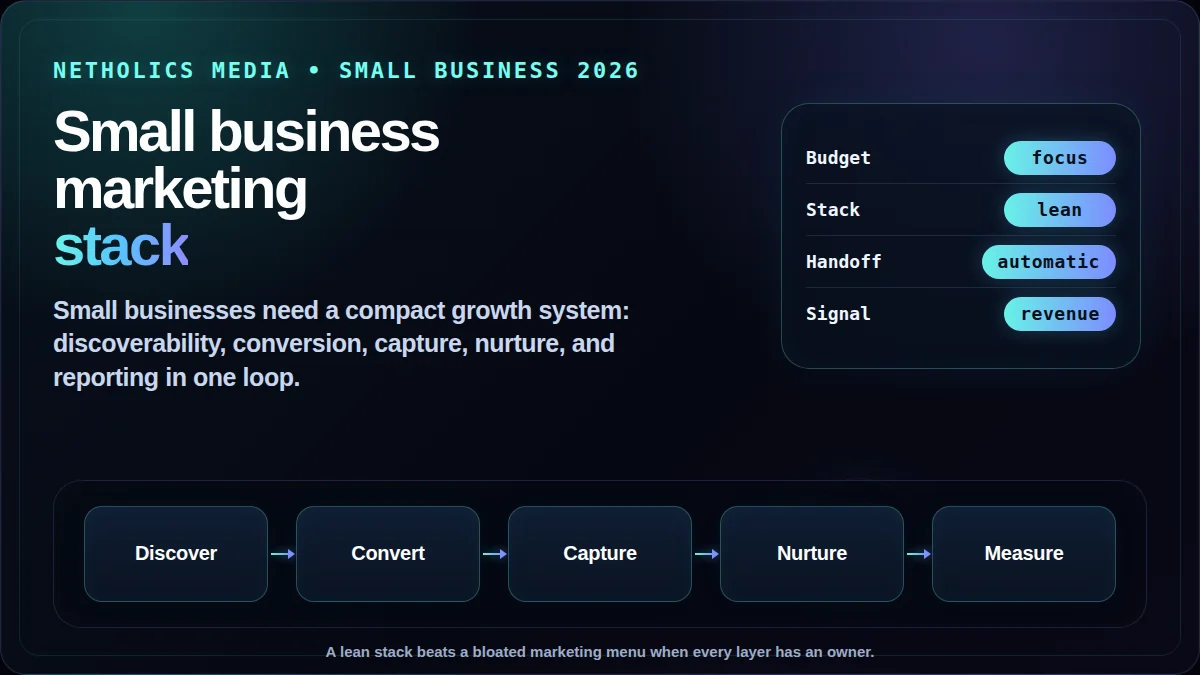
The core services most small businesses need
The practical stack is not complicated. You need a clear offer, pages that answer buyer questions, search/content assets, a simple CRM or lead tracker, conversion forms, email or SMS follow-up, analytics, and a review cadence.
That does not mean all of it must be enterprise-grade on day one. A well-managed spreadsheet can be a temporary CRM. A single strong service page can outperform five vague pages. A simple follow-up reminder can recover more value than another content calendar.
How to prioritize a small digital marketing budget
Spend first on assets and handoffs that reduce waste. Improve the primary service page. Make the offer clear. Track every lead source. Speed up response time. Add one useful follow-up workflow. Then invest in content and campaigns that feed the system.
Paid ads are useful when the page, offer, and follow-up path are ready. If they are not, ad spend becomes a diagnostic tool at best and a leak amplifier at worst.
Where automation and AI help small businesses
Automation should remove repetitive handoffs: form-to-CRM, owner assignment, reminders, review requests, appointment follow-ups, reporting summaries, and simple lead triage. AI can help draft, classify, summarize, and spot gaps.
Keep humans in control of strategy, brand claims, customer-sensitive replies, and final publication. Small businesses win when automation increases consistency without making the brand feel careless.
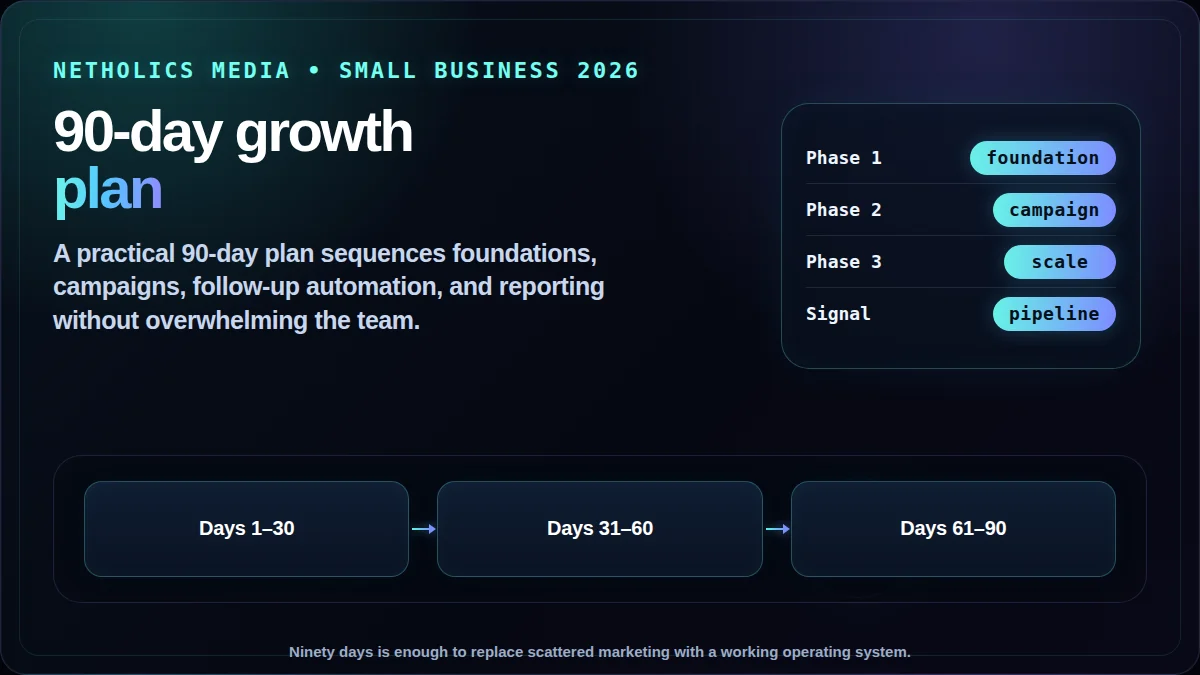
A practical 90-day rollout
Month one should fix the most obvious leak: offer, page, form, or follow-up. Month two should add content or campaigns that feed the repaired path. Month three should automate one repetitive handoff and tighten reporting.
The goal is not to look like a large company. The goal is to create a small system that responds quickly, learns monthly, and compounds with every improvement.
The practical operating map
| Priority | Best first service | Why it comes first |
|---|---|---|
| Unclear offer | Positioning and page rewrite | Traffic cannot convert confusion |
| Low visibility | SEO/content foundation | Captures durable demand |
| Poor conversion | Landing page optimization | Improves every channel |
| Lead leakage | CRM capture and routing | Prevents missed opportunities |
| Slow response | Follow-up workflow | Improves speed-to-lead |
| Unclear results | Analytics dashboard | Shows what to improve next |
A worked example
A small professional-services firm has referrals but weak online conversion. The first 90 days should clarify the offer, rebuild the main service page, route forms into a lead tracker, add follow-up reminders, publish two buyer-question articles, and review source-to-call results monthly.
diagnose: biggest_leak
connect: page -> lead_capture -> CRM -> follow_up
measure: source, conversion, speed_to_lead
review: weekly bottleneck, monthly roadmapWhat other experts say
U.S. Small Business Administration The SBA encourages businesses to define customers, positioning, pricing, and promotion before scaling marketing activity, which supports sequencing strategy before channel volume.
Google Search Central Google’s SEO guidance supports creating helpful, accessible content that search engines and customers can understand.
Implementation checklist
- Name the one constraint wasting the most opportunity this month.
- Make the main offer and primary CTA easy to understand on the key page.
- Capture every inquiry in a CRM, lead tracker, or structured inbox with source context.
- Add one follow-up reminder or nurture step before scaling campaign volume.
- Use AI for drafting, summarizing, triage, and reporting — with human approval for customer-facing work.
- Reinvest only after the report shows which source and page produced qualified conversations.
Automation readiness / decision card
- High impact: name the one constraint wasting the most opportunity this month.
- Medium risk: AI-assisted production, routing, summaries, and recommendations with review gates.
- High risk: fully automated public claims, customer replies, or spend decisions without human context.
- Best first workflow: capture every inquiry in a crm, lead tracker, or structured inbox with source context.
- Do not automate yet: any step the team cannot measure, explain, or manually approve.
Frequently asked questions
Q: What digital marketing services does a small business need first?
Start with the biggest bottleneck: offer clarity, a conversion page, local/search visibility, lead capture, follow-up, or analytics. Do not buy every channel before the basic path is working.
Q: Is SEO or paid advertising better for a small business?
SEO builds durable demand over time, while paid advertising can test offers quickly. The best choice depends on the conversion path. Ads should not scale until pages, lead capture, follow-up, and measurement are readable.
Q: How much automation should a small business use?
Automate repetitive handoffs first: form capture, routing, reminders, review requests, and reporting. Keep human approval for strategy, public claims, sensitive replies, and high-value sales communication.
Q: What should be included in a small business digital marketing report?
A useful report should show qualified traffic, conversions, source-to-lead data, follow-up speed, booked calls or inquiries, and the next bottleneck to improve.
Q: Can a small business do digital marketing without a large team?
Yes. A small business can begin with a focused stack: one strong offer page, a few helpful articles, clean lead capture, a simple CRM, follow-up reminders, and monthly review.
Q: How does Netholics build digital marketing for small businesses?
Netholics builds the operating stack: content, conversion pages, CRM handoffs, automation, and reporting. The work is sequenced around the constraint that will create the most measurable progress.
Further reading / sources
Build a small-business stack that compounds monthly.
Netholics helps small businesses prioritize the digital marketing services that fix leaks first, then layer content, automation, and reporting.