AI agent fallback and escalation: when automation should stop
Design clear fallback paths so agents ask, route, retry, or stop instead of guessing through uncertainty.
The 60-second answer
- Design clear fallback paths so agents ask, route, retry, or stop instead of guessing through uncertainty.
- Use NIST-style governance language, OWASP-style threat thinking, and tool-call logs before giving an agent more autonomy.
- The safest first launch is narrow, logged, reversible, and human-approved.
The problem this solves
The safest agent is not the one that always answers. It is the one that knows when to stop. Fallback and escalation design defines what happens when data is missing, confidence is low, a tool fails, a customer is angry, a request is sensitive, or the next action is irreversible.
Do not start with a vendor demo. Start with the operating controls: what the agent may see, what it may do, what it must log, when it must stop, and who approves the next step. That keeps the system useful without pretending autonomy is free.
The workflow to build first
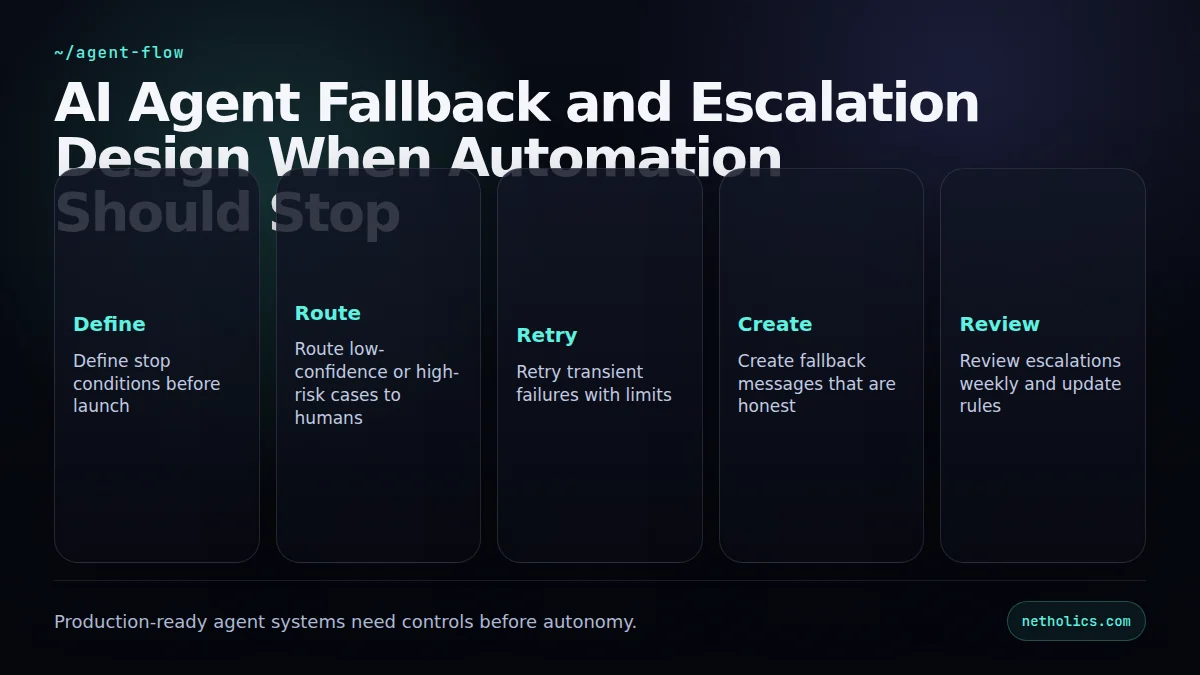
- Define stop conditions before launch. Use this as a control point before expanding autonomy.
- Route low-confidence or high-risk cases to humans. Use this as a control point before expanding autonomy.
- Retry transient failures with limits. Use this as a control point before expanding autonomy.
- Create fallback messages that are honest. Use this as a control point before expanding autonomy.
- Review escalations weekly and update rules. Use this as a control point before expanding autonomy.
The practical control matrix
| Control | What it enables | Main risk | Safer default |
|---|---|---|---|
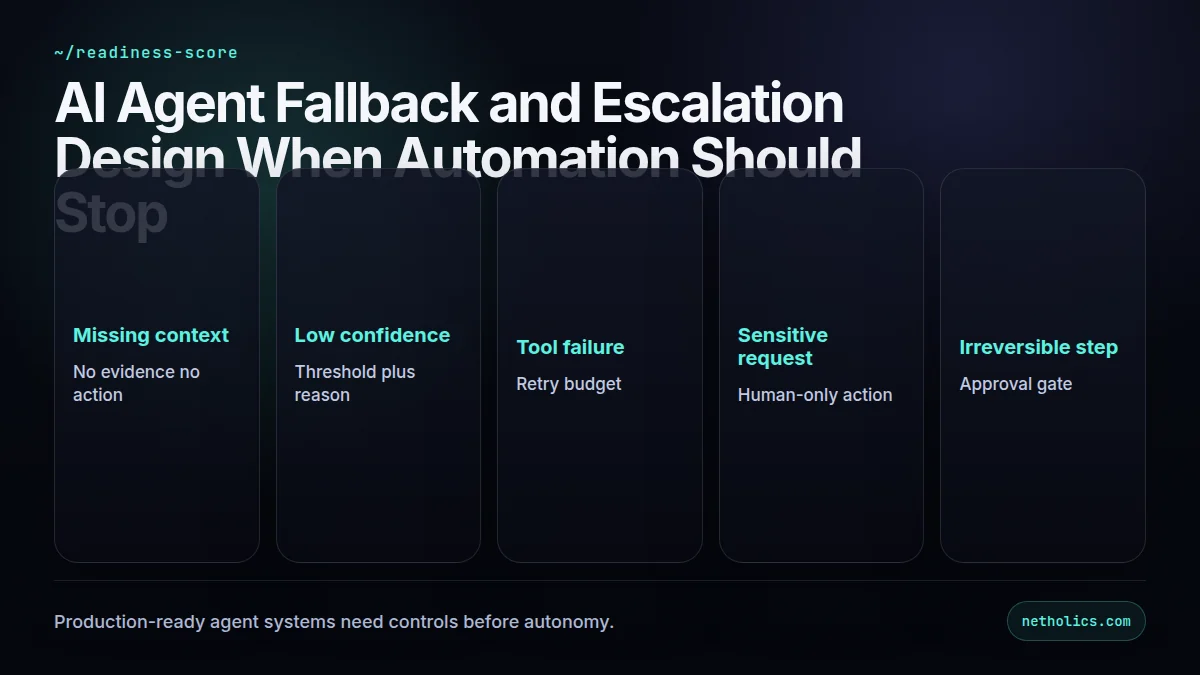
| Missing context | Ask for details | Invented answer | No evidence no action |
| Low confidence | Queue for review | Confident mistake | Threshold plus reason |
| Tool failure | Retry then alert | Silent drop | Retry budget |
| Sensitive request | Escalate | Policy breach | Human-only action |
| Irreversible step | Require approval | Permanent error | Approval gate |
Two diagrams to make the system operational
A launch runbook that avoids demo traps
Run the workflow manually first. If the manual version cannot create a better decision, the automated version will only create faster uncertainty. Keep the first launch narrow, record everything, and widen autonomy only after evidence accumulates.
- Scope the job. Define what success and failure look like in business terms.
- Connect one tool first. Prove the tool boundary before adding more integrations.
- Force review on risky actions. Customer-facing, financial, destructive, or sensitive actions need a human gate.
- Review logs weekly. Improve prompts, retrieval, permissions, and fallback paths from actual runs.
What other experts say
NIST, OWASP, OpenAI, Anthropic, and Google all point toward the same practical lesson: AI systems need mapped risks, constrained tool use, logged decisions, and secure lifecycle controls. The Netholics interpretation is simple: an agent is not production-ready until its permissions, tests, logs, fallbacks, and owners are visible.
Implementation checklist
- Name the workflow owner
- Define the allowed tools and actions
- Write the approval and stop conditions
- Test happy paths and failure paths
- Log decisions, tool calls, and final actions
- Review failed runs before widening autonomy
Should you build this now?
Build now if the workflow has clean inputs, a clear owner, narrow tool access, and a human approval point.
Wait if the source data is messy, the process is undocumented, or the agent would need broad write/delete/admin access to create value.
Frequently Asked Questions
Q: What is AI agent escalation design?
It is the set of rules that tells an agent when to ask for help, retry, route to a human, or stop.
Q: When should an agent stop?
When data is missing, risk is high, tool calls fail, confidence is low, or the next action is irreversible.
Q: Can fallback rules be automated?
Yes, deterministic routing rules should handle many fallback paths, with human review for ambiguous or risky cases.
Q: How do you improve escalations over time?
Review escalated cases, label root causes, and update prompts, retrieval, permissions, or workflow logic.
Verified sources
- NIST AI Risk Management Framework — risk governance, measurement, and trustworthy AI controls.
- NIST AI RMF 1.0 PDF — Map, Measure, Manage, Govern lifecycle language.
- OWASP Top 10 for LLM Applications — LLM-specific risks such as excessive agency, prompt injection, and data exposure.
- OpenAI function calling guide — tool/function calling and structured tool boundaries.
- Anthropic tool use documentation — tool use patterns and tool-result handling.
- Google Secure AI Framework — secure AI system controls and lifecycle posture.
Build safer AI agents
Netholics can audit the workflow, map permissions, connect tools, and design the first supervised agent build.