Is Your Business Ready to Scale AI Agents?
A CIO keynote just said autonomy without architecture creates risk. Here is what that means when you have three pilots, not sixty-three agents.
The 60-second answer
- Most small businesses already run two to four disconnected AI agents, such as a chatbot, an n8n workflow, and maybe a scheduling bot, with no shared owner, no kill switch, and no log of what each one actually did. That is the real starting point, not “should I try AI agents.”
- A June 2026 CIO keynote at Info-Tech LIVE named the enterprise version of this problem: autonomy without architecture creates risk, and successful agent systems get mapped, engineered, and governed before they scale. The same logic applies at three agents, just translated from an org chart into a spreadsheet.
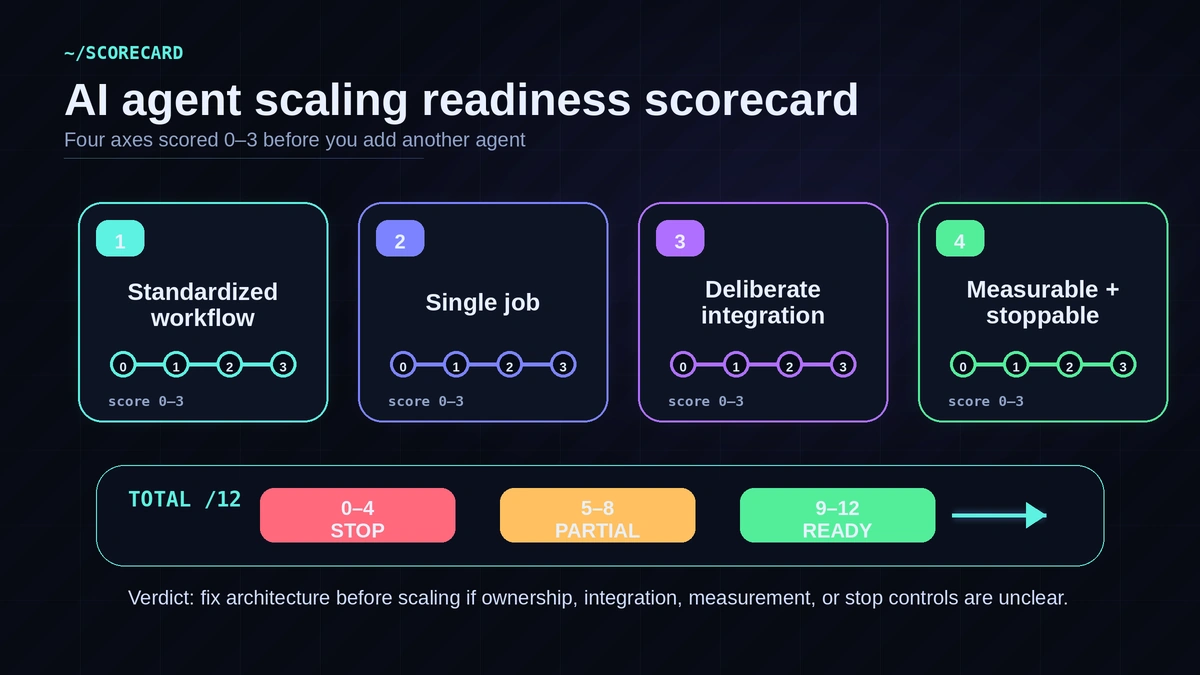
- Score yourself on four axes below, standardized workflow, single-job design, deliberate integration, and a working kill switch, before you add agent three or four. Under five out of twelve on any agent, fix architecture first; scaling on top of chaos compounds the risk, not just the workload.
You are not choosing whether to scale AI agents. You are already running some.
The framing “should my business adopt AI agents” is a year out of date. According to the SBE Council’s 2026 Small Business Tech Use Survey, 82% of small business employers have already invested in AI tools, and the typical small business now runs a median of five separate tools across its daily operations. The real question sitting in front of most owners is not whether to start, it is whether what they already have is built on anything solid enough to add to.
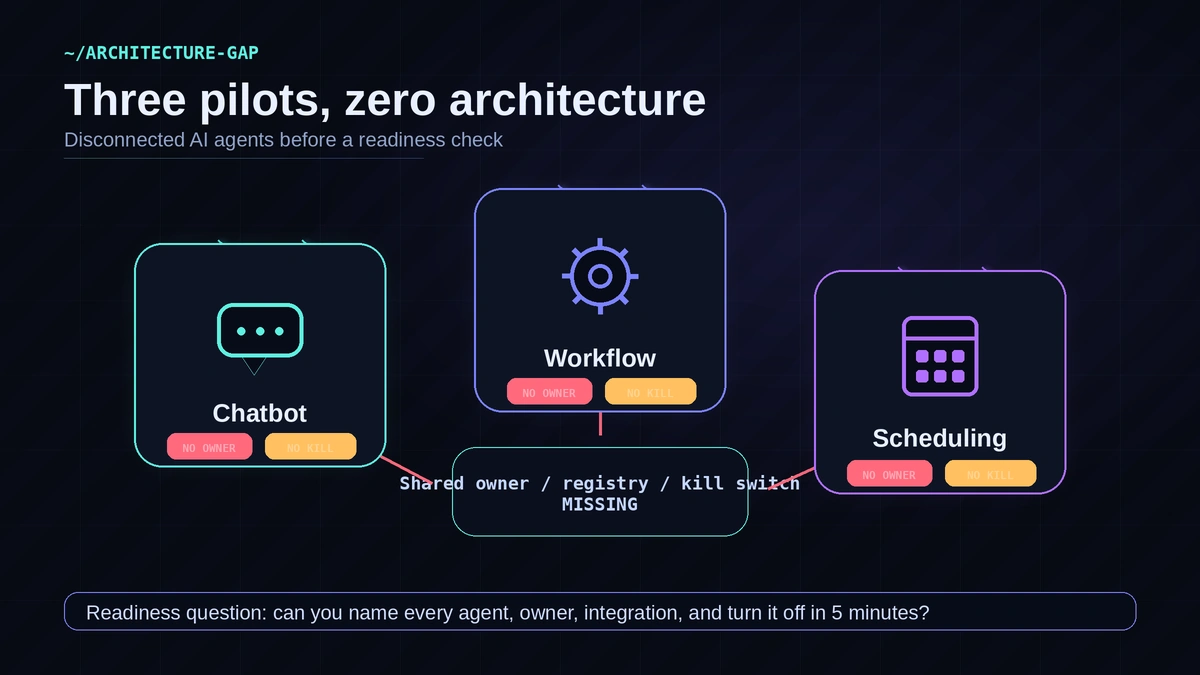
Here is what that looks like in practice: a chatbot answers pricing questions on the website, an n8n workflow routes new leads to the right person, and a scheduling tool confirms appointments by text. Each one showed up separately, solved an immediate problem, and nobody has looked at the three of them together since. No one document lists all three. No one person owns all three. If the chatbot started quoting a wrong price tomorrow morning, the first sign might be a customer complaint, not a monitoring alert.
This gap is not rare. Research from BlackFog, reported by Forbes, found that 49% of workers are already using AI in ways their employer has not approved or reviewed. Between tools employees found themselves and tools an owner half-adopted and never revisited, most small businesses are running more automation than anyone could list from memory. That is the actual starting line for a readiness conversation: not “are we ready to scale,” but “do we know what we are already running.”
The keynote that named the problem: architecture before autonomy
At Info-Tech LIVE 2026, held June 9 to 11 at the Bellagio in Las Vegas, Info-Tech Research Group’s Principal Research Director Martin Bufi delivered a keynote titled “Agents 2.0: Architect for Autonomy.” He walked attendees through a year of his team’s own agentic AI development: 13 prototypes, 63 agents built, 123 tools created, spanning 13 workflows across 5 domains. That scale is Info-Tech’s own research effort, not evidence about any specific company’s deployment, and it is worth being precise about that distinction before drawing conclusions from it.
The line from that keynote that matters here is a direct quote: “Autonomy without architecture creates risk.” Bufi’s point was that successful agentic systems get mapped, engineered, and governed before they are allowed to scale, not after something goes wrong. His practical lessons, reported alongside the keynote, were to standardize workflows before automating them, design agents around one specific job instead of a broad generalist role, build tool integrations on purpose rather than by accident, and make sure every agent can be measured, stopped, and improved.
None of that requires an enterprise budget to be true. It requires a translation. At Info-Tech’s scale, architecture means a governance layer, a platform team, and a review board. At the scale of a business running three agents, architecture means a shared document with four columns: who owns this agent, what one job it does, what it is allowed to touch, and how you turn it off. Enterprise governance is a hierarchy. Small business governance is a checklist someone actually keeps up to date. For more on what a written version of that looks like, see our guide to an AI automation governance policy for small businesses.
The 5-minute test: can you turn your agents off?
Of Bufi’s four lessons, one does more diagnostic work than the rest combined, and it takes five minutes to fail. Right now, without opening a laptop, can you name every agent or automation currently running in your business, say who owns each one, and describe exactly how you would disable it if it started doing something wrong? Most small business owners cannot answer that in under a minute, and that gap is the actual risk, not a compliance checkbox.
Picture the realistic failure: a chatbot starts hallucinating a discount code at 11 p.m. on a Friday. Nobody is watching a dashboard, because there is no dashboard. The first person to notice is a customer forwarding a screenshot, two days later, after a dozen people have already used the code. The lesson here is not “install monitoring software.” It is that failure discovery, not governance theater, is what a kill switch actually buys you. If you cannot find out something broke within hours, you are not ready to add a second or third agent on top of the one you cannot currently see.
This is also where human-in-the-loop guardrails earn their keep: a person in the loop on anything irreversible is the cheapest kill switch you can build, and it does not require new tooling, only a rule everyone actually follows.
Bufi’s four lessons, translated to your scale
Here is the direct translation from what an enterprise research team means by each lesson to what it means when you have a handful of agents and no platform team.
| Lesson | At enterprise scale | At your scale |
|---|---|---|
| Standardize before automating | Formal SOPs documented across departments before any agent touches the process. | Write the process down once, then again a week later. If the two versions do not match, the process is not standardized, and automating it just automates the inconsistency. |
| Design for one job | Purpose-built agents scoped narrowly within a single department or workflow. | One agent, one job. A chatbot that answers FAQs, qualifies leads, and books calls is three agents wearing one name, and none of the three gets the review it needs. |
| Build integrations on purpose | A governed integration layer with security review before a new tool connection ships. | Write one sentence per agent: exactly which tools and data it can touch. If you cannot write that sentence today, the integration happened by accident, not on purpose. |
| Measurable, stoppable, improvable | Dashboards, audit logs, and kill switches built into the platform layer. | Can you see what an agent did today, and can you turn it off in under five minutes? If either answer is no, it is not architected yet, regardless of how well it performs. |
Score yourself before you add agent three (or four)
This is the actual diagnostic, not just a discussion prompt. Run it against every agent or automation you currently run, before you add the next one.
- List every agent or automation running right now, in one place. A shared document, a spreadsheet, a sticky note on a monitor all count. If you cannot produce this list in under two minutes, every agent on it scores zero on the axes below by default, because nothing can be measured or stopped if nobody can find it.
- Score each agent zero to three on all four axes. Zero means not true at all, three means fully true: does it run on a standardized, documented workflow; does it do one specific job rather than several; are its tool and data connections written down and deliberate; and can you see what it did today and turn it off inside five minutes.
- Add the four axis scores together, out of twelve, per agent. Do this for each agent separately. A business running three agents ends up with three separate scores, not one average, because the weakest agent is the one that creates risk when you add a fourth.
- Read the verdict. Zero to four means stop: you are scaling on top of chaos, and adding another agent multiplies the risk rather than the workload. Five to eight means partial architecture: close the specific gaps the score revealed before adding anything new. Nine to twelve means the agent is genuinely ready to have a sibling built alongside it.
Copy this template and fill it in for every agent you found in step one:
Agent name:
Job (one sentence):
Owner:
Kill switch (how, and who):
Last checked:
Standardized workflow (0-3):
Single job (0-3):
Deliberate integration (0-3):
Measurable + stoppable (0-3):
Total score (out of 12):
If this is the first time your business has had a written answer to “who owns this and how do we turn it off,” that alone is worth more than the score. For a broader gut-check on where your automation stands, see our AI systems audit framework.
What this looks like for a real small business
Take a home services contractor running three tools that arrived separately over eighteen months. A chatbot answers pricing and scheduling questions on the website. An n8n workflow routes form submissions to the right technician by service area. A text-message bot confirms appointments the day before. Individually, each one works. Together, nobody has ever looked at them as one system, which is exactly the pattern common to home services businesses adopting AI agents.
Running the self-check on all three: the chatbot scores low on single-job design, because it answers FAQs and also attempts to quote exact prices, a job it was never scoped for. The routing workflow scores well on standardization, because the lead form has not changed in years, but scores zero on measurability, because nobody has ever checked its output log. The appointment bot scores reasonably across the board, but its kill switch is “log into the vendor’s dashboard and find the right toggle,” which is not a five-minute task for anyone but the person who set it up two years ago and no longer works there.
None of the three scores above eight out of twelve. The verdict here is not “stop using AI,” it is “do not add a fourth agent, such as automated invoice follow-ups, until these three have a shared owner, a written kill switch each, and a log someone actually reads.” That is the architecture layer sitting between three disconnected pilots and a business that can scale with confidence.
What other experts say
Reference card · Info-Tech LIVE 2026 keynote
Autonomy without architecture creates risk.
Netholics comment: Martin Bufi said this to a room of CIOs managing dozens of agents, but the mechanism holds at any scale. Risk does not come from having an AI agent, it comes from having one nobody has mapped, tested, or can stop. That is exactly what the four-axis self-check above is built to catch before you scale.
Before you add another agent, do this
- Put every agent in one shared document. A Google Sheet someone actually maintains counts as architecture; a mental list does not.
- Name one human owner per agent. Not “the team,” one person who gets the alert and answers for it.
- Write the kill-switch steps down and test them once. If nobody has actually clicked through disabling an agent, you do not have a kill switch, you have a theory.
- Log every action, even a simple timestamp and outcome. Silence is what let disconnected pilots run unnoticed in the first place.
- Write the underlying process down twice, a week apart, before automating it. If the two versions disagree, standardize the process before you touch the agent.
- Give every new agent exactly one job. Resist folding “also handle scheduling” into the chatbot that already handles FAQs.
- Review every agent’s score monthly, not just at setup. Architecture decays as vendors update tools and staff turn over; a score from six months ago is not current.
For the monitoring side of this without buying a platform you do not need yet, see lightweight n8n production monitoring, and if you are still deciding whether to build an agent in-house or buy one, our build vs buy AI agents guide covers how architecture readiness changes that decision.
Automation readiness card
| Impact | High. A working readiness check prevents the outage or trust loss that ends AI adoption at a small business entirely, not just the wasted setup time. |
| Risk | Directly tied to the self-check score above. Any agent scoring under five out of twelve carries active risk today, not a hypothetical one. |
| Effort | Low. The self-check takes about fifteen minutes per agent, and most fixes are naming an owner and writing down a kill switch, not new software. |
| Best first workflow to architect | Whichever agent touches customers directly and has no logged owner today. For most small businesses, that is the chatbot. |
| Do not scale yet if | Any current agent scores under five out of twelve, or you cannot name who owns it and how to stop it inside five minutes. |
Frequently Asked Questions
Q: What does “AI agent architecture” mean for a small business?
It means every agent has a named owner, does one specific job, has its tool and data access written down, and can be measured and switched off inside a few minutes. At enterprise scale this lives on a platform; at small business scale it is usually a shared document that someone actually keeps current. The absence of architecture is not a missing feature, it is the default state most businesses are already in.
Q: How many AI agents can I run before I need real governance?
There is no fixed number, because the risk comes from the gap between agents you run and agents you can account for, not from the count itself. A single unowned, unmonitored agent already carries the core risk described in the readiness self-check. The practical trigger is simpler: the moment you cannot list every agent from memory in under two minutes, you need a written system before adding another.
Q: What is an AI agent kill switch, and do I actually need one?
It is a documented, tested way to disable a specific agent quickly, along with a named person who can do it. You need one because the realistic failure mode is not a dramatic outage, it is a small mistake, like a wrong quote or a bad automated reply, that nobody notices for days because nothing was watching. A kill switch is really a failure-discovery system with an off switch attached.
Q: Is this readiness framework only for enterprise companies?
The framework originates from an enterprise keynote, but the underlying lessons translate directly: standardize before automating, give each agent one job, connect tools on purpose, and make everything measurable and stoppable. The scale changes from a governance platform to a shared spreadsheet; the logic does not change at all.
Q: What’s the fastest first step if my readiness score is low?
List every agent you run in one place, then name one human owner for each. Those two steps alone typically take under thirty minutes and close most of the gap that caused the low score, because most low scores come from nobody being able to say who is responsible, not from a technical failure.
Q: Does adding more AI agents really increase risk faster than the number of agents?
It can, once agents start sharing data, tools, or customers, because each new agent adds not just its own risk but new interactions with every agent already running. An unarchitected agent added to two other unarchitected agents does not add one unit of risk, it adds a new set of ways they can conflict or fail together. That is why the self-check scores each agent individually rather than averaging across your whole stack.
Q: How is this different from an AI systems audit?
An audit is a broader, one-time review of your automation stack, tools, and opportunities. This readiness check is narrower and repeatable: a fifteen-minute-per-agent scorecard you can run before every single scaling decision, not just once a year. Many businesses use the self-check monthly and save a full audit for a bigger strategic review.
Verified Sources
Architect before you scale, with Netholics
If you are past the pilot stage and adding your next AI agent, we help small businesses build the ownership, logging, and kill-switch layer first, so scaling adds capability instead of risk. We map what you are already running before we help you add anything new.