Internet Marketing Services in 2026: Build the System Before You Buy More Traffic
Internet marketing services only compound when SEO, paid traffic, landing pages, CRM, follow-up, analytics, and automation work as one operating system. This guide shows what to buy, what to avoid, and how Netholics sequences the work.
The 60-second answer
- Internet marketing services should be evaluated by how they move a prospect from search or discovery into a measurable next step, not by how many channel tasks they include.
- The minimum stack is market research, search/content, conversion pages, CRM capture, follow-up, analytics, and a weekly optimization cadence.
- Paid traffic can accelerate a working system, but it exposes leaks quickly when pages, offers, routing, or reporting are weak.
- AI is useful for research, briefs, lead scoring, repurposing, QA, and reporting; keep human approval around public claims and high-stakes messages.
- The safest first project is a diagnostic: find the biggest leak, fix it, measure it, then add traffic.
What internet marketing services should actually do
Internet marketing is often sold as a bundle of channels: SEO, PPC, social, email, and analytics. The useful version is more specific. It creates a path from the first problem-aware search to a captured lead, a useful follow-up, and a decision about what to improve next.
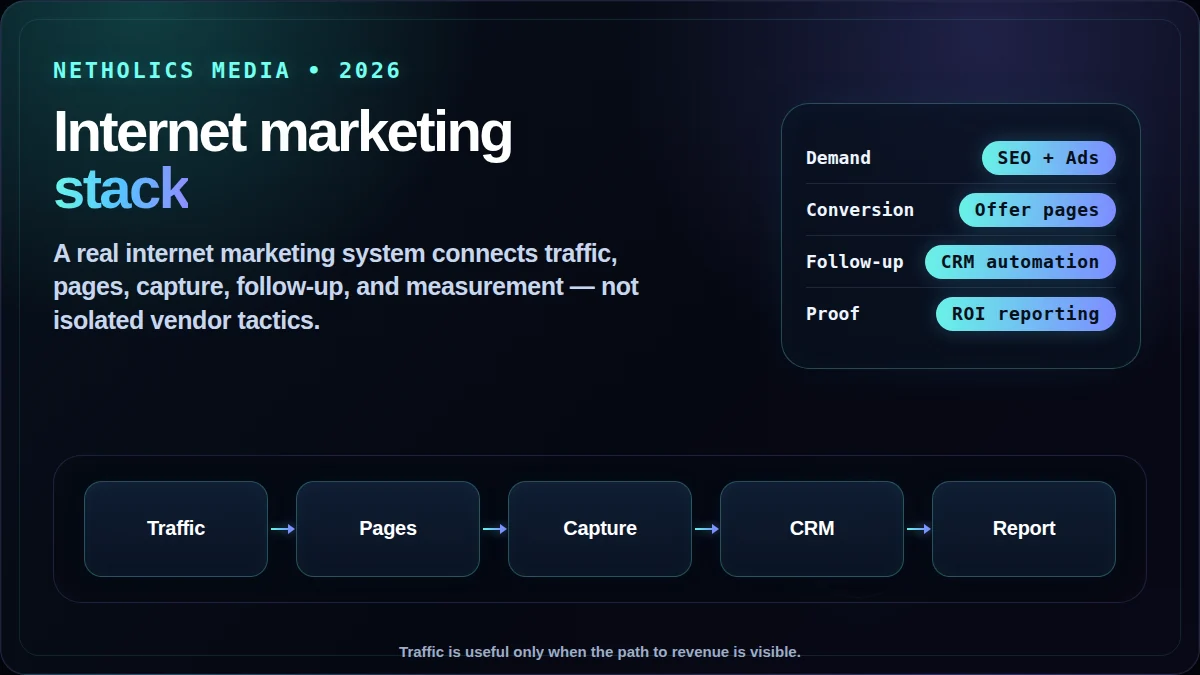
That means the service provider should be able to explain the handoff between every layer. A keyword produces a page. The page creates a conversion event. The event enters a CRM. The CRM triggers a next action. Reporting shows whether the system produced qualified demand.
Netholics treats this as a growth system rather than a marketing menu. If a channel does not connect to a next step, it is unfinished infrastructure, not a finished service.
The core service layers to include
A strong internet marketing program usually needs seven layers before it needs exotic tactics. The exact order depends on the business, but skipping the connective tissue is what causes most campaigns to underperform.
Start with positioning and offer clarity. Then build search and content assets that answer buyer questions. Add conversion pages that make the next step obvious. Route every lead into a CRM or lead system with source context. Add follow-up workflows that educate and remind. Build analytics around the journey. Only then increase paid acquisition confidently.
Do not buy more traffic until the conversion path is readable
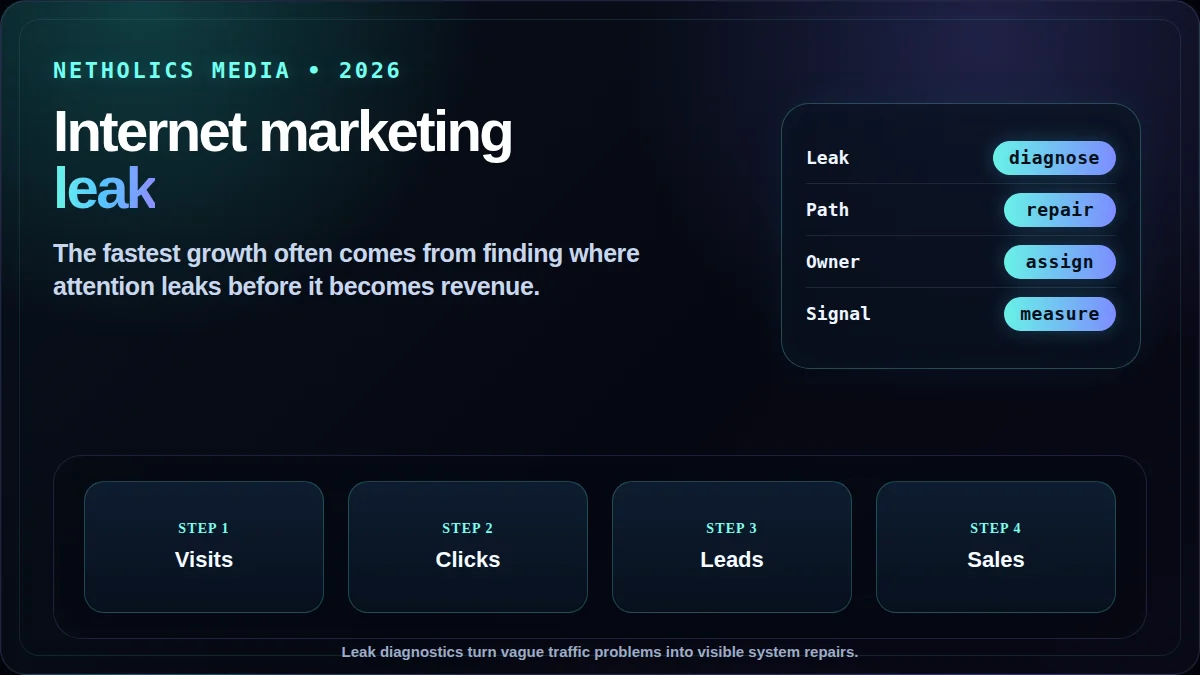
More traffic is tempting because it feels like progress. But if the offer is unclear, forms are unreliable, sales follow-up is slow, or nobody knows which page created the lead, traffic simply makes the leak more expensive.
Before scaling spend, inspect the basic funnel: which pages bring qualified visitors, where users hesitate, how forms behave, how quickly the team responds, and whether the reporting can tie a source to a sales outcome.
Where AI belongs in internet marketing services
AI belongs inside the operating process, not as a shortcut around strategy. Use it to accelerate research, organize search intent, draft briefs, summarize calls, classify leads, prepare email drafts, and flag reporting anomalies.
The risk appears when AI auto-publishes unsupported claims, mass-sends customer messages, or makes strategic decisions without context. The durable pattern is AI-assisted production with human approval and clear source control.
How to choose an internet marketing services partner
Ask providers to map their work to a measurable business result. A credible answer should include the channel, the conversion event, the handoff, the reporting metric, and the review cadence.
If the pitch is only about volume — more posts, more ads, more emails — ask what happens after a prospect engages. The partner you want is willing to diagnose the system before selling more activity.
The practical operating map
| Layer | What it solves | First metric |
|---|---|---|
| Positioning | Clarifies who the offer is for and why it matters | Qualified inquiries |
| SEO/content | Captures durable intent and answers buyer questions | Organic assisted leads |
| Paid traffic | Tests demand and accelerates proven offers | Cost per qualified lead |
| Conversion pages | Turns attention into a next step | CTA and form conversion |
| CRM routing | Prevents lead leakage after capture | Speed-to-lead |
| Follow-up | Educates prospects after first touch | Reply and booked-call rate |
| Analytics | Shows what to improve next | Source-to-pipeline |
A worked example
A local B2B company has traffic but weak follow-up. In the first 30 days, Netholics would tighten the primary service page, tag every form submission with source and page context, route leads into the CRM, add a reply/reminder workflow, and build a simple weekly dashboard before increasing ad spend.
diagnose: biggest_leak
connect: page -> lead_capture -> CRM -> follow_up
measure: source, conversion, speed_to_lead
review: weekly bottleneck, monthly roadmapWhat other experts say
Google Search Central Google’s SEO Starter Guide emphasizes helpful, search-readable content and crawlable structure — a direct fit for building durable demand capture instead of chasing isolated tricks.
Google Analytics Help Google Analytics conversion guidance supports measuring meaningful events instead of treating traffic volume as the finish line.
Implementation checklist
- Confirm the core offer, audience, and conversion action before increasing channel volume.
- Map search, paid, referral, and social demand to the pages that should convert it.
- Tag every form or booking request with source, page, service interest, and owner.
- Build one follow-up path for new leads and one reporting view for the team.
- Use AI for briefs, QA, summaries, and reporting support — not unsupported auto-publishing.
- Review the bottleneck weekly: traffic, conversion, routing, follow-up, or measurement.
Automation readiness / decision card
- High impact: confirm the core offer, audience, and conversion action before increasing channel volume.
- Medium risk: AI-assisted production, routing, summaries, and recommendations with review gates.
- High risk: fully automated public claims, customer replies, or spend decisions without human context.
- Best first workflow: tag every form or booking request with source, page, service interest, and owner.
- Do not automate yet: any step the team cannot measure, explain, or manually approve.
Frequently asked questions
Q: What are internet marketing services?
Internet marketing services are digital activities that attract, convert, follow up with, and measure customers online. In 2026, useful services connect channels such as SEO, paid traffic, email, CRM, analytics, and automation into a measurable system.
Q: Are internet marketing services the same as digital marketing services?
They overlap heavily. Internet marketing usually emphasizes online channels, while digital marketing can include a broader mix of digital customer experiences. For a small business, the practical question is whether the services connect to leads, sales, and reporting.
Q: Which internet marketing service should come first?
Start with the largest leak. If people cannot find you, improve search/content. If visitors do not convert, improve pages and offers. If leads go cold, fix CRM routing and follow-up. If reporting is unclear, fix analytics before adding spend.
Q: Should a business run ads before SEO is working?
Ads can test offers quickly, but they should not be used to hide a broken conversion path. A lean campaign is useful when the landing page, lead capture, follow-up, and measurement are already readable.
Q: How does AI improve internet marketing services?
AI can speed up research, briefs, segmentation, lead scoring, content repurposing, and reporting. It should support a controlled workflow rather than auto-publish unsupported claims or send high-stakes messages without review.
Q: How does Netholics approach internet marketing?
Netholics starts with the system: offer clarity, conversion path, CRM capture, follow-up, analytics, and automation. Channel work is then sequenced around the bottleneck that will create the most measurable improvement.
Further reading / sources
Turn internet marketing into operating infrastructure.
Netholics connects internet marketing services to conversion pages, CRM handoffs, automation, and reporting so every channel has a job.