Cut LLM Token Costs in AI Automations
A practical playbook for cutting token spend in deployed AI automations — routing, caching, batching, compact prompts, and output limits — without degrading the quality your workflow already ships.
The 60-second answer
- LLM token cost in an automation is roughly runs times the tokens you send plus the tokens you get back, so the fastest savings come from running cheaper models on easy work and sending fewer tokens per run.
- The five levers that move the bill most are: route by task difficulty, cache repeated context, cap output shape, batch async work, and compact context instead of replaying full transcripts.
- You can usually cut spend substantially without hurting quality, because most cost in production automations comes from oversized prompts, premium models on trivial tasks, and verbose output — not from the hard reasoning that actually needs a strong model.
Why LLM token costs balloon in automations
A one-off prompt is cheap. An automation that runs that same prompt thousands of times a month is where bills get out of hand, because every inefficiency is multiplied by volume. The usual culprits are predictable: a loop or retry that fires more model calls than intended, replaying the entire conversation or document context on every single run, and oversized system prompts packed with instructions and examples the model rereads each time.
Output is the other quiet drain. Letting the model “explain its reasoning” or return long free-form prose when you only needed a label, a score, or a short JSON object burns generated tokens — and generated tokens are usually the more expensive side of the bill. The same goes for reaching for a premium model on tasks a small, cheap model handles perfectly: routing a simple classification through a frontier model pays top price for work that did not need it.
None of these require new technology to fix. They require treating tokens as a budget you design around, the same way an AI systems audit treats latency, reliability, and security as things you measure before scaling volume.
The cost formula that actually predicts your bill
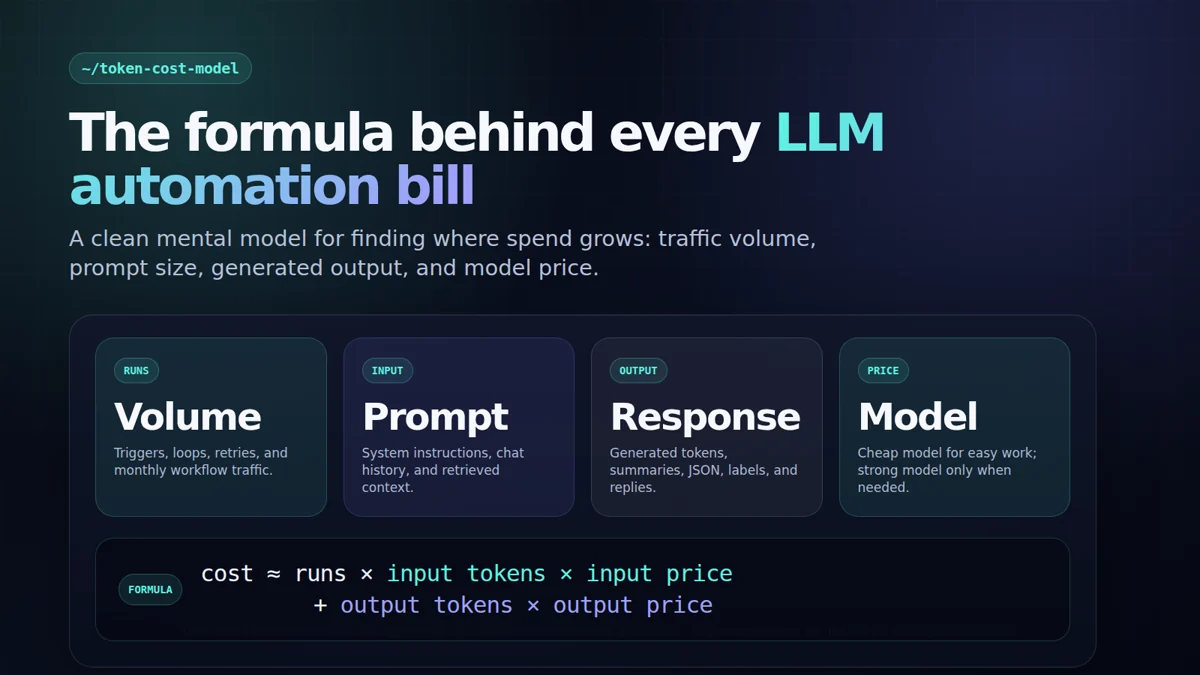
You can predict an automation's LLM bill with one mental model: cost ≈ runs × (input tokens × input price + output tokens × output price). Every lever in this guide reduces one of those terms — fewer runs, fewer input tokens, fewer output tokens, or a lower per-token price from a cheaper model.
Two details matter when you apply it. First, on most providers output (generated) tokens cost more per token than input (prompt) tokens, so trimming verbose responses often pays off more than trimming the prompt. Second, prompt caching can give cached input tokens a different, lower rate than fresh input tokens — which is why repeated context is such a strong target.
Do not hard-code the dollar figures from a blog post, including this one. Pull each provider's current published price from its official pricing page, write down the date you checked, and plug those numbers into the formula. Prices change; the structure of the formula does not.
Five levers to cut token cost
- Route by task difficulty. Default to a small, cheap model and escalate to an expensive one only when the task genuinely needs it. A lightweight classifier or rules check can decide whether a request is simple (let the cheap model answer) or complex (hand off to the strong model). Most automation traffic is repetitive and easy, so routing the easy majority to a cheaper model can cut spend substantially while reserving premium tokens for the cases that earn them.
- Cache repeated context. If every run resends the same system prompt, instructions, tool definitions, or retrieved reference material, prompt caching lets the provider reuse that prefix at a lower rate instead of charging full price each time. Caching helps most when the same large context repeats across many runs and the stable content sits at the front of the prompt; it does little when each run's input is mostly unique.
- Cap output shape. Set a sensible max-tokens limit and ask for the smallest useful output: a label, a score, a short structured object rather than an essay. Because generated tokens are usually the pricier side, constraining output is often the highest-leverage single change — and structured, bounded output is also easier to validate downstream.
- Batch async work. For jobs that do not need an instant answer — overnight enrichment, bulk classification, backfills — batch APIs trade latency for a lower price per token. If a task can wait minutes or hours instead of seconds, moving it to a batch endpoint can meaningfully lower cost for the same work.
- Compact and retrieve context instead of replaying full transcripts. Rather than resending an entire conversation or document on every call, keep a short running summary and retrieve only the relevant chunks for the current step. Sending the few hundred tokens the model actually needs, instead of the full history, shrinks input on every run and compounds across high-volume automations.
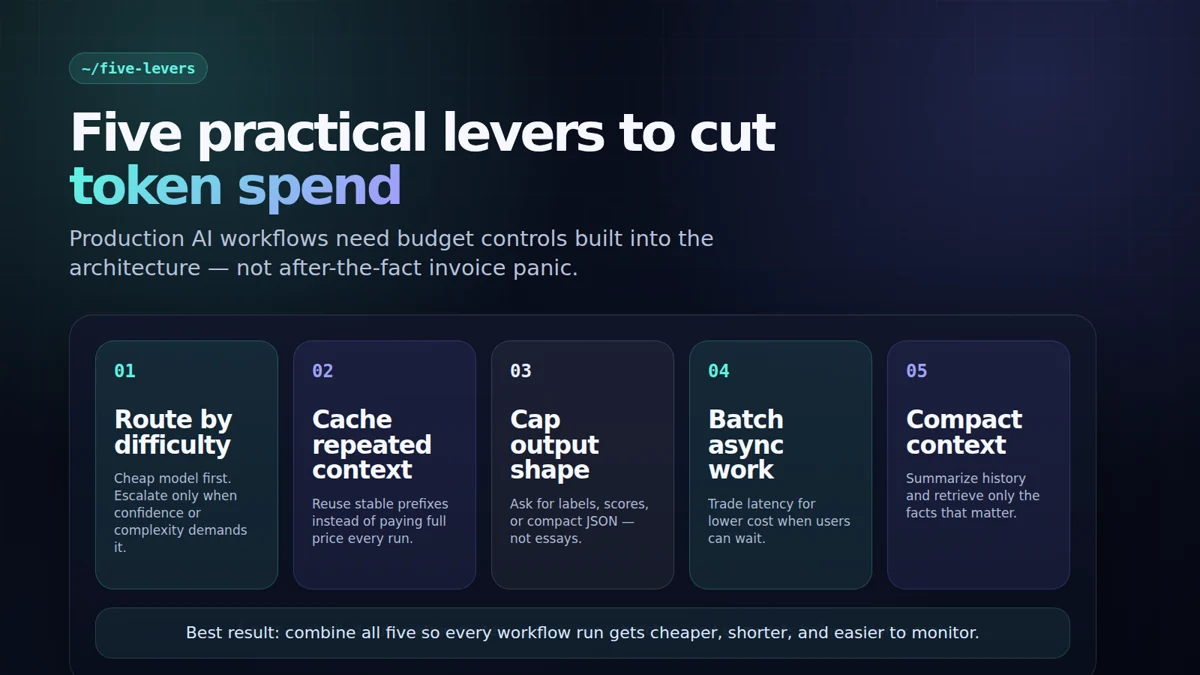
Implemented together, these levers reduce different terms of the cost formula at once, which is why teams that combine them see the largest drop. Netholics builds this kind of cost-aware workflow through our n8n automation agency and AI agent development services.
Levers at a glance
| Lever | Where it fits | Typical risk | Implementation note |
|---|---|---|---|
| Route by difficulty | High-volume mixes of easy and hard requests. | A weak router sends hard cases to the cheap model and drops quality. | Classify first, escalate on low confidence, and log which model handled each case. |
| Cache repeated context | Stable system prompts, tool defs, or RAG context reused across runs. | Cache misses when the stable content is not at the front of the prompt. | Put fixed context first, variable input last, and follow each provider's caching rules. |
| Cap output shape | Classification, extraction, scoring, short replies. | Too tight a limit truncates valid answers. | Set max tokens, request structured/short output, and validate before acting. |
| Batch async work | Bulk or overnight jobs that tolerate delay. | Added latency is unacceptable for real-time paths. | Route only non-urgent work to a batch endpoint; keep interactive paths synchronous. |
| Compact & retrieve context | Long conversations, large documents, agent loops. | Over-aggressive summarizing drops detail the task needed. | Keep a rolling summary plus retrieval; test that key facts survive compaction. |
A cost-controlled n8n pattern
In n8n this is a Switch (or IF) node fed by a small classification step. The classifier returns a narrow JSON decision — intent plus a difficulty or confidence score — and the Switch routes simple cases to a cheap model node and complex cases to a stronger one. A shared cache node holds stable context so repeated prefixes are not re-billed at full price, and a final logging step records input tokens, output tokens, and which model ran, so you can watch the budget per run instead of discovering it on the invoice.
Cost control is one face of running automations responsibly. Pair it with securing n8n AI workflows against untrusted input and monitoring n8n in production so a runaway loop shows up as an alert long before it shows up as a bill.
Frequently Asked Questions
Q: Why is my AI automation so expensive?
Usually because a cheap inefficiency is multiplied by volume. The common causes are loops or retries that fire extra model calls, replaying full conversation or document context on every run, oversized system prompts, verbose output when a short answer would do, and using a premium model for tasks a cheap model could handle. Cost equals runs times the tokens in plus the tokens out, so any of those terms left unchecked balloons the bill.
Q: Does prompt caching actually reduce cost?
Yes, when the same large context repeats across many runs and the stable content sits at the front of the prompt. Caching lets the provider reuse that prefix at a lower rate instead of charging full input price every time. It helps little when each run's input is mostly unique, so it pays off most for fixed system prompts, tool definitions, and reused reference material rather than constantly changing user text.
Q: Should I use a cheaper model for everything?
No. The goal is matching the model to the task, not minimizing model strength everywhere. Default to a cheap model for the easy, high-volume majority and escalate to a stronger model only when the task needs deeper reasoning. A small classifier or confidence check can make that routing decision, so you pay premium prices only for the cases that genuinely benefit.
Q: Do output tokens cost more than input tokens?
On most providers, yes — generated (output) tokens are typically priced higher per token than prompt (input) tokens, and prompt caching can make cached input cheaper still. That is why capping and shortening output is often the highest-leverage change you can make. Always confirm the current rates on each provider's official pricing page, because the exact numbers change over time.
Q: How do I estimate cost before building an automation?
Estimate the tokens for one representative run — input and output separately — then multiply by each provider's current published prices and by your expected monthly run count. Use the formula cost equals runs times input tokens times input price plus output tokens times output price. Date the prices you used, then run a small real sample to check your token estimates against actual usage before scaling volume.
Verified Sources
Cut your automation's token bill with Netholics
If your AI automations are running at volume, start with a cost and architecture review. We'll map routing, caching, output limits, batching, and context strategy against your real traffic before the bill scales.