Multi-LLM GEO Testing Workflow: Compare AI Search Answers Before You Rewrite Content
A practical workflow for checking how different AI systems answer buyer questions, whether they mention your brand, and which content gaps deserve the next edit.
The 60-second answer
- Generative Engine Optimization is not just writing pages and hoping ChatGPT, Gemini, Claude, or Google AI features cite them. You need a repeatable test harness that asks the same buyer questions across models and records what comes back.
- The useful output is not a vanity visibility score. It is a prioritized content backlog: missing proof, weak service pages, absent FAQs, unclear entities, and answers where competitors are easier to cite.
- A small n8n workflow can run prompts through several model APIs, normalize the answers, score brand mention and answer coverage, then push the fixes into a spreadsheet, Notion database, or editorial queue.
Why GEO testing needs a measurement loop
Search is becoming more answer-shaped. Google documents AI features as another way Search can help people understand information, and model vendors keep expanding the ways developers can ask, evaluate, and structure answers. That does not mean every business should chase every model. It means the old content workflow is incomplete if nobody checks how AI systems summarize your market.
The mistake is treating GEO as a one-time copywriting trick: add a few FAQs, mention entities, publish, and wait. AI answers are probabilistic, sources change, and each model has different retrieval and summarization behavior. A page that is clear to Google may still be too vague for a model answer. A service page that converts humans may lack the concise facts an answer engine wants to quote.
A measurement loop keeps the team honest. It separates three questions that often get blurred together: do AI systems understand the topic, do they mention the brand, and do they recommend the next step you actually sell? If the answer is no, the fix might be a clearer service page, a comparison section, a proof block, a structured FAQ, or a new supporting article.
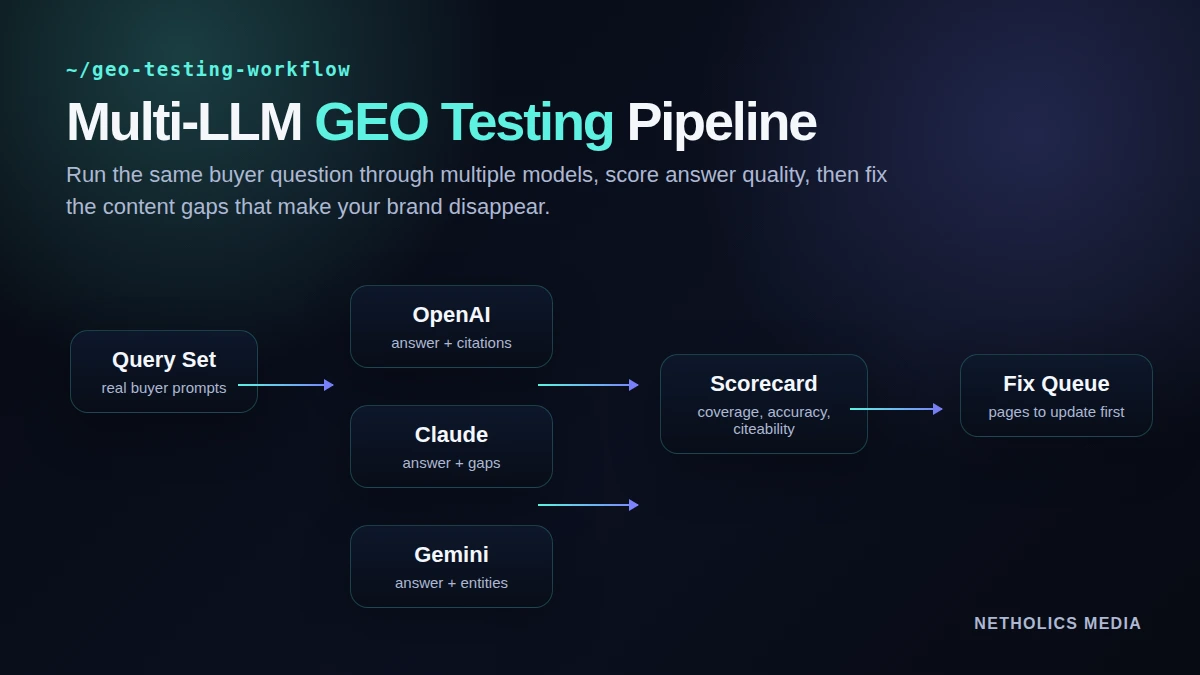
The five-part workflow
The workflow starts with real buyer questions, not keyword vanity. Use questions that a lead would ask before choosing an automation agency, a GEO partner, or a platform specialist. Examples: “who can build n8n workflows for a small business,” “how should I test an AI workflow before production,” and “what does an AI systems audit include?”
1. Build a prompt set from commercial questions
Group prompts by intent: discovery, comparison, implementation, risk, and vendor selection. Keep each prompt stable for a few weeks so trend data is meaningful. Include at least one local or niche version if geography matters, such as “marketing automation agency in Wyoming” or “AI automation agency for ecommerce brands.”
2. Send the same prompt to multiple answer surfaces
Use API calls where terms allow it. For an internal testing harness, n8n’s HTTP Request node is enough: one branch for each model endpoint, shared variables for the prompt, and a fixed output schema. Avoid scraping consumer interfaces when an official API or documented endpoint exists. If a platform does not expose the surface you care about, record that limitation instead of pretending the test is exact.
3. Normalize answers into the same fields
Store the raw answer, model name, date, prompt ID, token cost when available, brand mentioned yes/no, competitors mentioned, source URLs if provided, and a short evaluator note. The goal is a stable dataset that an editor can inspect without reading every raw response.
4. Score for business usefulness
Do not over-engineer the first version. A 0–2 score for brand presence, answer accuracy, service fit, and next-step clarity is enough. The score is a routing tool, not scientific truth. Low accuracy means a human reviews the prompt and answer before any page is rewritten.
5. Convert weak answers into editorial tasks
The best output is not “Claude mentioned us twice.” The best output is “the AI systems audit page needs a tighter deliverables section,” “the GEO page needs clearer service proof,” or “we need one article explaining multi-model testing because current pages assume the reader already knows the process.”
A practical GEO scorecard
Keep the scorecard small enough that someone will actually use it. The first pass should identify patterns, not create a false sense of precision.
| Dimension | Score 0 | Score 1 | Score 2 |
|---|---|---|---|
| Brand presence | Brand absent or confused with another company. | Brand appears but without a useful reason to choose it. | Brand appears with a relevant service or proof point. |
| Answer coverage | The answer misses the buyer’s main problem. | The answer covers basics but lacks implementation depth. | The answer covers risk, process, and next step clearly. |
| Source fit | No source or irrelevant source. | A related page appears but not the best page. | The strongest service/article page supports the answer. |
| Next-step clarity | The answer leaves the buyer with generic advice. | The answer suggests an action but not a clear path. | The answer points toward audit, build, or implementation help. |
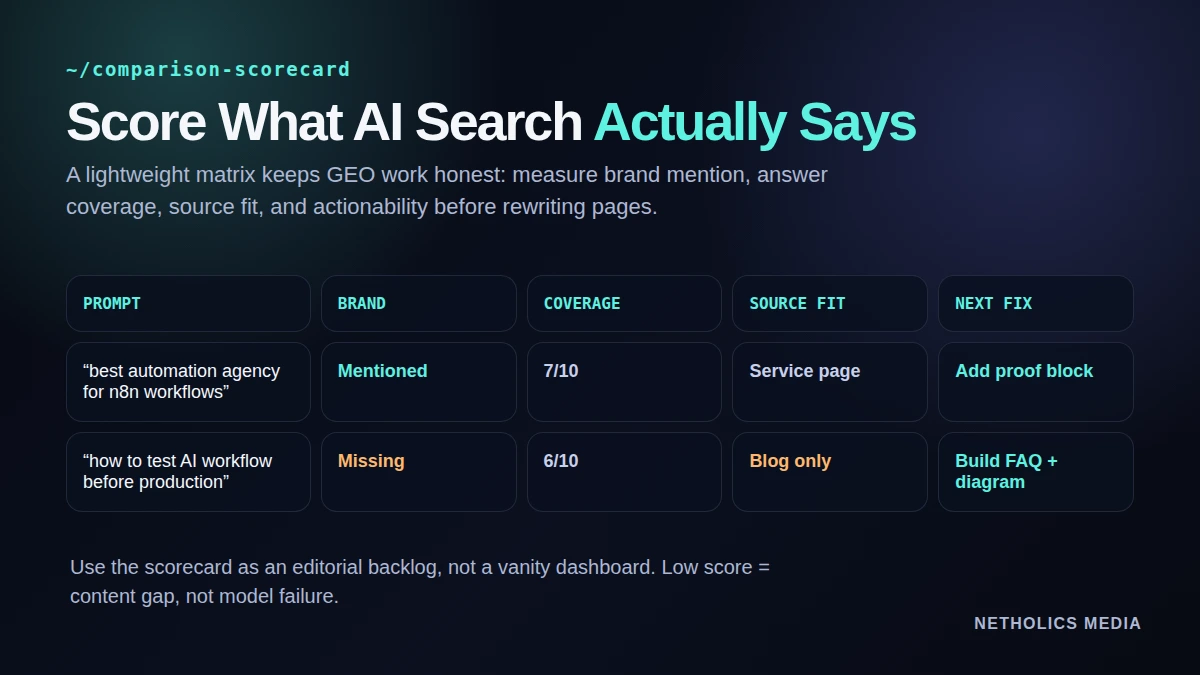
The testing loop in one diagram
Copy-paste test record schema
Start with one JSON shape for every model answer. Add fields later; do not start with a dashboard before the records are consistent.
{
  "prompt_id": "geo_comparison_001",
  "prompt": "Who can build n8n automation workflows for a small business?",
  "model": "provider-model-name",
  "run_date": "2026-07-03",
  "raw_answer": "...",
  "brand_mentioned": false,
  "competitors_mentioned": ["example competitor"],
  "source_urls": [],
  "scores": {
    "brand_presence": 0,
    "answer_coverage": 1,
    "source_fit": 0,
    "next_step_clarity": 1
  },
  "recommended_fix": "Add a concise n8n implementation proof block to the service page.",
  "human_reviewer": "editor"
}A seven-step launch runbook
- Inventory canonical pages. List the service pages and articles you want answer engines to understand: GEO, AI Systems Audit, n8n automation, SEO content automation, ecommerce automation, and any high-value case study pages.
- Write 20 buyer prompts. Use the language a prospect would use, not the language a marketer would use. Include comparison, problem, and risk prompts.
- Create one n8n workflow. Use a manual trigger first, one HTTP Request branch per model API, and one Code node to normalize the response into the shared record shape.
- Score with human review. Let the workflow draft scores if you want, but require a human reviewer before a page gets rewritten. GEO testing should improve quality, not chase noisy model output.
- Group failures by fix type. Separate missing brand mentions, weak source pages, inaccurate summaries, competitor-only answers, and unclear next steps.
- Rewrite the smallest useful block. Add a proof section, FAQ, comparison paragraph, diagram, or internal link. Avoid rewriting the entire page every time a model gives a weak answer.
- Retest on a cadence. Weekly is enough for early content work. Keep date, prompt, and model stable so you can see whether the site is becoming easier to cite.
What other experts say
Reference card · Google Search Central
Google’s AI features documentation emphasizes making helpful, people-first content available to Search with normal technical SEO foundations.
Netholics comment: GEO testing should not replace fundamentals. The test loop tells you which helpful content and structured explanations are still missing from the site.
Implementation checklist
- Use official APIs where possible. Do not build a fragile test harness on scraping consumer chat screens.
- Version the prompt set. Changing prompts every run makes trend data meaningless.
- Store raw and scored answers. Editors need evidence, not just a dashboard number.
- Separate model noise from content gaps. Require human review before rewriting important service pages.
- Link fixes to URLs. Every recommended improvement should point to the page, section, and reason.
- Keep personal data out of prompts. GEO testing rarely needs customer data; use public buyer scenarios instead.
- Retest after edits. A content update that is never retested is just hope with better formatting.
GEO testing readiness card
| Impact | High when service pages are already live but AI answers are generic or competitor-heavy. |
| Risk | Medium. The main risk is overreacting to one model run instead of looking for repeated patterns. |
| Effort | Low to medium. A first n8n workflow, score sheet, and 20 prompts can be built before a full dashboard exists. |
| Best first workflow | Run buyer prompts for your highest-margin service and compare whether AI answers cite your service page, articles, or nobody. |
| Do not automate yet | Do not auto-rewrite pages from model feedback. Keep editorial decisions human-reviewed. |
Frequently Asked Questions
Q: What is multi-LLM GEO testing?
Multi-LLM GEO testing is a repeatable workflow that asks the same buyer questions across several AI models or answer surfaces, records the answers, scores brand visibility and source fit, then turns weak answers into content improvements.
Q: Is GEO testing the same as rank tracking?
No. Rank tracking watches search result positions. GEO testing watches how AI systems summarize a topic, whether they mention the brand, what sources they use, and which page improvements could make the answer clearer.
Q: Which models should a small business test first?
Start with the AI surfaces your buyers are most likely to use and the APIs your team can access responsibly. A practical first set is one OpenAI model, Claude, Gemini, and Google AI Search features as a separately reviewed surface.
Q: Can n8n run a GEO testing workflow?
Yes. n8n can orchestrate prompt sets, call model APIs through HTTP Request nodes, normalize responses in Code nodes, and send scored records to spreadsheets, databases, or editorial tools.
Q: Should model answers automatically rewrite website content?
No. Model answers should create an editorial queue, not an automatic rewrite. A human should review repeated gaps, check source quality, and decide whether the page needs a proof block, FAQ, comparison section, or new article.
Q: How often should GEO tests run?
Weekly is enough for most small-business content programs. Run tests after major page updates, before important campaigns, and on a consistent cadence so prompt and model drift do not hide the signal.
Verified Sources
Turn GEO guesses into a testing system
Netholics builds AI search, content automation, and workflow measurement loops that connect strategy to implementation instead of another spreadsheet nobody trusts.