n8n Webhook Security and Authentication
A practical production guide to protecting n8n webhooks with authentication, signatures, allowlists, replay protection, validation, and safe response handling.
The 60-second answer
- A production n8n webhook is an internet-facing API endpoint. The URL alone is not a security boundary, even when the path looks random.
- The safe pattern is authenticate first, validate the raw request, reject replayed or oversized payloads, then run business logic only after the request passes every gate.
- The practical deliverable is a layered webhook entry design: sender authentication, payload validation, idempotency, rate limits, safe responses, and monitoring that catches abuse before it becomes workflow damage.
Why webhook security matters in n8n
Webhook workflows are attractive because they remove polling and make automations feel instant. A form submission can create a lead, a payment event can start onboarding, and a support event can update a CRM in seconds. The same convenience also creates a public entry point into your automation stack. If the entry point is weak, every node after it inherits that weakness.
The most common mistake is treating the webhook URL as a secret. Random paths reduce casual discovery, but URLs can appear in browser history, logs, screenshots, tickets, vendor dashboards, exported workflows, analytics tools, and chat messages. Once a URL is known, any caller can hit it unless another control exists.
For n8n operators, webhook security is not only about blocking attackers. It is also about blocking accidental repeats, malformed vendor retries, oversized payloads, stale events, and internal tests pointed at production. A resilient workflow knows the difference between a trusted event and a random HTTP request before it enriches data, sends messages, or writes to a database.
The layered webhook model
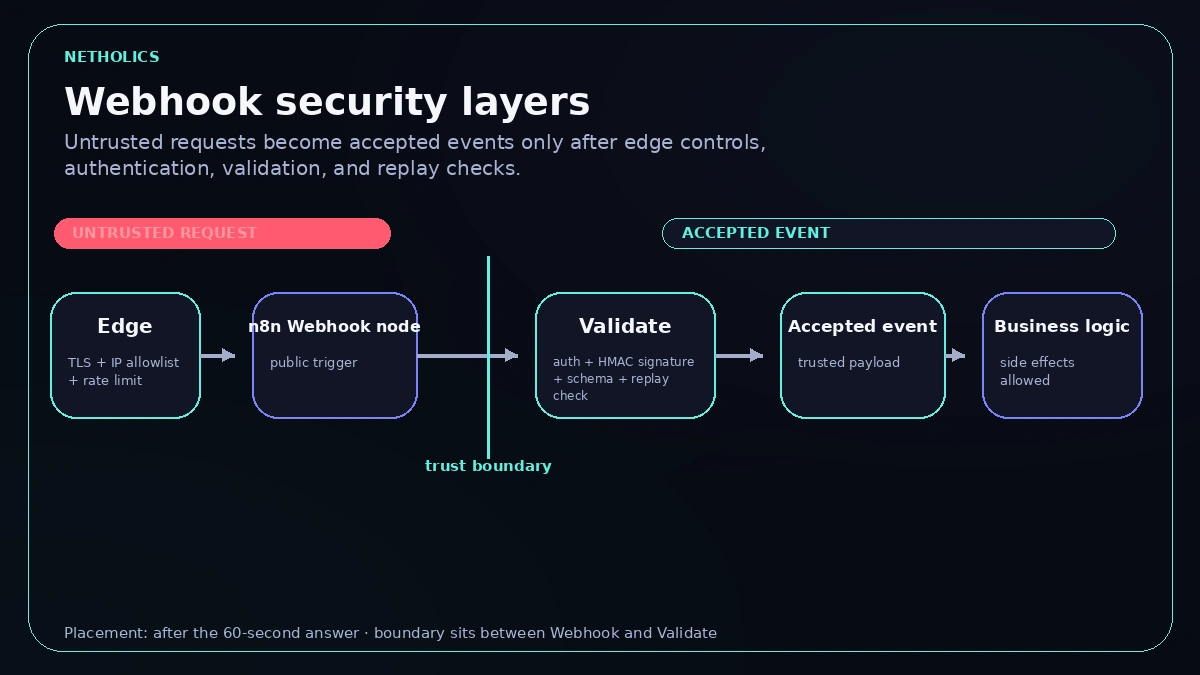
A secure webhook should have several small checks instead of one heroic check. At the edge, a reverse proxy or gateway can enforce TLS, source restrictions, size limits, and rate limits. At the n8n entry point, the Webhook node receives only the method and path you expect. Immediately after that, a validation step checks authentication, timestamp, content type, required fields, and idempotency.
The business workflow starts only after the request has been promoted from untrusted input to accepted event. That boundary matters. If enrichment, email, CRM writes, or AI calls happen before validation, then every invalid request can spend money or mutate customer systems.
The best design also separates response handling. Some senders need a fast acknowledgement and later asynchronous processing. Others need a final answer from the workflow. In both cases, error details belong in internal logs and review queues, not in a public response body.
Webhook controls by failure mode
Do not choose controls by fashion. Choose them by what can go wrong with this specific webhook: unauthorized callers, duplicate events, malformed payloads, vendor retries, or flood traffic.
| Control | Purpose | Implementation note |
|---|---|---|
| Authentication | Proves the sender is allowed to call the endpoint. | Use Basic Auth, secret headers, signed payloads, or gateway auth depending on sender support. |
| Replay protection | Stops old or duplicate events from running again. | Check timestamps, event IDs, and a short-lived seen-event store. |
| Payload validation | Blocks malformed requests before business logic. | Validate content type, size, required fields, and allowed enum values. |
| Rate limiting | Prevents floods from consuming execution capacity. | Prefer gateway or proxy limits before requests reach n8n. |
| Safe response | Gives the sender a useful result without exposing internals. | Return minimal public errors and store detailed diagnostics internally. |
The secure webhook entry flow
A good webhook flow is short and strict. The first nodes decide whether the request is allowed to exist. The later nodes decide what the business should do with a trusted event. Keeping those responsibilities separate makes testing and incident review much easier.
A copy-paste validation starting point
This example shows the shape of the check, not a vendor-specific implementation. Two setup details make it actually work in n8n: enable Raw Body on the Webhook node so you can hash the exact bytes the sender signed, and on self-hosted n8n allow the crypto module with NODE_FUNCTION_ALLOW_BUILTIN=crypto (on n8n Cloud, or Community without that flag, compute the HMAC with the built-in Crypto node instead). Keep the shared secret outside the visible workflow, compare signatures in constant time, and store recent event IDs so an accepted event cannot be replayed.
// Code node immediately after the Webhook node (Raw Body enabled).
// Needs NODE_FUNCTION_ALLOW_BUILTIN=crypto on self-hosted n8n, or use the
// built-in Crypto node instead of require to compute the HMAC.
const crypto = require("crypto");

const item = $input.first().json;
const headers = item.headers || {};

// Hash the EXACT received body, not a re-serialized object: JSON.stringify
// changes key order and whitespace and will never match the sender signature.
const rawBody = item.rawBody || "";

const signature = String(headers["x-signature"] || "");
const timestamp = Number(headers["x-timestamp"]);
const now = Math.floor(Date.now() / 1000);

if (!signature || !timestamp || Math.abs(now - timestamp) > 300) {
  return [{ json: { accepted: false, reason: "stale_or_unsigned" } }];
}

// Pull the secret from an allowed source, never inline in the workflow.
const secret = $env.WEBHOOK_SHARED_SECRET || "";
const expected = crypto
  .createHmac("sha256", secret)
  .update(`${timestamp}.${rawBody}`)
  .digest("hex");

// Constant-time compare, but guard length first: timingSafeEqual throws on a mismatch.
const sig = Buffer.from(signature);
const exp = Buffer.from(expected);
if (sig.length !== exp.length || !crypto.timingSafeEqual(sig, exp)) {
  return [{ json: { accepted: false, reason: "bad_signature" } }];
}

const body = item.body || {};
if (!body.event_id || !body.customer_id || !body.event_type) {
  return [{ json: { accepted: false, reason: "missing_required_fields" } }];
}

return [{ json: { accepted: true, event: body } }];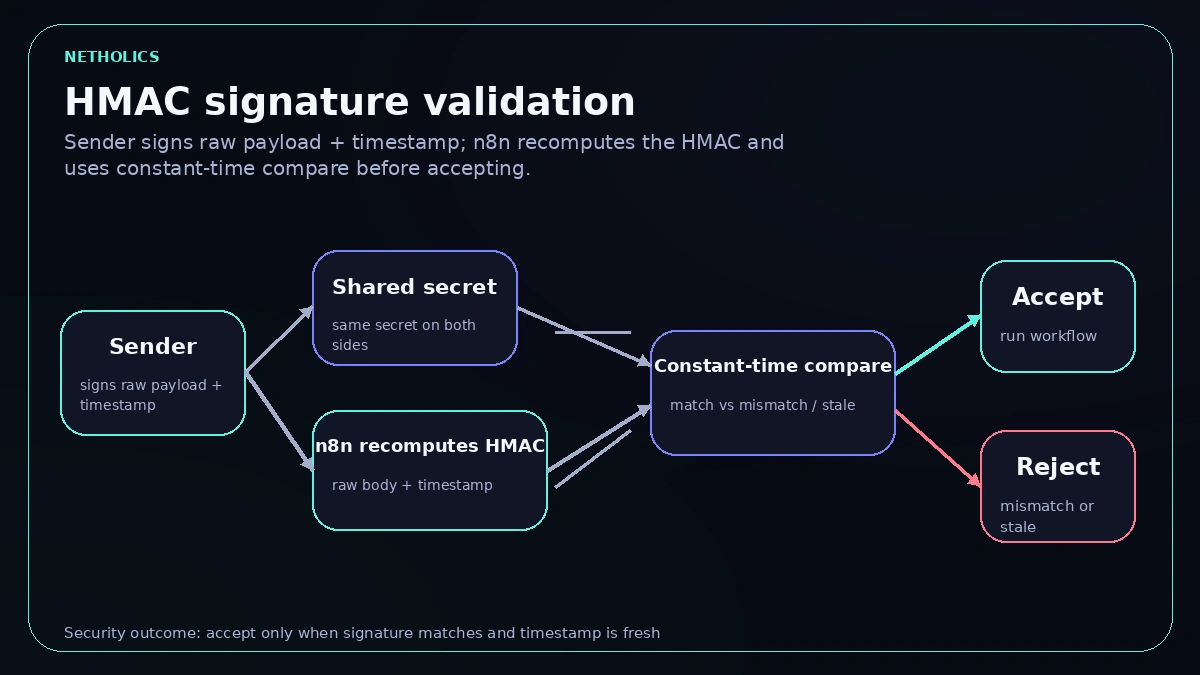
Payload validation before business logic
Authentication answers one question: is the sender allowed to call this endpoint? Payload validation answers a different question: is this particular request safe and meaningful for the workflow? A trusted vendor can still send an unexpected event type, a retry with an old event, or a payload that is valid JSON but invalid for your business process.
Start with mechanical checks. Require the HTTP method you expect, the content type you parse, the maximum body size you can safely handle, and the fields your workflow actually needs. Then add business checks: allowed event types, allowed account IDs, expected currency, known tenant, and whether the event is newer than the last processed state.
Do not let validation become invisible. Failed validation should create a small internal record with timestamp, source, reason, and request identifier. It should not store raw secrets or unnecessary personal data. The goal is to diagnose abuse or vendor drift without creating a new privacy problem.
A seven-step launch runbook for n8n webhooks
Use this runbook before a webhook is connected to production systems. It is written to catch mistakes while the webhook can still be changed without customer impact.
- Name the trust boundary. Decide whether authentication happens at the sender, gateway, reverse proxy, n8n credential, or validation Code node.
- Choose the sender identity. Create a dedicated upstream app, token, or webhook secret for this integration rather than reusing a personal account.
- Validate bad cases first. Test missing auth, wrong signature, old timestamp, duplicate event ID, wrong content type, oversized body, and unsupported event type.
- Place side effects after acceptance. CRM writes, email sends, database updates, AI calls, and payment actions must sit after the acceptance branch.
- Return minimal public errors. Give the sender an actionable status code while keeping detailed diagnostics in internal logs or an error workflow.
- Record idempotency. Store event IDs or business keys so retries and replay attempts cannot create duplicate downstream actions.
- Monitor launch traffic. Watch rejection count, accepted event count, duplicate count, execution time, and downstream error rate during the first real traffic window.
Worked example: payment event to onboarding task
Imagine a payment provider calls an n8n webhook when a customer buys an onboarding package. The workflow creates a CRM deal, sends a welcome message, creates a project task, and notifies operations. Without controls, anyone with the URL could create fake onboarding work or trigger duplicate messages.
The secure version starts with a provider-specific signing secret and timestamp. The first branch rejects unsigned, stale, or badly signed requests. The second branch checks that the event type is the purchase event you expect, the account ID belongs to your business, and the event ID has not already been processed. Only then does the workflow create the CRM deal and task.
If the provider retries the event because the first response timed out, the idempotency check recognizes the event ID and returns a safe acknowledgement instead of creating a second deal. If the payload shape changes, validation fails before any customer-facing action runs. Operations sees a review item with the reason and can update the parser deliberately.
Monitoring and incident signals
Webhook monitoring should distinguish blocked traffic from failed business logic. A spike in rejected signatures means a different response than a spike in accepted events that fail at the CRM node. One points at abuse or sender configuration. The other points at downstream system health.
The useful metrics are simple: accepted events, rejected events by reason, duplicate event IDs, average response time, body size rejections, downstream failure count, and oldest unprocessed event. A lightweight monitoring setup can track these without heavy tooling. If a webhook starts receiving traffic from a new IP range or a sudden burst of old timestamps, the security review can start from evidence instead of guesswork.
Keep the incident path small. If authentication fails, rotate the shared secret or upstream app, review recent accepted events, and confirm whether any downstream action ran. If validation fails after a vendor release, pause only the affected event type where possible instead of disabling every webhook.
Gateway and reverse-proxy controls
n8n can validate requests inside the workflow, but some controls are better handled before the request becomes an execution. A reverse proxy, API gateway, or edge worker can enforce body-size limits, method restrictions, source allowlists, request logging, and coarse rate limits. That protects n8n from work it never needed to perform.
This layer is especially useful when several workflows share the same public hostname. Instead of making each workflow rediscover the same security rules, the edge can reject obviously wrong traffic and pass only plausible requests to n8n. The workflow still performs sender-specific checks, but it no longer absorbs every scan, malformed body, or oversized payload.
The key is to avoid hiding trust decisions. Document which checks happen at the edge and which happen in n8n. If the gateway verifies a JWT, the workflow should know which claim it trusts. If the gateway allows only a vendor IP range, the workflow should still validate event identity because IP allowlists can change and do not prove payload integrity.
Secret rotation and incident recovery
A webhook secret needs the same ownership discipline as any other production credential, and the inventory and rotation habits from n8n credentials and secrets management apply directly. Someone must know where the sender secret lives, where the n8n validation secret lives, how to roll both sides, and what traffic should look like during the overlap. Without that plan, a suspected leak turns into a guessing exercise.
For signed webhooks, support a short dual-secret window when possible. Accept the current secret and the next secret during a controlled migration, then remove the old one after successful vendor delivery. If the sender does not support overlapping secrets, schedule the change during a quiet window and keep a tested rollback ready.
Incident recovery starts with containment. Rotate the shared secret or upstream app, check accepted events since the suspected exposure, review downstream side effects, and compare rejection metrics before and after rotation. The goal is not only to restore service, but to prove whether the leaked path was used.
Common webhook mistakes to avoid
Relying on the random URL. Webhook paths can leak through logs, screenshots, exports, and vendor dashboards. Use real authentication.
Validating after side effects. A request that reaches a CRM write before validation has already crossed the important boundary.
Returning too much detail. Public responses should not reveal secrets, stack traces, full validation rules, or internal hostnames.
Ignoring replay behavior. Vendors retry. Attackers replay. Your workflow needs event IDs, timestamps, and duplicate handling.
No rotation path. A shared secret without an owner and replacement plan becomes permanent infrastructure debt.
Production acceptance test
The final acceptance test is simple: a bad request should be boring. It should stop early, produce a minimal public response, create an internal reason code, and leave every customer-facing system untouched. If a malformed webhook can still create a CRM record, send an email, or spend an AI token, the trust boundary is in the wrong place. A clean launch also proves that duplicate vendor retries do not create duplicate business actions, and that the on-call operator can see why each request was accepted or rejected. That evidence is what turns webhook security from a one-time setup task into an operating practice, especially when multiple vendors and several internal workflows share the same automation host.
What other experts say
Reference card · OWASP API Security Top 10 (2023)
OWASP’s API Security Top 10 ranks broken authentication and unrestricted resource consumption among the leading API risks. A public webhook is an API endpoint, so it needs enforced authentication and request limits, not a hard-to-guess path.
Netholics comment: this is exactly why the secure pattern in this guide authenticates and validates every webhook request before any business node runs. The random URL is an address, not a control, and rate limits at the edge stop floods from consuming your n8n execution capacity.
Ship a secure n8n webhook
- Enable Raw Body. Turn on Raw Body on the Webhook node so you hash the exact bytes the sender signed, never a re-serialized object.
- Verify the signature in constant time. Recompute the HMAC over timestamp plus raw body, guard buffer length first, then compare with
crypto.timingSafeEqual. - Reject stale and unsigned requests. Require a timestamp header and drop anything outside a five-minute window before the workflow trusts the payload.
- Store recent event IDs. Keep a short-lived seen-event store so a retried or replayed event returns a safe acknowledgement instead of a duplicate downstream action.
- Validate the payload shape. Check content type, body size, required fields, allowed event types, and known account or tenant IDs before any side effect.
- Place side effects after acceptance. Keep CRM writes, emails, AI calls, and payment actions strictly on the accepted-event branch.
- Return minimal public errors. Send a clear status code to the sender and write the detailed reason code to internal logs or an error workflow.
- Pin the rotation owner. Record where the sender secret and the n8n validation secret live, and how to roll both sides during a controlled overlap window.
Webhook hardening readiness card
| Impact | High. The webhook is the trust boundary for every downstream node, so one weak entry point exposes the whole workflow. |
| Risk | Medium. Mistakes are usually placement errors, such as validating after a CRM write, rather than missing cryptography. |
| Effort | Low to medium. A signature check, timestamp window, idempotency store, and edge rate limit are a focused afternoon, not a project. |
| Best first workflow | A signed provider event, such as a payment or form webhook, where the sender already supports HMAC signatures and timestamps. |
| Do not auto-process yet | Any webhook from a sender that cannot sign requests until it sits behind a gateway that enforces auth, source allowlists, and limits. |
Frequently Asked Questions
Q: Are n8n webhook URLs secure if the path is hard to guess?
No. A hard-to-guess URL is not authentication. Treat the URL as an address, then add a real control such as Basic Auth, a signed request, an upstream gateway, or a secret header that is validated before the workflow trusts the payload.
Q: What is the safest authentication pattern for production n8n webhooks?
Use the strongest pattern the sender supports. Signed webhooks with timestamp and replay protection are best for event providers. For internal systems, put the webhook behind a gateway or reverse proxy that handles authentication, rate limits, and source restrictions before n8n receives the request.
Q: Should I put webhook secrets inside workflow nodes?
Avoid placing long-lived secrets directly in node parameters or examples. Keep secrets in n8n credentials, environment-backed settings, or the upstream gateway, and document the owner and rotation path.
Q: How do I stop replay attacks against n8n webhooks?
Require a timestamp, reject requests outside a short window, verify a signature over the raw body plus timestamp, and store recent event IDs or signatures so the same event cannot be accepted repeatedly.
Q: Can a Webhook node return errors safely?
Yes, but the response should reveal as little as possible. Return clear status codes for the sender, log detailed reasons internally, and avoid echoing secrets, stack traces, or validation internals to the public caller.
Q: How should I test webhook authentication before launch?
Test valid requests, missing auth, bad signatures, old timestamps, duplicate event IDs, oversized payloads, wrong content types, and malformed JSON. The workflow should reject each bad case before any side-effecting node runs.
Q: What should happen if webhook authentication fails?
The workflow should stop before business actions run, return a minimal unauthorized or bad-request response, and log enough context for security review without storing raw secrets or unnecessary personal data.
Verified Sources
Make n8n production-safe with Netholics
If your n8n workflows already touch customer systems, the safest next step is a focused audit of inputs, credentials, transformations, failures, and recovery paths before the next automation goes live.