AI Automation Pricing in 2026: What It Really Costs
An honest buyer’s guide to what AI automation actually costs a small business, so you can budget with confidence and tell a fair quote from a hopeful one.
The 60-second answer
- There is no single price for AI automation because the work is custom: a small, well-scoped workflow and a multi-system agent that runs all day are different products with different bills. Budget in ranges, not a sticker price.
- Split every quote into a one-time build cost and a recurring run cost. The run cost (LLM tokens, hosting, monitoring, and maintenance) is the part buyers underestimate, and over twelve months it often rivals or exceeds the build.
- The deliverable below is a way to reason in total cost of ownership: a cost-component table, the pricing models and their trade-offs, a copy-paste 12-month worksheet, a worked example, and what a fair proposal must contain.
Why AI automation pricing feels so opaque
Ask three agencies to automate “lead intake” and you can get three quotes that differ by an order of magnitude, all of them honest. That is not a market full of cowboys. It is what happens when the thing being priced is bespoke engineering, not a product on a shelf. Two quotes can both be fair and still look nothing alike because each shop scoped a different system.
The opacity comes from a few real sources. The word “automation” hides enormous variance: a single trigger-to-email flow and a multi-step agent that reads documents, calls four APIs, and routes exceptions to a human are both “an automation,” yet one is a day of work and the other is a quarter. Pricing also mixes one-time and recurring costs that vendors present inconsistently, so a low build number can quietly carry a heavy monthly tail. And usage-based costs, especially LLM tokens, only reveal themselves at volume, long after the proposal is signed.
The fix is not to find the one true price. It is to break any quote into its parts, price each part in a defensible range, and add it up over a realistic time window. Do that and the scary opacity turns into a budget you can defend to whoever signs the cheque. The rest of this guide is that breakdown.
The real cost components
Every AI automation quote, however it is packaged, is assembled from the same underlying line items. Some are one-time, some recur forever, and the ones buyers forget are almost always recurring. Here is the full set, what drives each one up, and the most reliable lever to bring it down.
| Cost component | Typical cost driver | How to reduce it |
|---|---|---|
| Discovery & scoping | Unclear requirements, many stakeholders, and undocumented processes that have to be mapped before anything is built. | Arrive with the process written down and the success metric agreed. A tight brief shortens discovery directly. |
| Solution design | Workflow complexity: number of steps, branches, exception paths, and how much human review the risk level demands. | Automate one clear path first and handle edge cases manually until volume justifies them. Scope narrow, then widen. |
| Build | Hours of engineering, prompt and logic work, and test data. Custom UI or bespoke logic costs far more than wiring known tools. | Use a proven platform (n8n, Make, Zapier) rather than coding glue from scratch where the connectors already exist. |
| Integrations | Each external system added: legacy software, custom APIs, auth quirks, and rate limits all add build and test time. | Prefer systems with stable, documented APIs. Every extra integration is a recurring point of breakage, not just a build cost. |
| LLM / API usage | Token volume per run multiplied by runs per month, plus the price of the model chosen. Flagship models cost far more per token than small ones. | Right-size the model to the task and trim context. See LLM token cost control for the levers. |
| Hosting & infrastructure | Where the workflow runs: managed SaaS task fees or self-hosted servers, plus databases, queues, and storage. | Match hosting to volume. Self-hosting saves at scale but adds ops time; managed plans win for low, spiky volume. |
| Monitoring & observability | Logging, alerting, error tracking, and the dashboards that tell you the automation is still working and within budget. | Start with the platform’s built-in logs and a single failure alert. Add tooling only when volume earns it. |
| Maintenance & change requests | Fixing breakage when an upstream API changes, updating prompts and model versions, and the steady drip of “can it also do X?”. | Agree a maintenance arrangement up front and a clear change-request rate, so neither side is surprised. |
Two of these decide whether a project ages well: maintenance and LLM usage. Both are assumed to be near zero because the demo cost nothing to run and nothing had broken yet. In production they are the line items that quietly compound, which is why the next section separates the build you pay once from the run cost you pay forever.
One-time build cost vs recurring run cost
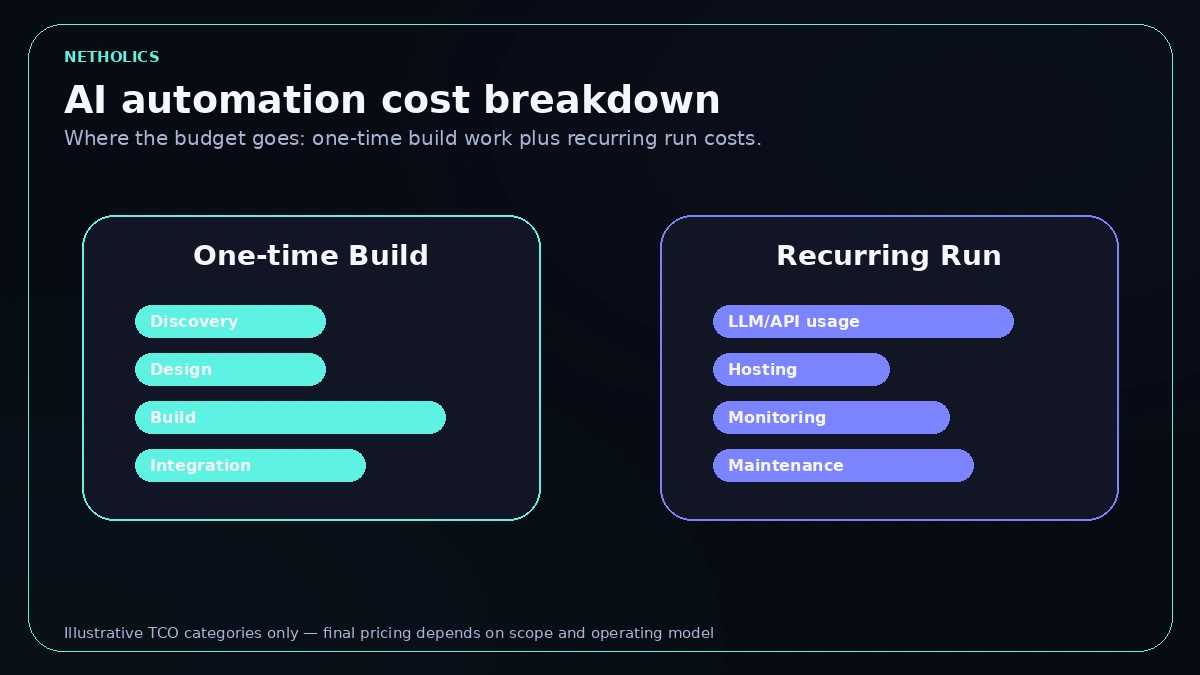
The single most useful thing you can do with any AI automation quote is split it in two. The build cost is the one-time spend to design, build, integrate, and test the workflow until it works. The run cost is what you pay every month afterwards just to keep it alive and correct: tokens, hosting, monitoring, and maintenance time.
Buyers anchor hard on the build number because it is the big figure on the proposal and it is easy to compare across vendors. The run cost is where projects actually go wrong. It is smaller per month, so it feels safe, but it never stops, it scales with how much you use the automation, and it is the part a cheap quote leaves out. A build that looks like a bargain can carry a run cost that overtakes it within the first year.
A simple rule of thumb keeps you honest: assume the recurring run cost over twelve months will land somewhere in the range of a quarter to the full size of the build cost, and more for anything that calls a flagship model on every run or touches fragile legacy systems. The exact split depends entirely on volume and model choice, so treat that as a prompt to ask the question, not a number to quote. The diagram below shows where a representative twelve-month budget tends to go.
Where a 12-month budget goes
Pricing models and their trade-offs
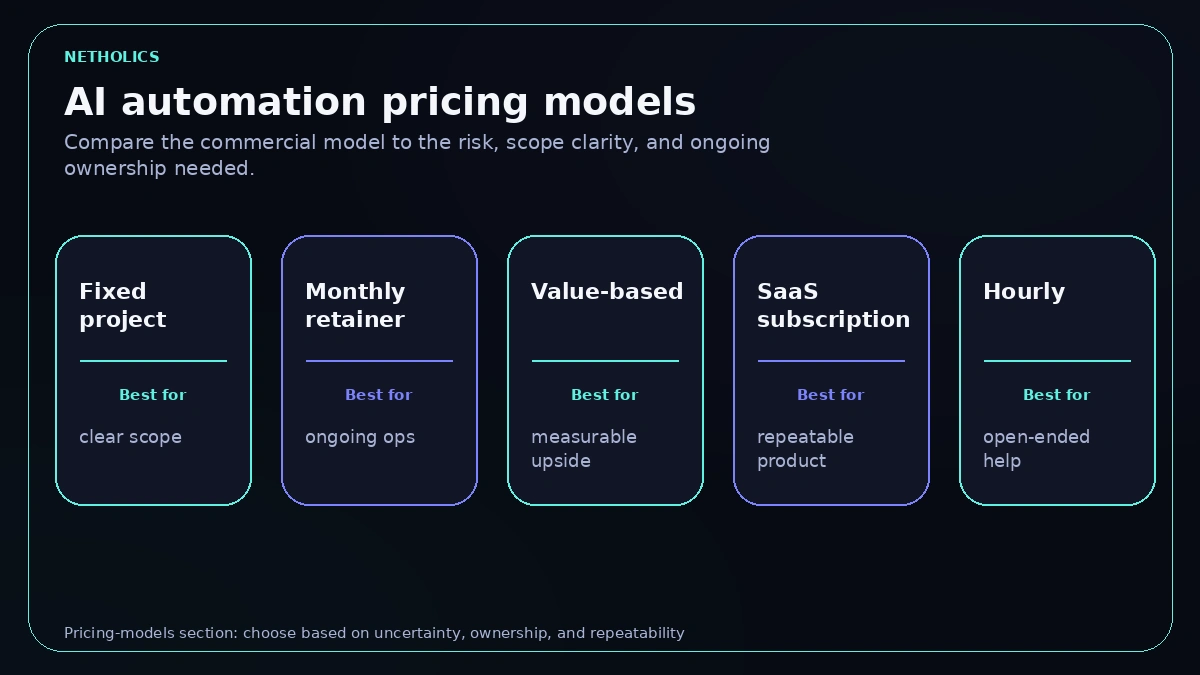
The same automation can be sold under several pricing models, and the model changes who carries the risk. None is automatically fairer than the others; each suits a different buyer and a different stage of clarity. Match the model to how well-defined the work is.
| Pricing model | Best for | Main watch-out |
|---|---|---|
| Fixed-scope project | A well-defined workflow with clear inputs, outputs, and a known set of integrations. | Anything outside the written scope becomes a change request. Vague scopes lead to padding or disputes. The recurring run cost is usually not in the project price. |
| Monthly retainer | Ongoing work: a pipeline of automations, plus maintenance and changes to existing ones. | Confirm what the retainer actually buys each month. An idle retainer is pure cost; ask how unused hours are handled. |
| Value / outcome-based | Cases where the benefit is measurable and attributable, such as cost saved or qualified leads added. | Both sides must agree the metric and a baseline up front, or “value” becomes an argument. Hard to apply when impact is diffuse. |
| Off-the-shelf SaaS | Common, standardized jobs where a product already exists and your process can fit its shape. | Per-seat or per-task fees scale with use, customization is limited, and you inherit the vendor’s roadmap and lock-in. |
| Hourly / time-and-materials | Exploratory work, prototypes, or small changes where the scope genuinely cannot be fixed in advance. | No cost ceiling without a cap. Ask for an estimate and a not-to-exceed figure so an open-ended bill cannot run away. |
A practical pattern for a first project is a fixed-scope build for the part you understand, paired with either a light retainer or an agreed hourly rate for the maintenance and changes that follow. That keeps the predictable work predictable and prices the genuinely uncertain work honestly.
DIY vs in-house vs agency vs platform
Who builds the automation is its own cost decision, separate from the pricing model. The cheapest option on paper is rarely the cheapest once you count the time and risk it loads onto you. Weigh the cost shape, not just the headline.
| Approach | Typical cost shape | Best when |
|---|---|---|
| DIY (owner builds it) | Low cash outlay, high owner-time cost, plus platform and token fees. Maintenance falls entirely on you. | The workflow is simple, low-risk, and you have the time and curiosity to learn a no-code platform. |
| In-house hire | A salary or contractor rate: the largest fixed cost, but full control and institutional knowledge that stays with you. | Automation is core to the business and there is a steady, long-term pipeline of work to justify the role. |
| Agency / specialist | A project or retainer fee that bundles expertise, speed, and accountability. Higher per-hour, lower total time-to-value. | You want it built right and supported without hiring, and you value an outside team that has solved it before. |
| Off-the-shelf platform | A predictable subscription with little build cost, but ongoing fees that scale and limited room to customize. | A product already does roughly what you need and bending your process to fit it is acceptable. |
These are not mutually exclusive. A common, sensible path is to buy off-the-shelf SaaS for standardized jobs, have an agency build the custom workflows that connect your specific systems, and keep simple internal tweaks DIY. The build vs buy decision for AI agents goes deeper on choosing per use-case rather than picking one approach for everything.
The “cheap now, expensive later” traps
The lowest quote is sometimes the most expensive purchase. The savings come from leaving out the unglamorous work that keeps an automation alive, and the bill for that arrives later, with interest. Watch for these patterns when a price looks too good.
- No monitoring. A workflow with no logging or alerting fails silently. You discover it broke when a customer complains, after it has been quietly dropping work for a week. The saving on observability is paid back as missed work and firefighting.
- A brittle build. Hard-coded values, no error handling, and no retries make a workflow that works in the demo and snaps the first time a real input is messy or an API hiccups. Robustness costs more to build and far less to own.
- Vendor or platform lock-in. A build that only runs inside one proprietary tool, with no export and no documentation, is cheap until you need to leave or scale, at which point the switching cost is the whole rebuild.
- Run cost left out of the quote. A build-only price that ignores tokens, hosting, and maintenance is not a full quote. The missing run cost does not disappear; it simply lands on you later, unbudgeted.
- No documentation or handover. If only the original builder understands the workflow, every future change is hostage to their availability and rate. Documentation is cheap to demand up front and ruinous to reconstruct later.
None of this means cheap is always wrong. It means a low price obliges you to ask what was left out. A fair, modest quote names the run cost and the maintenance plan; a too-cheap one stays silent about both.
What a fair quote or proposal contains
You do not need to be technical to judge a proposal. You need to check that it is honest about the whole cost and the boundaries of the work. A fair proposal answers these questions in writing, before you sign.
- A defined scope. Exactly which process is automated, what is in scope, and what is explicitly out. The boundary is as important as the inclusion.
- Both costs, separated. The one-time build cost and the expected recurring run cost, with the run cost broken into tokens or usage, hosting, and maintenance, not folded into a single number.
- Assumptions and volume. The runs-per-month and per-run usage the estimate assumes, so you can sanity-check it against reality and see what happens if volume doubles.
- A success metric. What “working” means in measurable terms, tied to the outcome you actually care about. Pair this with a real ROI measurement so the spend can be judged after the fact.
- Maintenance and change terms. Who fixes breakage, the response expectation, and the rate or retainer for changes once it is live.
- Ownership and exit. Who owns the workflow, where it runs, whether you get the source and documentation, and how you would move it if you parted ways.
If a proposal covers these, you can compare two very different-looking quotes fairly, because you are comparing the same thing: total cost of ownership against a defined outcome, not one big number against another.
A worked example: lead-intake automation over 12 months
Take one concrete, common automation: a workflow that catches inbound leads from a web form and email, uses an LLM to extract and tidy the details, scores them against simple rules, writes them to the CRM, and alerts sales to the hot ones. Here is how to budget it over a year. Every number below is illustrative, chosen to show the mechanics; your own figures will differ with volume, region, and model choice.
Assume a small business receiving roughly 500 leads a month. The build is a fixed-scope project. The run cost is dominated by a small, inexpensive model doing extraction (light token use per lead), modest hosting, and a maintenance allowance for the inevitable form change and CRM field tweak.
# Lead-intake automation - illustrative 12-month TCO (USD)
# These are example figures to show the method, NOT a quote.

one_time_build:
  discovery_and_scoping:   "low four figures"   # map the process, agree the metric
  design_and_build:        "mid four figures"   # workflow, prompt, scoring rules, tests
  integrations:            "low four figures"   # web form + email + CRM wiring
  # build_subtotal ~ high four to low five figures

recurring_run_per_month:
  llm_api_usage:           "tens of dollars"    # small model, ~500 light extractions
  hosting_infra:           "tens of dollars"    # managed platform tasks or small server
  monitoring:              "low tens"           # failure alert + run logs
  maintenance_allowance:   "low hundreds"       # avg of occasional fixes + changes
  # run_subtotal ~ a few hundred / month -> low-to-mid four figures / year

twelve_month_total: "build + (run_per_month x 12)"
# Decision rule: the recurring year often lands near a quarter-to-half of build.
# If a quote shows run cost as ~zero, that is the red flag, not the bargain.
The lesson is in the shape, not the digits. The build is the bigger one-time number, but the run cost across twelve months is a serious second figure that a build-only quote would have hidden. The token line is genuinely small here precisely because the design uses a cheap model on light context; swap in a flagship model on every lead and that one line can multiply several times over, which is the difference between a workflow that pays for itself and one that does not. To turn this budget into a verdict, run it through an honest ROI calculation against the time your team spends on manual intake today.
A 12-month TCO worksheet you can fill in
Copy this worksheet, replace every placeholder with your own figures, and you have a total cost of ownership you can put next to any vendor quote. Keeping build and run separate is the whole point; the final line is the number that actually matters.
# 12-month total cost of ownership worksheet
# Fill every value. Use your own currency. Ranges are fine.

assumptions:
  runs_per_month:        0      # how often the automation fires
  tokens_or_units_run:   0      # rough usage per run (see your model's pricing page)
  loaded_hourly_rate:    0      # for valuing internal/maintenance time

one_time_build:
  discovery_scoping:     0
  design_build:          0
  integrations:          0
  build_total:           0      # sum of the three above

recurring_monthly:
  llm_api_usage:         0      # runs_per_month x per-run model cost
  hosting_infra:         0
  monitoring:            0
  maintenance_changes:   0      # budget this even if it feels optional
  monthly_total:         0      # sum of the four above

twelve_month_totals:
  annual_run_cost:       0      # monthly_total x 12
  total_cost_of_owner:   0      # build_total + annual_run_cost

sanity_checks:
  run_vs_build_ratio:    ""     # annual_run_cost / build_total - if ~0, ask why
  cost_if_volume_2x:     ""     # recompute usage at double runs_per_month
The two sanity checks at the bottom catch the most common budgeting mistakes: a run cost suspiciously close to zero (something was left out) and a plan that quietly breaks if you grow. If the token line moves sharply when you double volume, that is your signal to read the token cost guide before you commit.
A scoping and budgeting runbook
This is the sequence we use to turn a vague “we want to automate this” into a number you can defend and a quote you can evaluate. Each step produces something concrete you keep.
- Write the process down. Document the manual workflow you want to automate, step by step, including who does what and where it breaks today. This single artifact shortens discovery and sharpens every quote you request.
- Pick the metric. Decide what success means in numbers: hours saved, faster response, fewer errors, more qualified leads. Without a metric you cannot judge whether any price is worth paying.
- Estimate volume. Count how often the process runs per month and how heavy each run is. Volume is the multiplier on both the benefit and the run cost, so a rough count changes the whole budget.
- Fill the worksheet. Use the TCO worksheet above to lay out build and run cost in ranges. You will not have exact numbers yet; defensible ranges are enough to set a budget and spot an outlier quote.
- Choose the model and the builder. Decide the pricing model and whether DIY, in-house, an agency, or a platform fits the scope, risk, and your available time. Match the approach to the work, not to the lowest sticker.
- Request and compare quotes. Ask each vendor for the fair-quote contents above. Normalize them to twelve-month total cost of ownership against your metric, then compare like with like.
- Start small and review. Commission the smallest version that delivers the metric, run it, and check real costs against the worksheet before scaling. The first live month tells you more than any estimate.
If you would rather not run this alone, an AI systems audit does exactly this work with you: it scopes the process, estimates the full cost of ownership, and hands back a budget and a recommendation before any build begins.
What other experts say
Reference card · Anthropic pricing
Anthropic publishes Claude pricing per million tokens, and the documented lineup spans a wide range of input and output rates, so the model you choose is the single biggest lever on what a workflow costs to run.
Netholics comment: this is exactly why the usage line in your budget is unpredictable until you fix the model. Right-size the model to the task and estimate tokens per run from the vendor’s own page before you commit to a recurring spend.
Before you sign a quote, check these
- Split the number. Make the vendor break their quote into a one-time build cost and a recurring monthly run cost; reject any single all-in figure that hides which is which.
- Pin the volume assumption. Get the runs-per-month and per-run usage the estimate is based on in writing, then recompute the run cost at double that volume to see where it lands.
- Name the model. Confirm which LLM each step uses and check its current per-token price on the provider’s pricing page, because that one choice can swing the usage line several-fold.
- Demand a maintenance term. Agree who fixes breakage, the response expectation, and the rate or retainer for changes, before the workflow is live rather than after it breaks.
- Require monitoring. Make sure a failure alert and run logs are in scope, so the automation cannot quietly drop work for a week before anyone notices.
- Settle ownership and exit. Get in writing who owns the workflow, where it runs, and whether you receive the source and documentation if you part ways.
- Total it over twelve months. Add build plus twelve months of run cost and judge every competing quote on that single comparable number, not the headline build price.
AI automation budgeting readiness card
| Impact | High when a manual task is frequent and measurable; a clear hours-saved or leads-added metric is what makes any spend defensible. |
| Risk | Mostly budget risk: a hidden run cost or an unbounded usage line that grows with volume. Manageable once build and run are separated and volume is pinned. |
| Effort | Low to start. Writing the process down, picking a metric, and filling the 12-month worksheet takes hours, not weeks, and sharpens every quote. |
| Best first workflow | One high-volume, well-defined manual task on a stable system, priced fixed-scope for the build with a light retainer or hourly rate for changes. |
| Do not budget yet | Anything whose volume or value you cannot yet estimate, or any quote that shows a near-zero run cost. Measure first, then commission the smallest version. |
Frequently Asked Questions
Q: How much does AI automation cost for a small business in 2026?
There is no single figure, because the work is custom. A simple, single-path workflow on an existing platform is a small, low-four-figure build with modest monthly costs, while a multi-system agent with custom logic and heavy usage can run into five figures to build and carry a substantial recurring bill. The honest answer is to budget in ranges: split any quote into a one-time build cost and a recurring run cost, estimate each from your own volume, and total it over twelve months.
Q: What is the difference between build cost and run cost?
Build cost is the one-time spend to design, build, integrate, and test the automation until it works. Run cost is what you pay every month afterwards to keep it alive: LLM tokens and API fees, hosting, monitoring, and maintenance time. Buyers focus on the build because it is the big visible number, but the run cost is what catches them out, since it never stops and scales with how much you use the automation. Over twelve months it often lands near a quarter to half of the build, and more for usage-heavy workflows.
Q: Why are AI automation quotes so different from each other?
Because each vendor scoped a different system. “Automation” hides huge variance, so one shop may have priced a simple trigger-to-email flow while another priced a robust, monitored, multi-integration workflow with error handling. Quotes also mix one-time and recurring costs inconsistently, and usage-based token costs only show up at volume. Two very different quotes can both be fair. The way to compare them is to break each into the same components and total them as twelve-month cost of ownership.
Q: How much do LLM tokens add to the cost?
It depends almost entirely on the model you choose and how much text each run processes. Published vendor pricing is per million tokens, and small or efficient models are dramatically cheaper per token than flagship models, so the same workflow can have a trivial or a serious token bill depending on that one choice. Always check the provider’s current pricing page, estimate tokens per run, and multiply by runs per month. For the levers that bring this line down, see the dedicated token cost control guide.
Q: Is it cheaper to build automations myself or hire an agency?
DIY has the lowest cash cost but the highest cost in your own time, and all the maintenance falls on you, so it suits simple, low-risk workflows. An agency costs more per hour but delivers faster, builds it more robustly, and supports it, which usually means a lower total time-to-value for anything that touches several systems or carries real risk. Many small businesses mix the two: DIY the simple internal tweaks, and bring in a specialist for the custom, integrated workflows.
Q: What should a fair AI automation proposal include?
A defined scope with what is explicitly out, both the build cost and the recurring run cost shown separately, the volume and usage assumptions behind the estimate, a measurable success metric, clear maintenance and change-request terms, and ownership and exit details so you know who owns the workflow and how you could move it. If a proposal names the run cost and the maintenance plan, you can trust it; if it stays silent on both, the low price is hiding something.
Q: Why is the cheapest quote often the most expensive?
Because the savings usually come from leaving out the unglamorous work that keeps an automation alive: monitoring, error handling, documentation, and a maintenance plan. A workflow with no monitoring fails silently and drops work; a brittle build snaps on the first messy input; an undocumented one holds every future change hostage. The missing run cost does not vanish, it simply arrives later as firefighting and rebuilds. A fair modest quote names what it includes; a too-cheap one is quiet about what it omits.
Q: How do I budget for AI automation over a year?
Think in total cost of ownership, not a sticker price. Write the process down, pick a success metric, estimate how often it runs, then fill in a worksheet that separates one-time build from recurring monthly run cost and multiplies the run cost by twelve. Add the two for your annual total, and pressure-test it by recomputing at double volume. That twelve-month number, set against the value of the time or errors you save today, is what tells you whether any given quote is worth it.
Verified Sources
Budget your automation with Netholics
If you want a number you can defend, with build and run cost separated, a twelve-month total, and an honest recommendation before any build starts, that is exactly what our audit delivers. No opaque quote, no hidden run cost.