AI Content Repurposing Workflow: Build a Controlled Content System
Turn one approved source asset into channel-specific articles, email, social, sales, and video briefs without letting every derivative drift away from the original evidence.
The 60-second answer
- Start with one approved source package, not an unverified AI draft.
- Define a transformation brief for each channel so format changes without changing the underlying claim.
- Preserve source IDs, reviewer decisions, and version history across every derivative.
- Measure usefulness and conversion by asset, then retire weak variants instead of multiplying them.
Why this needs a controlled workflow
Repurposing usually fails in one of two directions. A team manually rewrites the same idea until production becomes too slow, or it asks a model to generate ten formats at once and publishes a family of inconsistent claims. Both approaches lose the connection between the original evidence and the final asset.
A production workflow treats the source package as a controlled object. It stores the approved transcript, article, webinar, research note, or product explanation together with its audience, claims, sources, exclusions, owner, and review status. Channel outputs are transformations of that object—not fresh inventions.
This is where AI Content Automation Agency work differs from generic generation: the workflow owns evidence, state, review, and the next safe action.
The content repurposing workflow operating model
The system has five bounded stages. Each stage produces an inspectable artifact before the workflow advances.
- Approve the source package. Lock the canonical argument, evidence, audience, exclusions, and owner before generation.
- Map channel jobs. Specify what the email, social post, article, sales note, and video brief must accomplish.
- Transform with constraints. Give the model permitted claims, format rules, length, CTA, and prohibited additions.
- Review the delta. Compare each derivative with the source package and reject unsupported facts or changed meaning.
- Publish and learn. Track asset-level engagement and conversion, then feed approved lessons into the next transformation brief.
Controls that keep automation honest
Use the control table to separate evidence and state from generated prose. The goal is not more fields; it is a small record that makes unsafe shortcuts visible.
| Layer | Store | Do not allow |
|---|---|---|
| Source package | Approved claims, evidence, transcript, audience, owner | Silent edits after derivatives are created |
| Transformation brief | Channel job, voice, length, CTA, exclusions | One generic prompt reused for every channel |
| Derivative record | Parent source ID, prompt/version, reviewer, status | Orphaned assets with no provenance |
| Measurement | Clicks, qualified responses, assisted conversions, retire/keep decision | Vanity output counts as the success metric |
Four failure modes to design out
A useful workflow can still fail when the sequence is technically valid but operationally unowned. Watch for these four patterns during the pilot.
Input not approved
The automation begins before approve the source package is complete. The system then scales ambiguity: reviewers correct facts, audience, and scope downstream even though those decisions belonged at intake. Make the first-stage artifact a hard requirement, not an optional prompt field.
Volume becomes the KPI
Teams count generated drafts or updated records because output is easy to measure. That rewards activity even when the work is rejected, creates no qualified response, or makes the content estate harder to maintain. Measure accepted work and useful outcomes instead.
Review has no owner
An approval node does not create accountability by itself. Name who can approve, what evidence they must see, which defects return the item, and how long a pending review may wait before escalation. Otherwise the gate becomes a ceremonial click.
No safe rollback
The workflow changes WordPress, media, metadata, or source records without preserving the previous state. A later problem becomes an emergency reconstruction. Store the prior version, workflow input, approval record, and affected URLs before every consequential write.
Measure the system, not just the output
Choose a small metric set before launch. Capture the baseline manually, then compare the automated path against the same definition. This prevents faster production from being mistaken for better operations.
| Metric | Measure | Interpretation |
|---|---|---|
| Input acceptance rate | Share of candidates that arrive with the source, owner, scope, and required fields complete. | Low acceptance means the workflow is compensating for a broken intake process. |
| First-pass approval rate | Share of generated items approved without factual, structural, or brand correction. | Track rejection reasons separately; a single percentage cannot show what to fix. |
| Defect escape rate | Published items later corrected for unsupported claims, broken media, wrong state, links, or metadata. | Count escaped defects even when a customer never reports them. |
| Qualified outcome | High when one expert source can serve several buyer moments without losing coherence. | Tie the workflow to the reader, search, operational, or commercial job it was built to improve. |
Review these metrics by workflow version and content type. If results are blended together, a high-volume low-risk path can hide failures in a smaller but commercially important path.
A minimal control record
This example is intentionally platform-neutral. Store equivalent fields in a database, spreadsheet, CMS record, or workflow payload so the decision survives beyond one prompt.
source_id: webinar-2026-07-01
status: approved
claims:
  - id: claim-01
    text: source-backed operating claim
    evidence_url: https://example.com/primary-source
channels:
  email:
    job: drive readers to the full guide
    max_new_claims: 0
  social:
    job: explain one practical takeaway
    max_new_claims: 0
review:
  compare_to_source: required
  approver: content-owner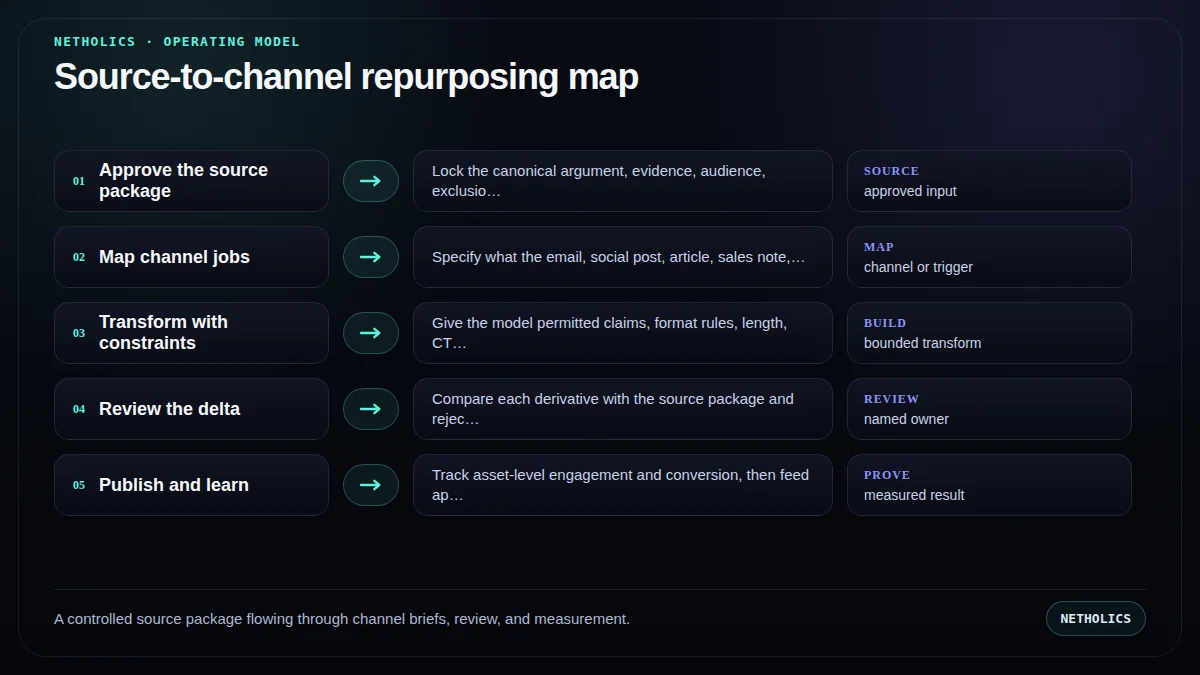
A practical launch runbook
Run the system manually before scheduling it. Automation should make a proven review process repeatable—not hide an undefined one.
- Choose one durable source. Use an asset with a clear audience, verified claims, and enough substance to support more than one channel.
- Create the claim ledger. Extract the statements that derivatives may repeat and attach the supporting URL or internal evidence.
- Write channel contracts. Define the reader, job, format, CTA, and words or claims that must not appear.
- Generate one channel first. Pilot the transformation on a single derivative before widening the fan-out.
- Run a source-delta review. Check meaning, numbers, product language, links, and CTA against the approved parent.
- Measure and prune. Keep assets that help the audience or pipeline; archive weak variants so volume does not become clutter.
A staged 30–60–90 rollout
Days 1–30: baseline and shadow mode. Complete the first runbook steps manually, record current review time and defect types, and let the workflow produce recommendations without writing to production. Compare every proposed action with a human decision.
Days 31–60: limited live pilot. Allow one narrow, reversible path to write only after approval. Cap weekly volume, keep the previous version, and review input acceptance, first-pass approval, and escaped defects. Do not widen scope to make a weak metric look better.
Days 61–90: controlled expansion. Add one adjacent use case only when the first path has stable ownership and a qualified outcome. Reuse the state model and logging, but write a fresh risk boundary for the new path.
After day 90: operate, do not merely launch. Assign maintenance, source revalidation, workflow-version review, and rollback testing. The best first workflow remains Approved webinar or guide → email summary → social explanation → human review.; expansion is earned by evidence rather than by schedule.
What authoritative sources add
Netholics comment: official guidance is a boundary, not a substitute for implementation judgment. The workflow still needs an accountable owner and a visible reason for every consequential transition.
Implementation checklist
- Name one canonical source package and accountable owner.
- Give every reusable claim a source or evidence reference.
- Define a distinct job and CTA for each channel.
- Forbid new factual claims unless they return to research review.
- Record parent source, workflow version, reviewer, and publish status.
- Compare derivatives against the parent before approval.
- Measure qualified outcomes and archive weak variants.
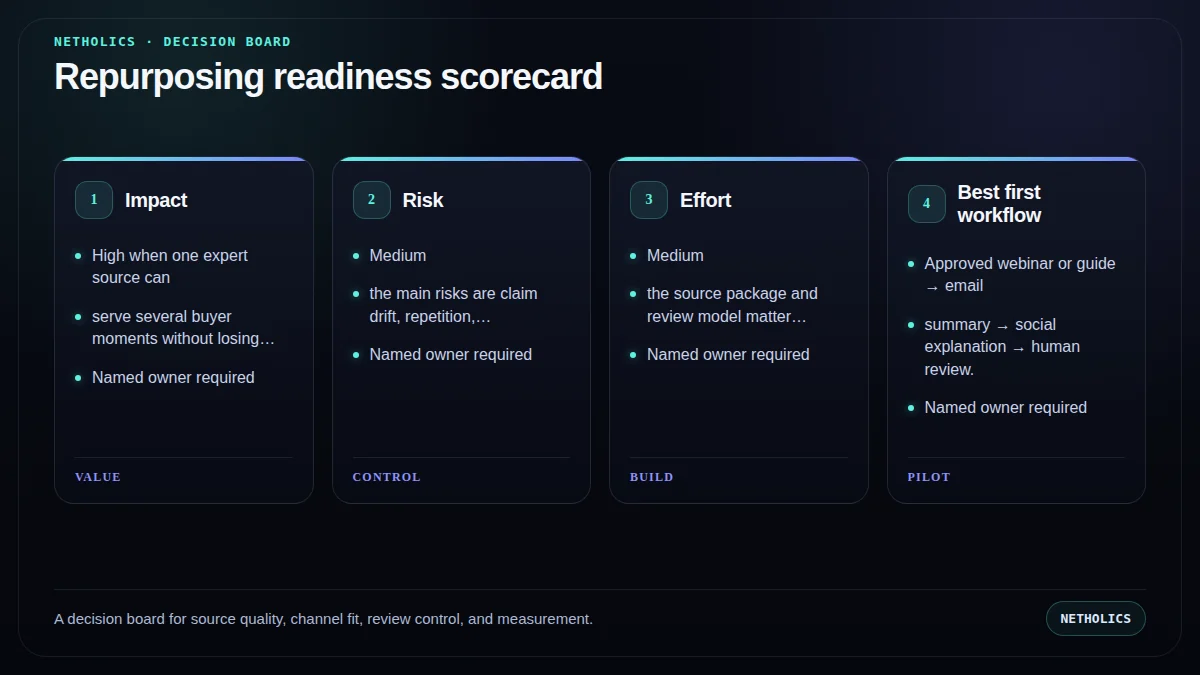
Automation readiness card
| Decision | Score |
|---|---|
| Impact | High when one expert source can serve several buyer moments without losing coherence. |
| Risk | Medium; the main risks are claim drift, repetition, and publishing low-value variants. |
| Effort | Medium; the source package and review model matter more than the generation node. |
| Best first workflow | Approved webinar or guide → email summary → social explanation → human review. |
| Do not automate yet | When the source is unverified, rapidly changing, legally sensitive, or owned by nobody. |
Frequently asked questions
Q: What is an AI content repurposing workflow?
It is a controlled process that transforms one approved source asset into channel-specific derivatives while preserving claims, evidence, ownership, and review history.
Q: Is content repurposing duplicate content?
Not when each derivative serves a distinct channel job and is rewritten for that audience. Copying the same text everywhere creates a weaker experience and should be avoided.
Q: Which source assets work best?
Durable webinars, research notes, expert interviews, service explanations, and long-form guides work well when their claims and sources have already been approved.
Q: Should AI publish every derivative automatically?
No. Start with draft generation and source-delta review. Automatic publishing should only follow repeated evidence that a narrow asset type is low risk.
Q: How do you measure a repurposing workflow?
Track qualified engagement and conversion by derivative, plus rejection reasons, review time, claim corrections, and which source packages create useful assets.
Q: How does this connect to SEO and GEO?
The workflow can turn approved expertise into search pages and answer-ready sections, but those outputs still need intent, evidence, internal links, and human editorial approval.
Verified sources and next steps
For related implementation detail, continue with AI Content Automation Agency, SEO Content Automation, AI SEO content brief workflow, SEO-safe AI content workflow.
Build the workflow before you scale the output
Netholics maps the source, state, review, WordPress, SEO, and GEO controls before automating production.