AI agent permission matrix: scope tool access before agents act
Scope what an AI agent can read, draft, write, send, delete, and escalate before it touches production systems.
The 60-second answer
- Scope what an AI agent can read, draft, write, send, delete, and escalate before it touches production systems.
- Use NIST-style governance language, OWASP-style threat thinking, and tool-call logs before giving an agent more autonomy.
- The safest first launch is narrow, logged, reversible, and human-approved.
The problem this solves
Most agent risk appears the moment the model can use tools. A prompt-only assistant can be wrong; a connected agent can update records, send messages, expose data, or trigger workflows. The permission matrix is the control layer that says what the agent may read, draft, write, send, delete, or escalate.
Do not start with a vendor demo. Start with the operating controls: what the agent may see, what it may do, what it must log, when it must stop, and who approves the next step. That keeps the system useful without pretending autonomy is free.
The workflow to build first
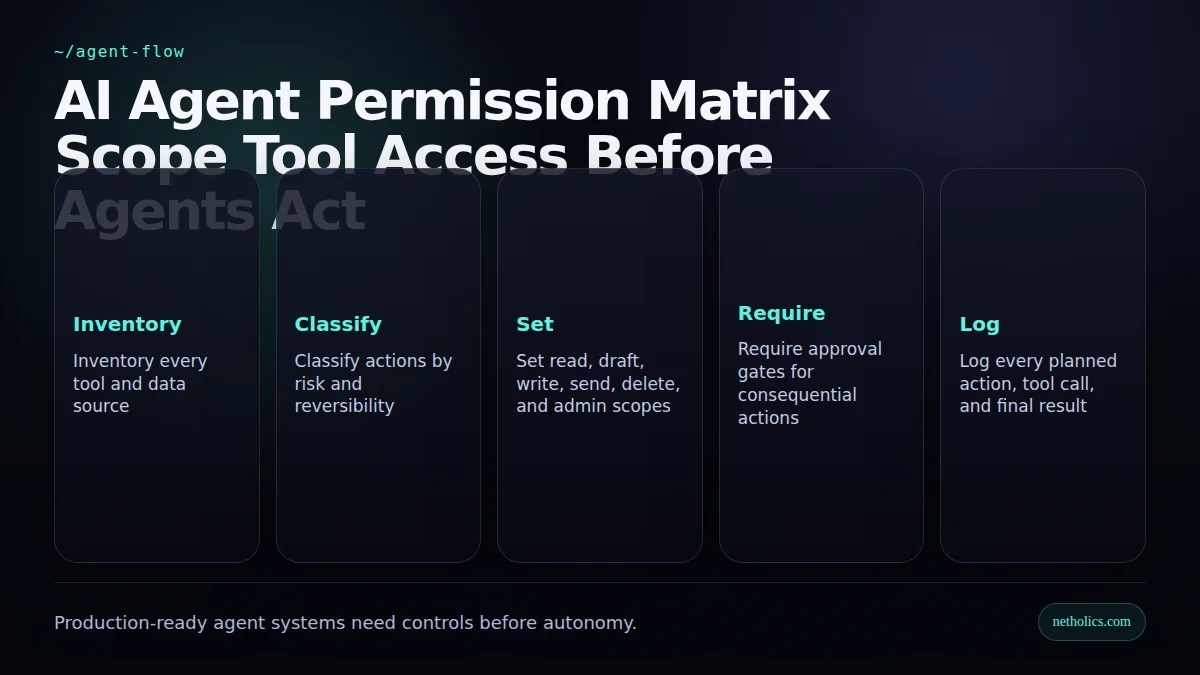
- Inventory every tool and data source. Use this as a control point before expanding autonomy.
- Classify actions by risk and reversibility. Use this as a control point before expanding autonomy.
- Set read, draft, write, send, delete, and admin scopes. Use this as a control point before expanding autonomy.
- Require approval gates for consequential actions. Use this as a control point before expanding autonomy.
- Log every planned action, tool call, and final result. Use this as a control point before expanding autonomy.
The practical control matrix
| Control | What it enables | Main risk | Safer default |
|---|---|---|---|
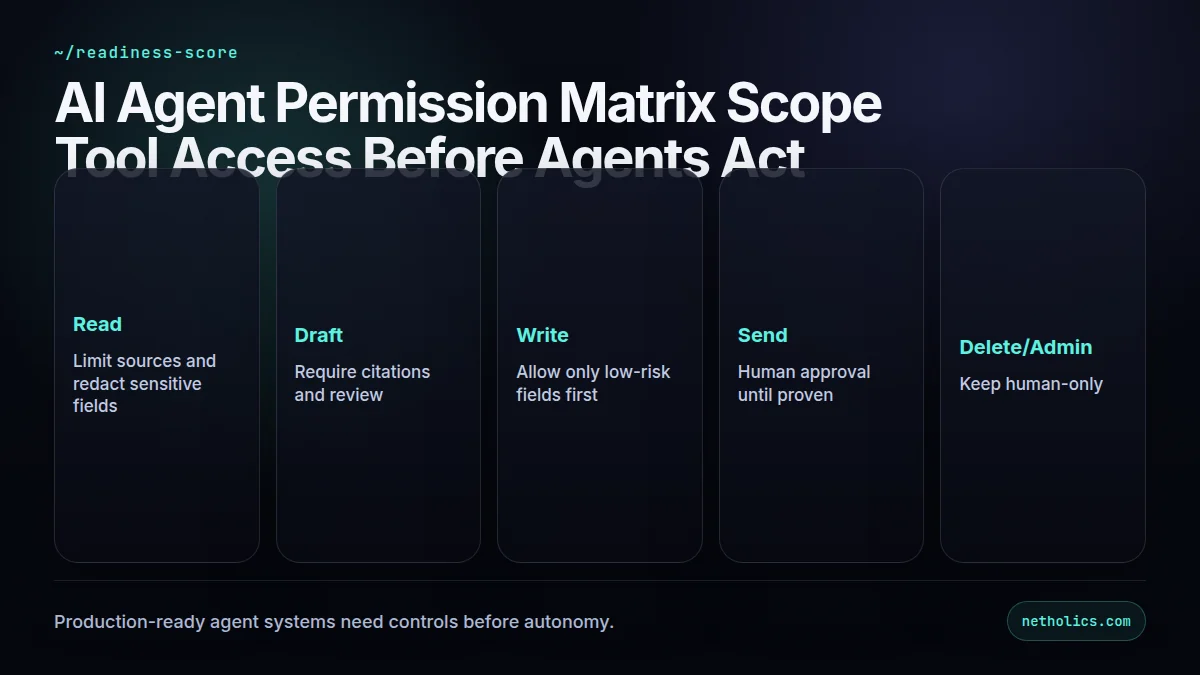
| Read | Allowed for approved knowledge and records | Data exposure through broad access | Limit sources and redact sensitive fields |
| Draft | Safe for responses, summaries, tickets | Confident wrong drafts | Require citations and review |
| Write | Useful for CRM or project updates | Bad state written to systems | Allow only low-risk fields first |
| Send | Customer-facing automation | Reputation and compliance risk | Human approval until proven |
| Delete/Admin | Usually too risky for early agents | Irreversible damage | Keep human-only |
Two diagrams to make the system operational
A launch runbook that avoids demo traps
Run the workflow manually first. If the manual version cannot create a better decision, the automated version will only create faster uncertainty. Keep the first launch narrow, record everything, and widen autonomy only after evidence accumulates.
- Scope the job. Define what success and failure look like in business terms.
- Connect one tool first. Prove the tool boundary before adding more integrations.
- Force review on risky actions. Customer-facing, financial, destructive, or sensitive actions need a human gate.
- Review logs weekly. Improve prompts, retrieval, permissions, and fallback paths from actual runs.
What other experts say
NIST, OWASP, OpenAI, Anthropic, and Google all point toward the same practical lesson: AI systems need mapped risks, constrained tool use, logged decisions, and secure lifecycle controls. The Netholics interpretation is simple: an agent is not production-ready until its permissions, tests, logs, fallbacks, and owners are visible.
Implementation checklist
- Name the workflow owner
- Define the allowed tools and actions
- Write the approval and stop conditions
- Test happy paths and failure paths
- Log decisions, tool calls, and final actions
- Review failed runs before widening autonomy
Should you build this now?
Build now if the workflow has clean inputs, a clear owner, narrow tool access, and a human approval point.
Wait if the source data is messy, the process is undocumented, or the agent would need broad write/delete/admin access to create value.
Frequently Asked Questions
Q: What is an AI agent permission matrix?
It is a table that defines which tools, data, and actions an agent can use, and which actions require human approval.
Q: Why not just give the agent full access?
Full access turns model mistakes into business-system mistakes. Start with least privilege and widen only after logs prove safety.
Q: Which permissions should always need approval?
Customer-facing sends, deletes, purchases, refunds, permission changes, financial actions, and sensitive data exports should start behind human approval.
Q: How often should permissions be reviewed?
Review after every workflow change, incident, new integration, or expansion of autonomy.
Verified sources
- NIST AI Risk Management Framework — risk governance, measurement, and trustworthy AI controls.
- NIST AI RMF 1.0 PDF — Map, Measure, Manage, Govern lifecycle language.
- OWASP Top 10 for LLM Applications — LLM-specific risks such as excessive agency, prompt injection, and data exposure.
- OpenAI function calling guide — tool/function calling and structured tool boundaries.
- Anthropic tool use documentation — tool use patterns and tool-result handling.
- Google Secure AI Framework — secure AI system controls and lifecycle posture.
Build safer AI agents
Netholics can audit the workflow, map permissions, connect tools, and design the first supervised agent build.