AI Automation for Insurance Agencies: Faster Service with Human Accountability
A practical agency workflow for moving requests and documents faster while keeping coverage interpretation, underwriting, claims decisions, adverse actions, and sensitive exceptions with authorized people.
The 60-second answer
- Use automation to capture, validate, classify, and route requests—not to decide coverage, underwriting, price, claims, eligibility, or adverse action.
- Separate customer-provided facts from extracted fields, inferred labels, carrier data, and approved agency decisions so provenance remains visible.
- Require human review for ambiguous documents, coverage questions, complaints, vulnerable customers, cancellations, claims, and any material mismatch.
- Measure first-pass completeness, routing accuracy, queue age, correction rate, complaint signals, and decision handoff quality rather than approval speed alone.
Begin with the decision boundary
Insurance agencies receive applications, endorsements, certificates, renewal questions, claims notices, carrier messages, and document attachments across many channels. Staff often copy data between portals and management systems, then chase missing fields.
A useful workflow can identify document type, extract bounded fields, compare required items, open a service task, and draft an acknowledgement. It should not silently convert an extraction or model score into a coverage interpretation, underwriting outcome, claim determination, or adverse customer action.
The agency also needs to know which party made each decision. Customer statements, carrier records, automation outputs, producer review, and final carrier or agency actions should not collapse into one unlabeled field.
A five-stage human-owned workflow
The same control pattern can support several operational queues without pretending that every decision is automatable. Each stage creates an inspectable record and can stop safely.
- Capture the request. Collect the minimum approved source fields and preserve who or what supplied them.
- Validate context. Confirm identity, record, scope, destination, required fields, and applicable policy state.
- Create reviewable work. Classify and transform into a draft task, packet, response, or exception without making the protected decision.
- Apply the human gate. Send consequential, sensitive, ambiguous, or low-confidence work to the named authorized owner.
- Record and improve. Preserve source, transformation version, reviewer, outcome, correction, and follow-up evidence.
Five workflows worth evaluating first
These are candidate operating patterns, not universal approvals. Start where the input is governed, the output is reviewable, and a named owner already manages the exception.
| Workflow | Bounded input | Automation role | Human gate | Operating measure |
|---|---|---|---|---|
| New-business intake | Customer-provided facts and approved application fields | Validate completeness, flag missing items, create producer task | Licensed or authorized staff review needs, representations and submission | Applications complete before carrier submission |
| Document triage | Inbound policy, certificate, endorsement or claim documents | Classify type and extract bounded fields with confidence | Staff verify document, customer, policy and requested action | Correct documents routed without reclassification |
| Policy service queue | Authenticated request and current policy context | Categorize request and propose task checklist | Authorized staff interpret coverage and approve changes | Service requests resolved without avoidable reopen |
| Renewal preparation | Policy dates, open tasks and approved account facts | Create renewal timeline and missing-information queue | Producer reviews exposure changes and client discussion | Renewal work started before internal deadline |
| Claims handoff | First-notice metadata and approved contact details | Create carrier/agency handoff record and acknowledgement | Authorized person handles coverage, claim guidance and escalation | Complete notices handed off with traceable owner |
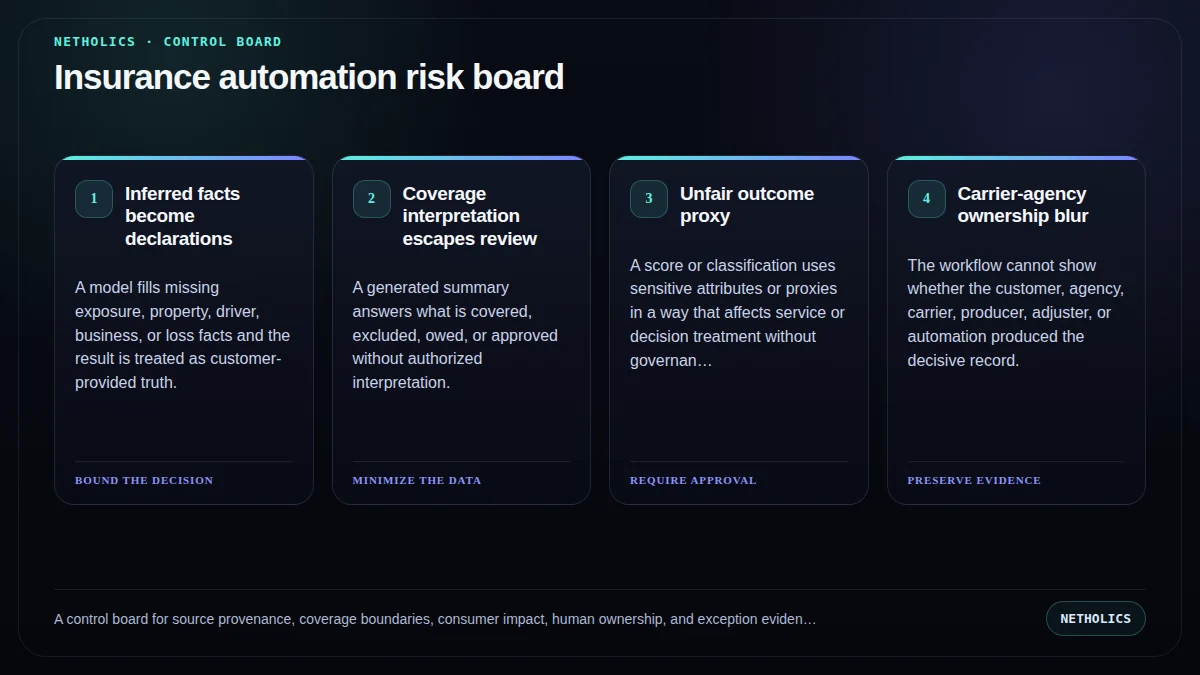
Four failures to design out
The primary risk is rarely a malformed prompt. It is an operating system that hides provenance, expands authority, or makes an exception look routine.
Inferred facts become declarations failure
A model fills missing exposure, property, driver, business, or loss facts and the result is treated as customer-provided truth.
Coverage interpretation escapes review failure
A generated summary answers what is covered, excluded, owed, or approved without authorized interpretation.
Unfair outcome proxy failure
A score or classification uses sensitive attributes or proxies in a way that affects service or decision treatment without governance.
Carrier-agency ownership blur failure
The workflow cannot show whether the customer, agency, carrier, producer, adjuster, or automation produced the decisive record.
Measure service quality, not the AI story
Lock definitions before the pilot. Segment clean-path work from exceptions and preserve the denominator, time window, owner, and correction history.
| Metric | Definition | Review use |
|---|---|---|
| First-pass submission completeness | Share of submissions with required customer-provided fields and documents before authorized review. | Open a diagnostic queue; do not convert the signal into an unsupported outcome claim. |
| Verified routing accuracy | Documents and requests accepted by the destination queue without material reclassification. | Open a diagnostic queue; do not convert the signal into an unsupported outcome claim. |
| Service queue age | Open authorized tasks by type, priority, owner, and customer dependency—not one blended average. | Open a diagnostic queue; do not convert the signal into an unsupported outcome claim. |
| Material correction and complaint signals | Extraction corrections, wrong-policy matches, coverage misunderstandings, complaints, and escalations linked to workflow state. | Open a diagnostic queue; do not convert the signal into an unsupported outcome claim. |
A minimal control record
Keep source facts, automation output, human decisions, and final system state separate. The record should be understandable after the model, vendor, staff member, or interface changes.
workflow: insurance-service-intake
record_layers: [customer_statement, extracted_field, agency_review, carrier_record, final_action]
prohibited_actions: [coverage_interpretation, underwriting_decision, claim_decision, adverse_action]
human_gate:
  owner: authorized-agency-staff
  required_before: [submission, policy_change, coverage_reply, claim_guidance]
exceptions: [identity_mismatch, low_confidence, complaint, cancellation, sensitive_data]
audit: [source, layer, timestamp, reviewer, destination, outcome]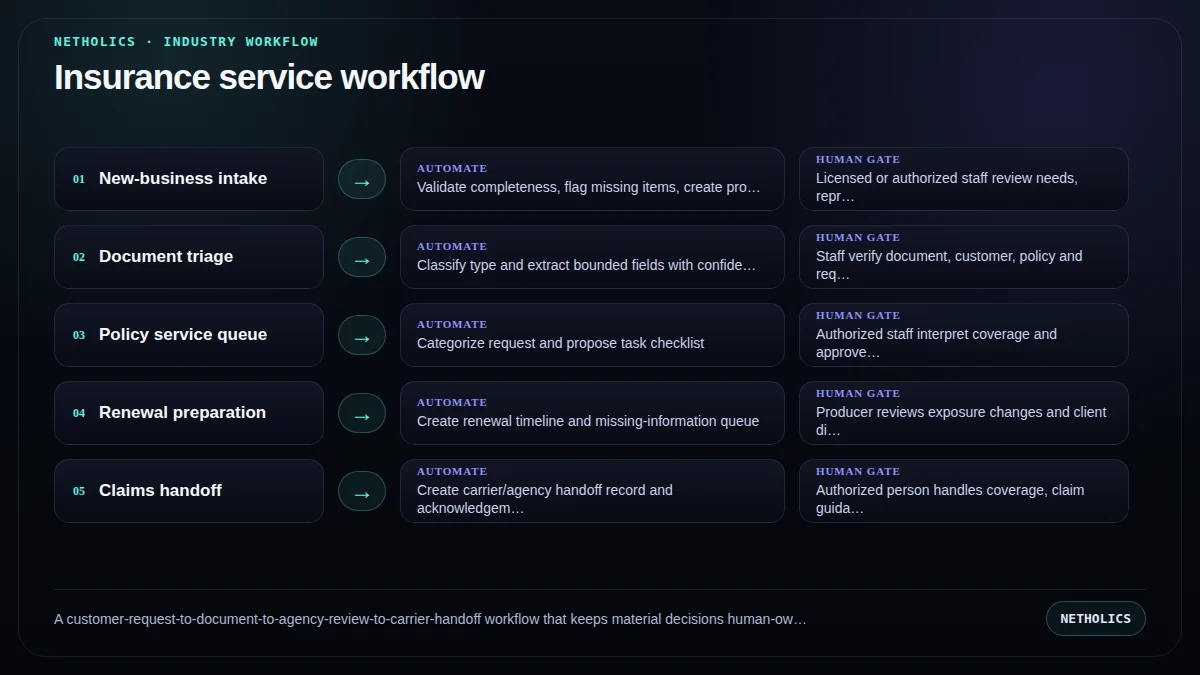
A practical implementation runbook
- Name the protected decision. Write what the system must never decide, send, change, approve, or suppress autonomously.
- Map data and authority. Inventory source systems, sensitive fields, identities, credentials, vendors, destinations, retention, and write permissions.
- Choose one bounded queue. Start with one certificate or endorsement intake route that validates required fields, creates an agency-management task, and drafts an acknowledgement without interpreting coverage or executing a change.
- Build exception-first. Define identity mismatch, missing data, conflict, low confidence, sensitive content, urgency, and policy exception routes before the clean path.
- Run in shadow mode. Compare proposed classifications and drafts with the existing process; record corrections without letting the workflow act.
- Approve a narrow production scope. Allow only the tested inputs, destinations, actions, owners, hours, volumes, and rollback conditions.
- Review evidence monthly. Inspect corrections, complaints, access failures, exceptions, policy changes, and whether the workflow still solves the original queue problem.
A staged 30–60–90 rollout
Days 1–30: map and baseline. Document the current queue, protected decisions, source systems, data classes, owners, failure paths, service times, and correction history. Test access and deletion before connecting production records.
Days 31–60: shadow the workflow. Let the system create proposed classifications, packets, tasks, or drafts while people continue the existing process. Compare every disagreement and repair policy, data, or routing before tuning prompts.
Days 61–90: release one bounded action. The recommended pilot is one certificate or endorsement intake route that validates required fields, creates an agency-management task, and drafts an acknowledgement without interpreting coverage or executing a change. Keep sending, record changes, consequential decisions, and material exceptions behind approval.
After day 90: expand by evidence. Add one queue, role, destination, or action at a time. Reassess vendor access, model behavior, policy, data, and rollback whenever the authority boundary changes.
What primary sources actually support
Netholics boundary: official material defines regulatory, privacy, security, or governance context. It does not certify this article, approve a vendor, or replace qualified sector-specific review.
Implementation checklist
- A named business owner and qualified policy reviewer approve the scope.
- The protected decisions and prohibited autonomous actions are explicit.
- Source, inferred, reviewed, and final values remain distinguishable.
- Sensitive fields, identities, roles, credentials, retention, and vendor access are mapped.
- Every consequential or low-confidence path has a tested human escalation.
- Draft, approval, send, system-change, and exception states are visibly different.
- Logs contain enough evidence to investigate without copying unnecessary sensitive data.
- The pilot has a baseline, rollback trigger, correction metric, and review date.
Automation readiness card
| Decision | Assessment |
|---|---|
| Impact | High when a repetitive queue delays customers, staff, records, or downstream work and already has a responsible owner. |
| Risk | High when the workflow touches sensitive data, protected decisions, vulnerable people, safety, money, rights, or external communications. |
| Effort | Medium to high; integration is often easier than data classification, authority design, exception handling, supervision, and evidence retention. |
| Best first workflow | One certificate or endorsement intake route that validates required fields, creates an agency-management task, and drafts an acknowledgement without interpreting coverage or executing a change. |
| Do not automate yet | When policy ownership, source-of-truth records, identity, escalation, access, or rollback cannot be demonstrated. |
Frequently asked questions
Q: What insurance agency workflows are good first candidates?
Start with intake completeness, bounded document classification, task creation, renewal timelines, and approved acknowledgements rather than coverage or claims decisions.
Q: Can AI interpret a policy for a customer?
This playbook keeps coverage interpretation, exclusions, claims guidance, and material customer decisions with authorized people.
Q: How should extracted document data be stored?
Keep the source document, extracted value, confidence or exception state, reviewer, correction, and final approved record distinguishable.
Q: Can the workflow make underwriting decisions?
Not in this playbook. Underwriting, pricing, eligibility, claims, and adverse actions require the applicable carrier, agency, regulatory, and human decision controls.
Q: Which metrics should an agency use?
Track first-pass completeness, verified routing accuracy, queue age, rework, wrong-policy matches, complaints, and material corrections.
Q: Why is jurisdiction important?
Insurance requirements and AI expectations vary by state, product, role, and carrier arrangement. The agency should map the rules and approvals that apply to its actual workflow.
Verified sources and next steps
Continue with AI Automation Agency, AI Systems Audit, AI document processing workflow, AI automation governance policy, Human-in-the-loop AI workflow.
Turn one operating queue into a controlled automation pilot
Netholics maps the data, authority, human gates, integrations, evidence, and rollout needed to automate without hiding risk.