AI Crawler Log Analysis Workflow: Prove What Bots Can Access
Turn raw CDN or server requests into verified evidence about which search and AI crawlers reach the site, what they request, what the server returns, and which failures deserve action.
The 60-second answer
- Collect a bounded log window from the CDN, reverse proxy, or origin before buying another visibility tool.
- Treat a user-agent string as a claim; verify published IP or reverse-DNS guidance where the crawler provides it.
- Group requests by verified bot, canonical URL, response class, content type, and time instead of reading individual lines.
- Turn blocked, redirected, throttled, or wasteful patterns into an owned remediation queue and recheck after changes.
Why this needs a controlled evidence workflow
Robots files and crawler documentation describe intended access, but they do not prove what reached the production edge. A bot may request the wrong hostname, hit a redirect chain, receive a challenge page, fetch an obsolete path, or never appear during the observed window.
Log analysis closes that evidence gap. It also creates a security obligation: user-agent strings are easy to copy, IP data is sensitive operational telemetry, and one short sample cannot prove universal crawler behavior. The workflow must preserve uncertainty and separate verified identities from unverified traffic.
This article focuses on request evidence. The structured-data guide covers what machines can read inside a page; this workflow establishes whether a crawler actually requested that page and what response it received.
The crawler evidence workflow operating model
Use five bounded stages. Each stage produces inspectable evidence before the workflow advances, and uncertainty remains visible instead of being converted into a confident score.
- Define the observation window. Choose the hostnames, dates, log source, privacy boundary, and crawler families included in the audit.
- Normalize requests. Parse timestamp, host, path, query, status, bytes, user agent, edge action, and source network into one record.
- Verify identity. Classify published crawler identities separately from user-agent-only matches and unknown automated traffic.
- Aggregate evidence. Summarize canonical paths, response classes, frequency, recency, wasted requests, and high-value omissions.
- Remediate and recheck. Assign a narrow owner, change one control, preserve the baseline, and compare a later log window.
Evidence controls that keep reporting honest
Keep the record small enough to operate and specific enough to audit. The table separates observations from conclusions so a dashboard cannot silently upgrade weak evidence.
| Evidence field | Useful question | Unsafe conclusion |
|---|---|---|
| Verified identity | Does the request satisfy the crawler's published verification method? | The user-agent name proves who sent it |
| Canonical path and host | Did the bot request the preferred URL and production hostname? | Any request means the canonical page was understood |
| Response and edge action | Was the response 200, redirect, blocked, challenged, throttled, or errored? | A 200 alone proves useful extraction |
| Window and frequency | How often did verified requests occur during this sample? | No request in a short window means permanent exclusion |
Four failure modes to design out
Technical validity is not the same as evidential validity. Review these patterns during every pilot and after any collection or methodology change.
Trusting the label failure
A named user agent is accepted as identity without IP or reverse-DNS verification where official guidance supports it.
Mixing host variants failure
Requests to staging, apex, www, HTTP, and legacy paths are blended into one optimistic crawl count.
Counting without context failure
A chart celebrates request volume while hiding blocked responses, challenge pages, redirects, or low-value assets.
Overclaiming absence failure
A crawler is missing from a short sample and the report declares the site permanently invisible to that system.
Measure the layer, not the story
Choose definitions before collecting results. Preserve the numerator, denominator, dates, cohort, exclusions, and collection version so a later reviewer can reproduce the interpretation.
| Metric | Measure | Guardrail |
|---|---|---|
| Verified crawler coverage | Share of named crawler requests that pass the documented verification method. | Never infer a stronger downstream result than this evidence supports. |
| Successful canonical fetch rate | Verified requests to preferred HTML URLs returning the intended response without challenge or avoidable redirect. | Never infer a stronger downstream result than this evidence supports. |
| High-value error count | Verified requests to priority URLs ending in 4xx, 5xx, blocked, or throttled states. | Never infer a stronger downstream result than this evidence supports. |
| Remediation confirmation | Findings whose expected change is visible in a comparable post-change log window. | Never infer a stronger downstream result than this evidence supports. |
Trend movement should open a diagnostic queue, not trigger automatic copy changes or unsupported commercial claims.
A minimal evidence record
This platform-neutral record can live in a warehouse, workflow payload, spreadsheet, or repository. Store enough context to distinguish an observation from an assumption and to re-run the check.
audit_window:
  source: edge-logs
  start: 2026-07-01T00:00:00Z
  end: 2026-07-08T00:00:00Z
  hosts: [www.netholics.com]
request_record:
  crawler_claim: GPTBot
  identity_state: verify_before-attribution
  canonical_path: /example-guide/
  status: 200
  edge_action: allow
  evidence_retention: 30-days
  owner: technical-seo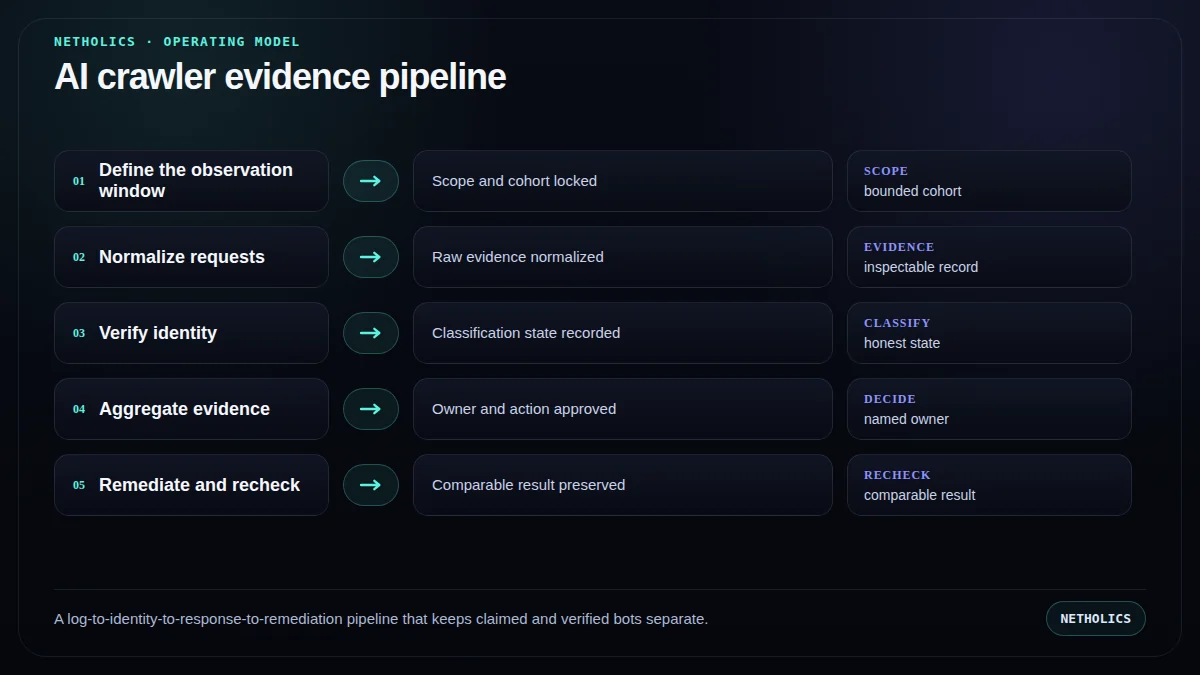
A practical launch runbook
Run the first cycle manually or in shadow mode. Automate collection only after definitions, ownership, exceptions, and review decisions produce a useful operating record.
- Select a trustworthy log source. Prefer edge or origin logs with timestamps, host, path, status, user agent, and action; document missing fields.
- Protect sensitive telemetry. Limit access, minimize retained IP data, and store only what the audit needs.
- Build a crawler registry. Link each named crawler to current official documentation and its available verification method.
- Normalize canonical URLs. Separate hostname, path, query, redirect target, and content type so variants do not fragment the result.
- Prioritize consequential findings. Fix high-value 4xx/5xx, accidental blocks, challenge loops, and repeated obsolete paths before cosmetic anomalies.
- Re-sample after change. Use the same fields and comparable window; record what changed and what remains unknown.
A staged 30–60–90 rollout
Days 1–30: establish definitions and baseline. Lock the initial scope, collect one manual evidence set, document blind spots, and compare the report with what operators already know. Do not publish a trend before the cohort and rules are stable.
Days 31–60: automate collection in shadow mode. Let the workflow normalize records and propose classifications while a named reviewer compares exceptions with raw evidence. Track disagreements and repair the definitions rather than forcing every row into a category.
Days 61–90: open one controlled action queue. Allow the report to create narrow tickets with owners, expected results, and rollback or recheck steps. Keep production changes behind approval.
After day 90: govern method changes. Version tools, rules, cohorts, and source changes. The best first workflow remains Seven-day edge-log sample → verified crawler matrix → high-value response-code remediation.; expansion is earned by reproducibility and useful decisions.
What primary sources actually support
Netholics boundary: official documentation defines capabilities, fields, or recommended practices. It does not guarantee ranking, citation, complete attribution, or revenue. Preserve those distinctions in every report.
Implementation checklist
- Record the exact log source and observation window.
- Minimize sensitive network data and restrict access.
- Keep verified, claimed, and unknown identities separate.
- Normalize hostnames, canonical paths, response classes, and edge actions.
- Distinguish discovery evidence from extraction or citation claims.
- Create an owner and expected result for each remediation.
- Repeat the same report after material access changes.
Automation readiness card
| Decision | Assessment |
|---|---|
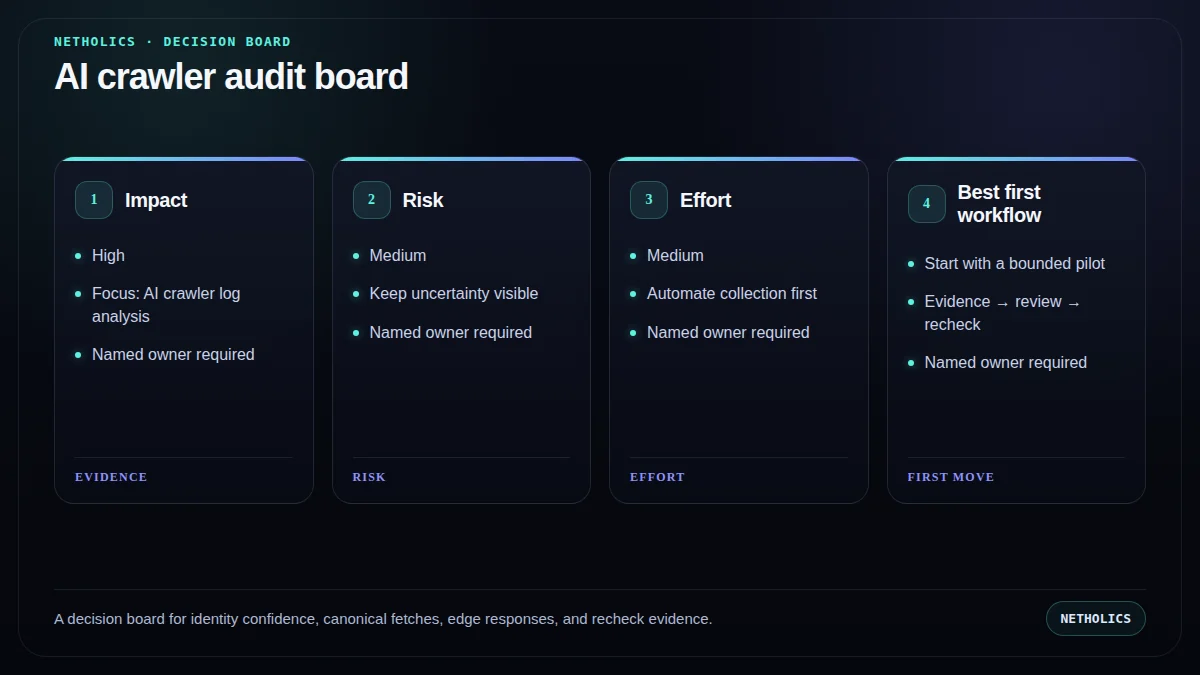
| Impact | High when crawl controls, migrations, CDN rules, or visibility claims need production evidence. |
| Risk | Medium; copied user agents and sensitive log fields can create false attribution or privacy problems. |
| Effort | Medium; parsing is straightforward, but identity verification and interpretation require care. |
| Best first workflow | Seven-day edge-log sample → verified crawler matrix → high-value response-code remediation. |
| Do not automate yet | When log retention, access approval, canonical hostnames, or bot-verification rules are undefined. |
Frequently asked questions
Q: What is AI crawler log analysis?
It is the process of using CDN, reverse-proxy, or origin request logs to examine claimed and verified AI/search crawler access, requested URLs, responses, frequency, and edge actions.
Q: Can I identify a crawler from its user agent?
A user agent is useful for discovery but can be spoofed. Use the crawler operator's current published verification method when available and keep unverified claims separate.
Q: Does a crawler request mean my page was cited?
No. A request proves only that the server handled a request. It does not prove successful extraction, indexing, use in an answer, citation, or ranking.
Q: How long should the observation window be?
Use a window long enough to include normal crawl variation and compare it with the site's size and update cadence. State the dates rather than presenting one interval as universal behavior.
Q: Which errors should be fixed first?
Prioritize verified requests to commercially or editorially important canonical pages that receive 4xx, 5xx, challenge, block, throttling, or avoidable redirect responses.
Q: How does this support GEO?
It gives GEO teams production evidence about machine access, allowing content and entity work to be separated from delivery failures.
Verified sources and next steps
Continue with Generative Engine Optimization, AI Systems Audit, Entity consistency audit, AI search measurement framework, Structured data for LLM crawlers, GEO readiness checklist.
Turn AI search claims into auditable operations
Netholics connects crawler evidence, entity facts, sourceable content, analytics, and accountable review into one measurable GEO system.