Entity Consistency Audit for AI Search: Govern the Facts
Create one governed fact set for the organization, people, services, locations, and identifiers—then reconcile every page, schema graph, profile, and directory that repeats those facts.
The 60-second answer
- Define the entity before auditing pages: legal name, public brand, canonical URL, descriptions, services, people, locations, and stable identifiers.
- Record where each fact is asserted across visible copy, JSON-LD, author pages, social profiles, directories, and commercial pages.
- Classify differences as legitimate context, stale data, unsupported expansion, or direct contradiction.
- Fix the authoritative source first, then update dependent surfaces and verify the rendered graph rather than editing snippets independently.
Why this needs a controlled evidence workflow
Entity consistency is often reduced to copying the same business name into every schema field. Real inconsistency is harder: service labels drift, locations remain after an office closes, an author has multiple bios, social profiles use outdated descriptions, and page copy contradicts structured data.
AI and search systems do not publish a simple consistency score that guarantees visibility. The defensible goal is operational: reduce contradictory public facts, make ownership explicit, preserve contextual variation where it is truthful, and give machines and people clearer evidence about who the organization is and what it does.
This is a fact-governance workflow, not another schema tutorial. The structured-data post explains markup patterns; this audit reconciles the facts that visible copy and markup are allowed to assert.
The entity consistency audit operating model
Use five bounded stages. Each stage produces inspectable evidence before the workflow advances, and uncertainty remains visible instead of being converted into a confident score.
- Create the entity ledger. Define canonical facts, owners, evidence, allowed variants, effective dates, and review cadence.
- Map assertion surfaces. Inventory home, about, service, location, author, schema, profile, directory, and partner records.
- Detect discrepancies. Compare exact values and meaning; separate harmless wording differences from stale or contradictory claims.
- Approve corrections. Resolve the authoritative fact with the accountable owner before editing dependent surfaces.
- Publish and verify. Update in dependency order, render the public graph, and retain an audit record for later changes.
Evidence controls that keep reporting honest
Keep the record small enough to operate and specific enough to audit. The table separates observations from conclusions so a dashboard cannot silently upgrade weak evidence.
| Entity fact | Authoritative record | Common conflict |
|---|---|---|
| Organization identity | Legal/public name, canonical URL, logo, founding facts, owner | Brand variants presented as separate organizations |
| Service catalog | Approved service name, scope, audience, canonical page | Old offers or inflated capabilities repeated in profiles |
| People and authors | Canonical bio, role, profile URL, credentials, effective dates | Different titles or unsupported expertise across articles |
| Locations and contact | Current address/area served, phone, email, opening/closing dates | Closed locations and legacy contact details remaining public |
Four failure modes to design out
Technical validity is not the same as evidential validity. Review these patterns during every pilot and after any collection or methodology change.
Schema becomes the truth failure
The team updates JSON-LD while visible pages and real business records remain contradictory.
Every wording change is an error failure
The audit creates noise by rejecting truthful context-specific descriptions that preserve the same fact.
Unsupported facts spread faster failure
Automation fills empty properties with inferred awards, locations, expertise, or relationships that nobody approved.
No change trigger exists failure
The initial spreadsheet becomes stale because service, people, and location changes do not reopen dependent records.
Measure the layer, not the story
Choose definitions before collecting results. Preserve the numerator, denominator, dates, cohort, exclusions, and collection version so a later reviewer can reproduce the interpretation.
| Metric | Measure | Guardrail |
|---|---|---|
| Critical contradiction count | Unresolved conflicts affecting identity, service scope, people, locations, or canonical URLs. | Never infer a stronger downstream result than this evidence supports. |
| Owned assertion coverage | Share of high-value assertions with a canonical fact, evidence, and accountable owner. | Never infer a stronger downstream result than this evidence supports. |
| Repair propagation time | Time from canonical fact approval to verified updates across controlled dependent surfaces. | Never infer a stronger downstream result than this evidence supports. |
| Recurrence rate | Previously corrected facts that drift again because templates, integrations, or ownership remain broken. | Never infer a stronger downstream result than this evidence supports. |
Trend movement should open a diagnostic queue, not trigger automatic copy changes or unsupported commercial claims.
A minimal evidence record
This platform-neutral record can live in a warehouse, workflow payload, spreadsheet, or repository. Store enough context to distinguish an observation from an assumption and to re-run the check.
entity:
  id: org-netholics
  canonical_url: https://www.netholics.com/
  public_name: Netholics Media
  facts:
    service_geo:
      value: Generative Engine Optimization
      owner: commercial
      source: /generative-engine-optimization/
      allowed_variants: [GEO]
      reviewed_on: 2026-07-14
assertions:
  - surface: organization-schema
    state: match
  - surface: partner-profile
    state: stale-review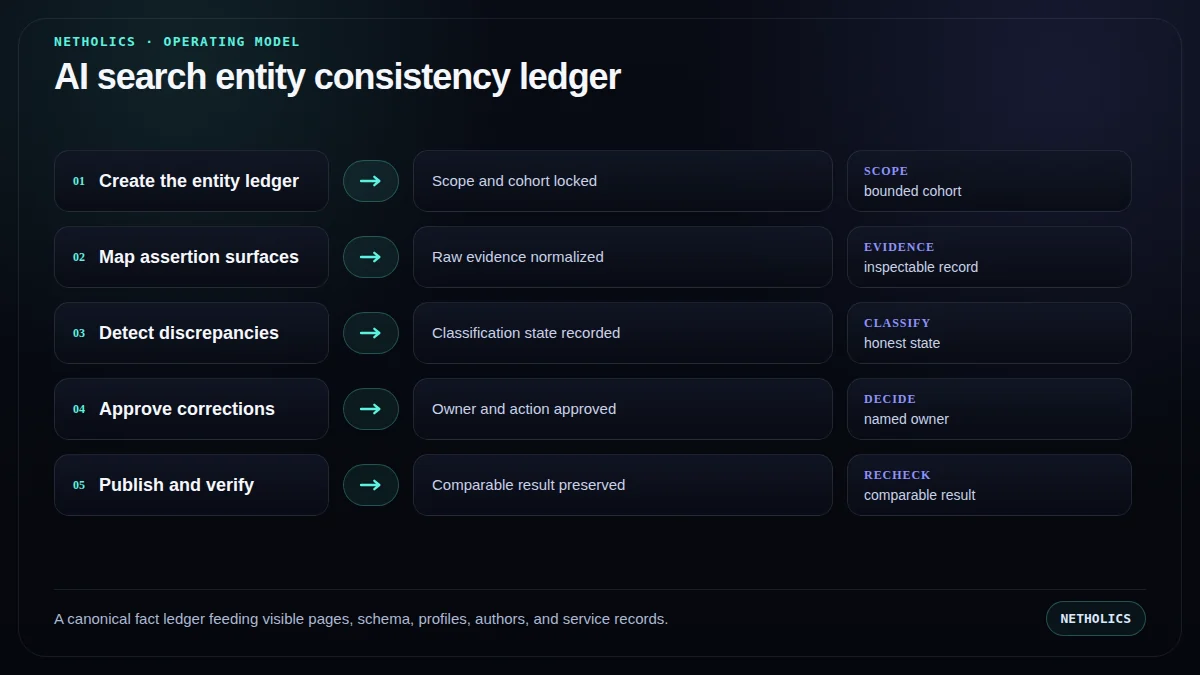
A practical launch runbook
Run the first cycle manually or in shadow mode. Automate collection only after definitions, ownership, exceptions, and review decisions produce a useful operating record.
- Choose one entity scope. Start with the organization and its highest-value services instead of crawling every mention at once.
- Name fact owners. Assign legal, brand, commercial, people, and location facts to accountable roles.
- Capture rendered assertions. Store the public URL, visible text or JSON-LD value, retrieval date, and relevant entity property.
- Classify semantic differences. Do not flag every paraphrase; flag changed meaning, stale dates, false precision, and unsupported claims.
- Repair upstream first. Update the canonical source and templates before one-off downstream copies to reduce recurrence.
- Re-crawl and monitor. Verify public copy and schema after cache purge, then trigger review when canonical facts change.
A staged 30–60–90 rollout
Days 1–30: establish definitions and baseline. Lock the initial scope, collect one manual evidence set, document blind spots, and compare the report with what operators already know. Do not publish a trend before the cohort and rules are stable.
Days 31–60: automate collection in shadow mode. Let the workflow normalize records and propose classifications while a named reviewer compares exceptions with raw evidence. Track disagreements and repair the definitions rather than forcing every row into a category.
Days 61–90: open one controlled action queue. Allow the report to create narrow tickets with owners, expected results, and rollback or recheck steps. Keep production changes behind approval.
After day 90: govern method changes. Version tools, rules, cohorts, and source changes. The best first workflow remains Organization + five core services → assertion matrix → contradiction repair → rendered verification.; expansion is earned by reproducibility and useful decisions.
What primary sources actually support
Netholics boundary: official documentation defines capabilities, fields, or recommended practices. It does not guarantee ranking, citation, complete attribution, or revenue. Preserve those distinctions in every report.
Implementation checklist
- Assign stable IDs to the organization, people, services, and locations.
- Record canonical facts, evidence, owner, effective date, and allowed variants.
- Inventory visible copy and structured assertions separately.
- Classify contradictions by business and search impact.
- Resolve the authoritative fact before editing dependent surfaces.
- Verify rendered JSON-LD and visible copy after deployment.
- Trigger a new audit when services, people, names, or locations change.
Automation readiness card
| Decision | Assessment |
|---|---|
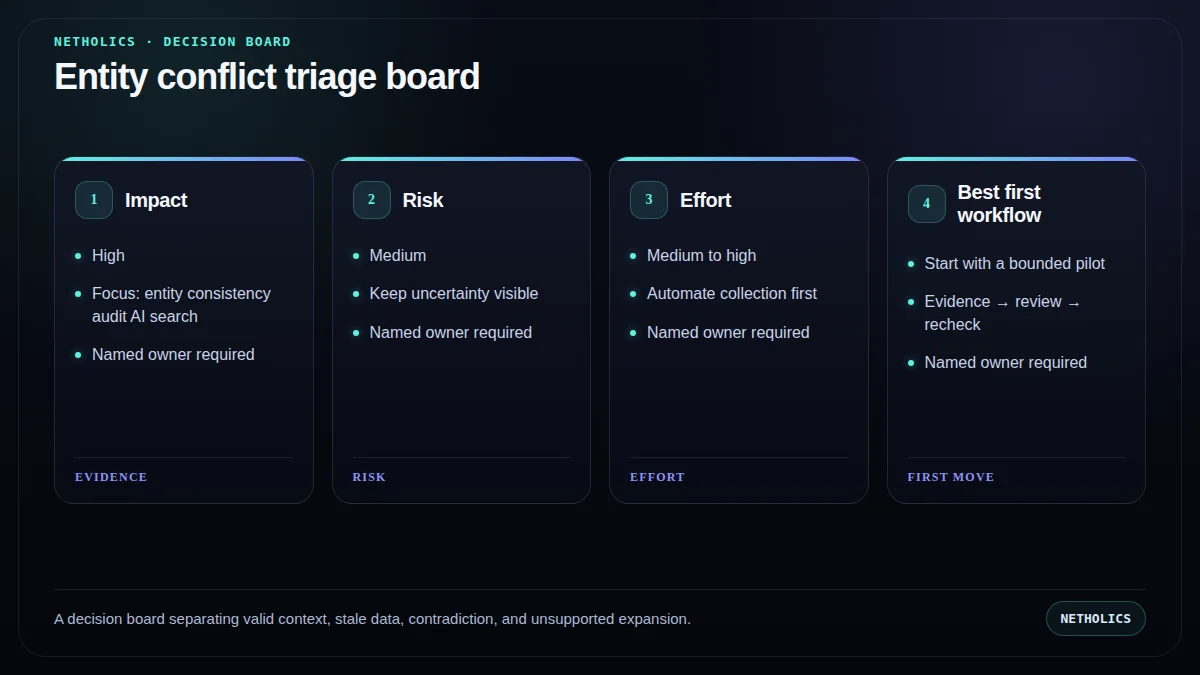
| Impact | High when the brand, services, authors, or locations are repeated across many controlled and third-party surfaces. |
| Risk | Medium; aggressive normalization can erase legitimate context or publish unsupported identity claims. |
| Effort | Medium to high; collecting assertions is easy, but resolving ownership and third-party records takes time. |
| Best first workflow | Organization + five core services → assertion matrix → contradiction repair → rendered verification. |
| Do not automate yet | When canonical facts, legal/brand ownership, or approved service scope are disputed. |
Frequently asked questions
Q: What is an entity consistency audit for AI search?
It is a controlled comparison of organization, person, service, location, and identifier facts across visible pages, structured data, profiles, and other public assertion surfaces.
Q: Does every description need identical wording?
No. Contextual wording can vary while preserving the same underlying fact. The audit should target contradictions, stale information, false precision, and unsupported additions.
Q: Is schema enough to establish an entity?
No. Structured data is one assertion surface. It should align with visible, supportable information and the site's canonical entity records.
Q: Which facts should be audited first?
Start with organization name and URL, core services, key people and authors, locations, contact details, and stable profile identifiers.
Q: How often should the audit run?
Run it after material changes and on a risk-based cadence. Service launches, rebrands, role changes, office changes, mergers, and profile migrations are strong triggers.
Q: How does consistency help GEO?
Clear, non-contradictory facts improve the evidence available to systems summarizing the business, but consistency alone does not guarantee citation or ranking.
Verified sources and next steps
Continue with Generative Engine Optimization, GEO Content Automation, AI crawler log analysis, AI citation readiness checklist, Structured data for LLM crawlers, GEO readiness checklist.
Turn AI search claims into auditable operations
Netholics connects crawler evidence, entity facts, sourceable content, analytics, and accountable review into one measurable GEO system.