WordPress AI Publishing Workflow: Draft, Review, Approve, Index
Treat AI publishing as a state machine: source-backed draft, public noindex review, named approval, technical QA, explicit index release, and a reversible post-publish record.
The 60-second answer
- Separate authoring status from search visibility; a public review URL does not need to be indexable.
- Use explicit states and transition requirements instead of one ambiguous Publish button.
- Store the approver, content hash or version, QA result, and index decision.
- Never let a model silently move its own draft from generation to index.
Why this needs a controlled workflow
A WordPress workflow becomes dangerous when generation, publication, and indexation collapse into one action. A valid API request can create a polished-looking page that has not been fact-checked, visually reviewed, linked, assigned correctly, or tested on mobile.
The fix is not another prompt. It is a publication state machine with named owners and observable transitions. WordPress post status, Yoast robots metadata, review URLs, revision history, workflow logs, and cache verification each represent a different control.
This is where AI Content Automation Agency work differs from generic generation: the workflow owns evidence, state, review, and the next safe action.
The publishing workflow operating model
The system has five bounded stages. Each stage produces an inspectable artifact before the workflow advances.
- Assemble source artifacts. Lock the brief, approved claims, internal links, schema, media, and owner before deployment.
- Create a draft record. Write the post with comments and pings closed, correct author/category, and no automatic index release.
- Open public noindex review. Use a shareable canonical URL when needed, but keep robots noindex, follow until review passes.
- Approve exact version. Record who approved the visible copy, schema, links, images, and responsive rendering.
- Release and monitor. Flip index explicitly, flush caches, check the sitemap/public head, and preserve rollback evidence.
Controls that keep automation honest
Use the control table to separate evidence and state from generated prose. The goal is not more fields; it is a small record that makes unsafe shortcuts visible.
| State | Required evidence | Allowed next action |
|---|---|---|
| Source ready | Brief, claims, sources, links, media concept, owner | Generate controlled draft |
| Draft | Valid HTML/schema, author/category, no markers | Deploy to review |
| Public review | Noindex, canonical, desktop/mobile screenshots, link checks | Approve or return to draft |
| Indexable | Named approval, sitemap/schema/robots pass, rollback copy | Monitor or patch through a new review |
Four failure modes to design out
A useful workflow can still fail when the sequence is technically valid but operationally unowned. Watch for these four patterns during the pilot.
Input not approved
The automation begins before assemble source artifacts is complete. The system then scales ambiguity: reviewers correct facts, audience, and scope downstream even though those decisions belonged at intake. Make the first-stage artifact a hard requirement, not an optional prompt field.
Volume becomes the KPI
Teams count generated drafts or updated records because output is easy to measure. That rewards activity even when the work is rejected, creates no qualified response, or makes the content estate harder to maintain. Measure accepted work and useful outcomes instead.
Review has no owner
An approval node does not create accountability by itself. Name who can approve, what evidence they must see, which defects return the item, and how long a pending review may wait before escalation. Otherwise the gate becomes a ceremonial click.
No safe rollback
The workflow changes WordPress, media, metadata, or source records without preserving the previous state. A later problem becomes an emergency reconstruction. Store the prior version, workflow input, approval record, and affected URLs before every consequential write.
Measure the system, not just the output
Choose a small metric set before launch. Capture the baseline manually, then compare the automated path against the same definition. This prevents faster production from being mistaken for better operations.
| Metric | Measure | Interpretation |
|---|---|---|
| Input acceptance rate | Share of candidates that arrive with the source, owner, scope, and required fields complete. | Low acceptance means the workflow is compensating for a broken intake process. |
| First-pass approval rate | Share of generated items approved without factual, structural, or brand correction. | Track rejection reasons separately; a single percentage cannot show what to fix. |
| Defect escape rate | Published items later corrected for unsupported claims, broken media, wrong state, links, or metadata. | Count escaped defects even when a customer never reports them. |
| Qualified outcome | High for teams publishing repeatedly through WordPress and AI-assisted workflows. | Tie the workflow to the reader, search, operational, or commercial job it was built to improve. |
Review these metrics by workflow version and content type. If results are blended together, a high-volume low-risk path can hide failures in a smaller but commercially important path.
A minimal control record
This example is intentionally platform-neutral. Store equivalent fields in a database, spreadsheet, CMS record, or workflow payload so the decision survives beyond one prompt.
publishing_state:
  slug: example-guide-2026
  status: public_review
  robots: noindex_follow
  source_commit: required
  checks:
    hard_gate: pass
    schema_parity: pass
    internal_links: pass
    desktop_mobile: pending
  approval:
    owner: Andrew
    approved_version: null
  next_transition: index_release_after_approval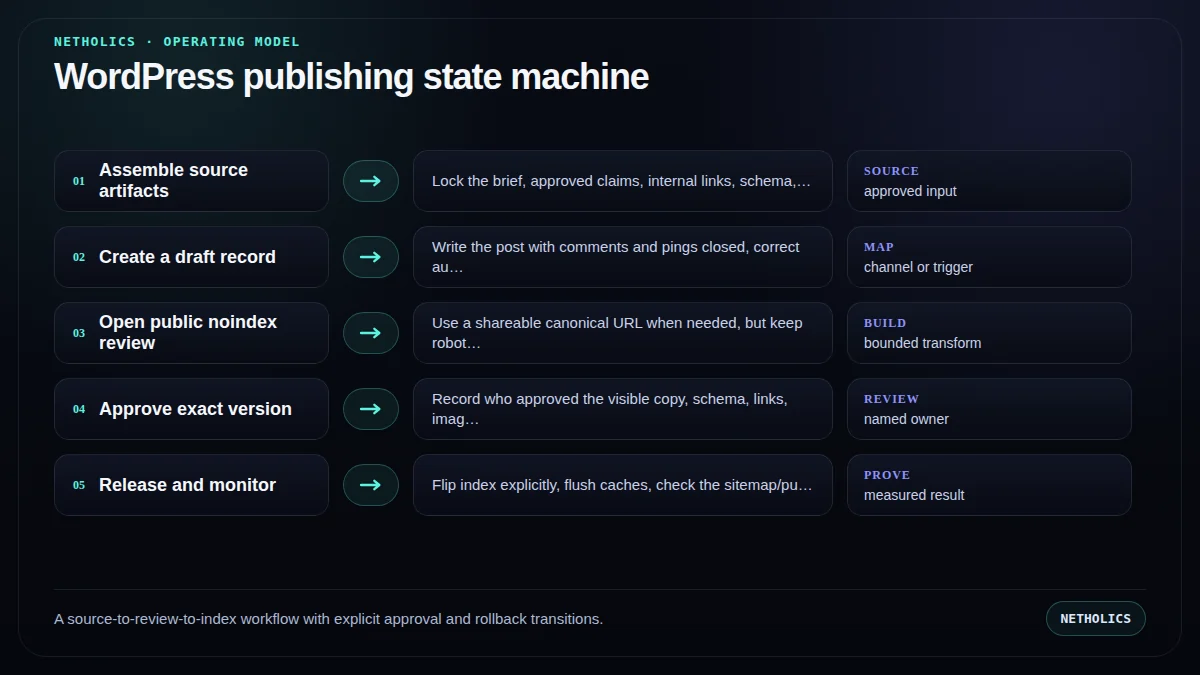
A practical launch runbook
Run the system manually before scheduling it. Automation should make a proven review process repeatable—not hide an undefined one.
- Define the states. Name source-ready, draft, public-review, approved, indexable, and retired states with one owner for each transition.
- Build source-first. Generate and validate repository artifacts before writing production WordPress content.
- Back up before mutation. Export any existing post, metadata, taxonomy, and media that the deployment may replace.
- Deploy review safely. Set the direct slug, author, category, shell flag, schema, metadata, closed comments, and noindex review state.
- Verify the visible version. Check canonical, robots, schema parity, links, images, desktop/mobile layout, nav, footer, and sitemap behavior.
- Release index explicitly. Store approval, remove noindex, flush cache, rerun the public checks, and retain the exact source version.
A staged 30–60–90 rollout
Days 1–30: baseline and shadow mode. Complete the first runbook steps manually, record current review time and defect types, and let the workflow produce recommendations without writing to production. Compare every proposed action with a human decision.
Days 31–60: limited live pilot. Allow one narrow, reversible path to write only after approval. Cap weekly volume, keep the previous version, and review input acceptance, first-pass approval, and escaped defects. Do not widen scope to make a weak metric look better.
Days 61–90: controlled expansion. Add one adjacent use case only when the first path has stable ownership and a qualified outcome. Reuse the state model and logging, but write a fresh risk boundary for the new path.
After day 90: operate, do not merely launch. Assign maintenance, source revalidation, workflow-version review, and rollback testing. The best first workflow remains Source artifact → WordPress public noindex review → named approval → index release.; expansion is earned by evidence rather than by schedule.
What authoritative sources add
Netholics comment: official guidance is a boundary, not a substitute for implementation judgment. The workflow still needs an accountable owner and a visible reason for every consequential transition.
Implementation checklist
- Define every publication state and permitted transition.
- Separate public accessibility from index eligibility.
- Back up content, metadata, taxonomy, and affected media.
- Require source hard gates before live deployment.
- Record the exact version and named approver.
- Verify robots, canonical, sitemap, schema, links, and responsive rendering.
- Route every later change through a new reviewable diff.
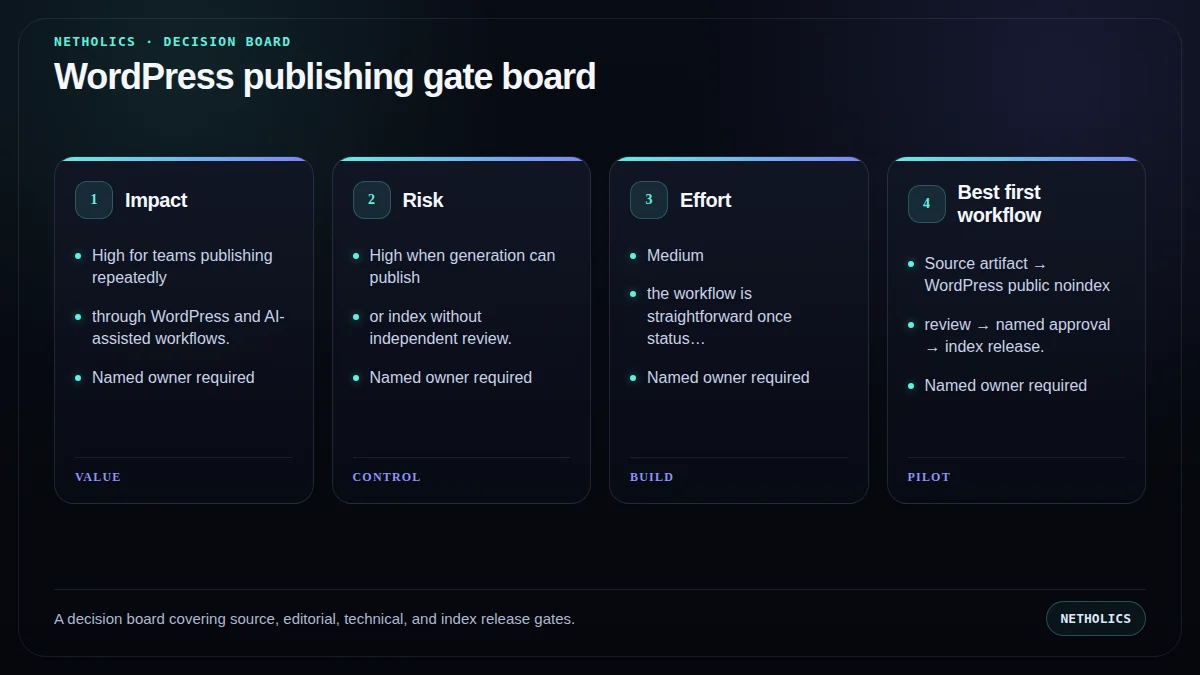
Automation readiness card
| Decision | Score |
|---|---|
| Impact | High for teams publishing repeatedly through WordPress and AI-assisted workflows. |
| Risk | High when generation can publish or index without independent review. |
| Effort | Medium; the workflow is straightforward once statuses and gates are explicit. |
| Best first workflow | Source artifact → WordPress public noindex review → named approval → index release. |
| Do not automate yet | When the site lacks backups, ownership, stable templates, or a reliable way to test the public result. |
Frequently asked questions
Q: What is a WordPress AI publishing workflow?
It is a controlled process that moves AI-assisted content through source preparation, draft, review, approval, technical QA, index release, and monitoring states.
Q: Why use a public noindex review page?
It allows reviewers to see the real URL and theme rendering while preventing the unapproved version from entering search results.
Q: Is WordPress draft status enough?
Not always. Drafts may require authentication and may not expose the exact public theme, caching, schema, or responsive behavior that needs review.
Q: Can n8n publish directly to WordPress?
Yes, but direct publishing should be constrained by status and approval rules. The safest first workflow creates or updates a review state rather than immediately indexing content.
Q: What should be recorded at approval?
Record the approver, approved source version, timestamp, visible URL, robots state, and results of schema, link, image, desktop, and mobile checks.
Q: How should post-publish changes be handled?
Create a new source version, back up the live post, deploy the change, review the diff and public rendering, then preserve the updated approval record.
Verified sources and next steps
For related implementation detail, continue with AI Content Automation Agency, WordPress AI Automation, Human-in-the-loop approval workflows, AI content brief automation.
Build the workflow before you scale the output
Netholics maps the source, state, review, WordPress, SEO, and GEO controls before automating production.