AI Search Citation Readiness Checklist: Make Claims Sourceable
Review a page before publication at the claim and passage level: can a reader identify the answer, verify the evidence, understand who owns it, and tell when it was last meaningfully reviewed?
The 60-second answer
- Citation readiness is an editorial quality gate, not a promise that any answer engine will quote the page.
- Give important questions concise answer passages, then preserve context, limitations, and supporting detail around them.
- Map material claims to primary sources and use crawlable links with descriptive anchors near the statements they support.
- Expose truthful authorship, dates, page purpose, and update responsibility; reject invented authority signals and cosmetic freshness.
Why this needs a controlled evidence workflow
A page can be accurate yet difficult to verify because the answer is buried, the source list is detached from the claims, links use vague anchors, authorship is unclear, or a modified date changed without meaningful review. Adding more FAQ markup does not repair those weaknesses.
Citation readiness asks whether the page contains useful, self-contained evidence units for people and machines. It cannot guarantee a citation: answer systems have independent selection, retrieval, and presentation behavior. The gate should improve reader trust even if no AI surface ever mentions the page.
This checklist is pre-publication evidence design. The answer-monitoring post measures what engines say later, and the provenance workflow governs claim history; citation readiness makes the visible page itself easier to inspect and quote responsibly.
The citation readiness gate operating model
Use five bounded stages. Each stage produces inspectable evidence before the workflow advances, and uncertainty remains visible instead of being converted into a confident score.
- Define the answer job. Name the audience, question, decision, and page purpose before editing passages.
- Extract material claims. Identify definitions, comparisons, numbers, recommendations, and claims a reader may rely on.
- Attach visible evidence. Place primary links, attribution, limitations, and update context close enough to verify the claim.
- Test extractable passages. Check whether concise answer blocks remain accurate when read with their heading and surrounding qualification.
- Approve the public record. Verify authorship, dates, canonical URL, links, schema parity, and an accountable revalidation trigger.
Evidence controls that keep reporting honest
Keep the record small enough to operate and specific enough to audit. The table separates observations from conclusions so a dashboard cannot silently upgrade weak evidence.
| Readiness layer | Pass condition | Failure signal |
|---|---|---|
| Answer passage | Directly answers one named question in clear language | Long preamble, vague thesis, or context-free slogan |
| Claim evidence | Material assertion maps to a relevant primary source or transparent internal evidence | Bibliography exists but does not support adjacent claims |
| Authorship and dates | Real owner, useful author information, publish date, and honest meaningful-update date | Generic byline or cosmetic freshness |
| Machine-readable parity | Article, FAQ, and entity markup matches visible supported content | Schema says more than the page or duplicates hidden answers |
Four failure modes to design out
Technical validity is not the same as evidential validity. Review these patterns during every pilot and after any collection or methodology change.
Snippet writing replaces substance failure
The page repeats short answers but provides no evidence, examples, limitations, or implementation depth.
Sources are decorative failure
Official links appear at the bottom but do not support the claims placed beside them.
Authority is simulated failure
Automation invents credentials, review dates, quotations, or confidence language to make the page look trustworthy.
Schema outruns the page failure
FAQ or Article markup contains answers, authors, or dates that are absent, hidden, or unsupported in visible content.
Measure the layer, not the story
Choose definitions before collecting results. Preserve the numerator, denominator, dates, cohort, exclusions, and collection version so a later reviewer can reproduce the interpretation.
| Metric | Measure | Guardrail |
|---|---|---|
| Material claim coverage | Share of material claims with relevant evidence and a support note. | Never infer a stronger downstream result than this evidence supports. |
| Passage qualification rate | Answer passages retaining required scope, limitation, and attribution when reviewed independently. | Never infer a stronger downstream result than this evidence supports. |
| Source-link health | Crawlable cited URLs returning the expected authoritative content at review time. | Never infer a stronger downstream result than this evidence supports. |
| Post-publication correction rate | Published pages requiring factual, attribution, date, or schema corrections after release. | Never infer a stronger downstream result than this evidence supports. |
Trend movement should open a diagnostic queue, not trigger automatic copy changes or unsupported commercial claims.
A minimal evidence record
This platform-neutral record can live in a warehouse, workflow payload, spreadsheet, or repository. Store enough context to distinguish an observation from an assumption and to re-run the check.
citation_gate:
  page: /example-guide/
  audience_question: How does the workflow verify a claim?
  answer_passage:
    heading_present: true
    direct_answer_words: 54
    limitations_present: true
  material_claims:
    total: 8
    primary_source_mapped: 8
  links:
    crawlable: pass
    descriptive_anchors: pass
  owner: editorial
  revalidate_on: source-change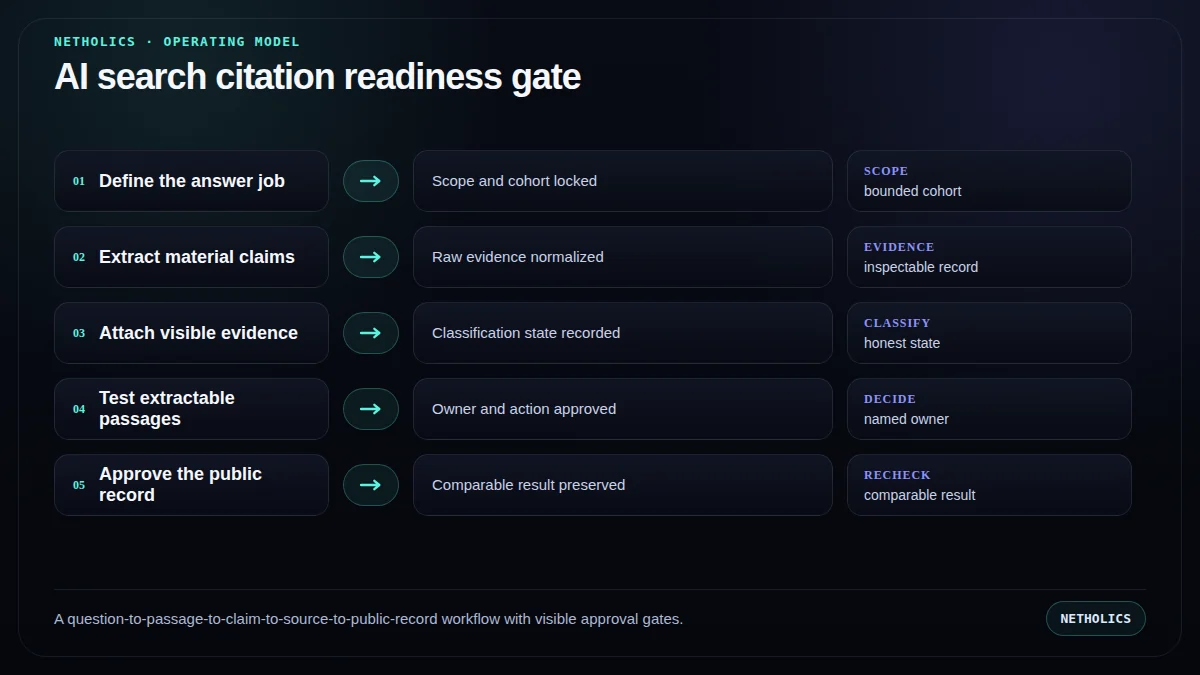
A practical launch runbook
Run the first cycle manually or in shadow mode. Automate collection only after definitions, ownership, exceptions, and review decisions produce a useful operating record.
- Select one high-value page. Choose a page with a real reader decision and enough expertise to support sourceable claims.
- Write question-answer pairs. Use the language of the audience, then answer directly before adding nuance and examples.
- Build the claim map. Record the exact statement, source, support note, volatility, and reviewer.
- Review passage boundaries. Read each answer with its heading, first paragraph, table row, or list context; restore missing qualifications.
- Validate technical parity. Check crawlable links, canonical URL, visible/schema FAQ match, article metadata, and public source responses.
- Publish with revalidation. Name the owner and trigger a review when evidence, products, regulations, or recommendations change.
A staged 30–60–90 rollout
Days 1–30: establish definitions and baseline. Lock the initial scope, collect one manual evidence set, document blind spots, and compare the report with what operators already know. Do not publish a trend before the cohort and rules are stable.
Days 31–60: automate collection in shadow mode. Let the workflow normalize records and propose classifications while a named reviewer compares exceptions with raw evidence. Track disagreements and repair the definitions rather than forcing every row into a category.
Days 61–90: open one controlled action queue. Allow the report to create narrow tickets with owners, expected results, and rollback or recheck steps. Keep production changes behind approval.
After day 90: govern method changes. Version tools, rules, cohorts, and source changes. The best first workflow remains One commercial support guide → claim map → passage review → source/link/schema gate.; expansion is earned by reproducibility and useful decisions.
What primary sources actually support
Netholics boundary: official documentation defines capabilities, fields, or recommended practices. It does not guarantee ranking, citation, complete attribution, or revenue. Preserve those distinctions in every report.
Implementation checklist
- Name the audience question and page decision.
- Place a direct answer under a descriptive heading.
- Keep necessary limitations with the extractable passage.
- Map every material claim to relevant evidence.
- Use crawlable links and descriptive anchors near supported claims.
- Keep visible content, authorship, dates, and schema aligned.
- Assign an owner and evidence-based revalidation trigger.
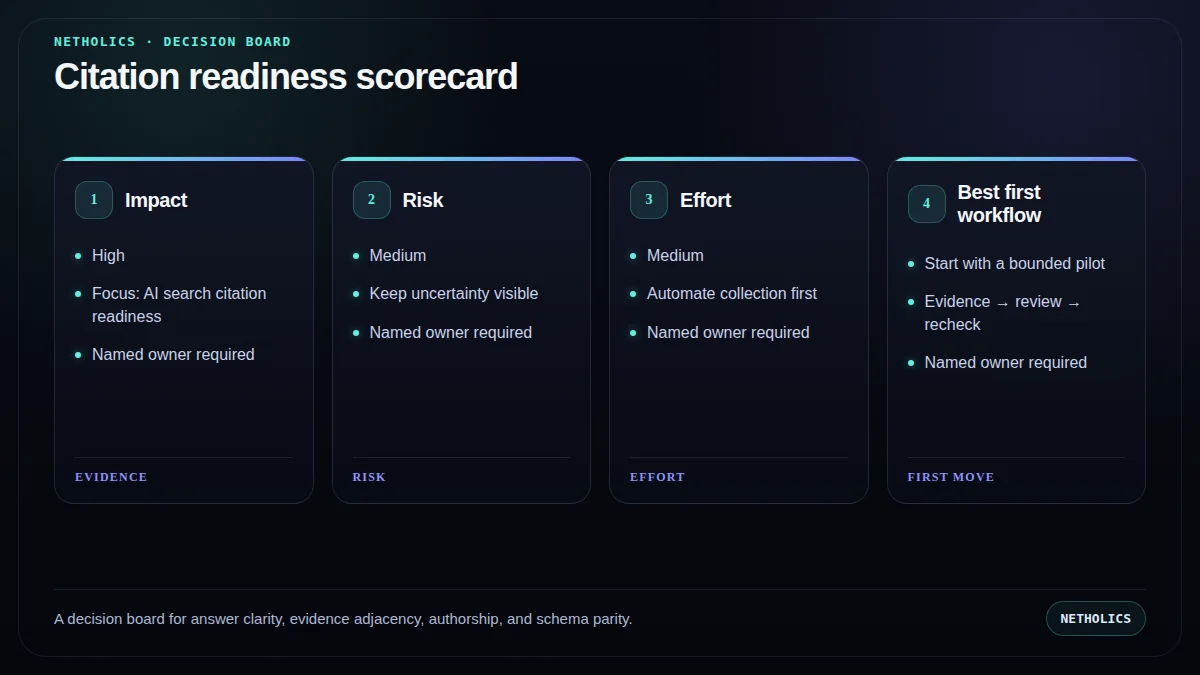
Automation readiness card
| Decision | Assessment |
|---|---|
| Impact | High for pages expected to explain technical systems, support buyer decisions, or serve as reference material. |
| Risk | Medium; over-optimizing snippets can remove nuance or turn the page into repetitive answer fragments. |
| Effort | Medium; claim mapping and passage review require editorial judgment, not just formatting. |
| Best first workflow | One commercial support guide → claim map → passage review → source/link/schema gate. |
| Do not automate yet | When the page lacks original expertise, sources are inaccessible, or nobody can approve material claims. |
Frequently asked questions
Q: What is AI search citation readiness?
It is the condition in which a page offers clear answers, sourceable material claims, crawlable evidence links, honest authorship and dates, and machine-readable data that matches visible content.
Q: Does passing a checklist guarantee an AI citation?
No. It improves page quality and verifiability, but answer engines independently decide what to retrieve, summarize, mention, or cite.
Q: How long should an answer passage be?
There is no universal fixed passage length. It should answer the question directly while retaining the qualifications needed to remain accurate outside the full article.
Q: Should every sentence have a citation?
No. Prioritize material claims: numbers, comparisons, product behavior, recommendations, quotations, and assertions a reader may rely on.
Q: Do FAQ and Article schema create citations?
They can clarify visible structure and metadata when eligible and accurate, but markup does not guarantee inclusion, ranking, extraction, or citation.
Q: How is this different from fact-checking automation?
Fact-checking and provenance govern claim evidence through production. Citation readiness is the final visible-page gate for clear passages, evidence adjacency, authorship, links, and schema parity.
Verified sources and next steps
Continue with GEO Content Automation, SEO Content Automation, Entity consistency audit, AI search measurement framework, Content provenance automation, AI answer monitoring workflow.
Turn AI search claims into auditable operations
Netholics connects crawler evidence, entity facts, sourceable content, analytics, and accountable review into one measurable GEO system.