AI Referral Traffic Attribution in GA4: Measure Without Guessing
Create a reproducible GA4 view of identifiable AI referrals, connect them to landing pages and business events, and state clearly which AI-influenced visits cannot be observed from referrer data.
The 60-second answer
- Start with raw session source and referrer evidence; do not rename every unfamiliar domain as AI traffic.
- Maintain a versioned allowlist of known AI referral hosts and normalize them into a custom reporting dimension or analysis layer.
- Evaluate landing pages, engagement, qualified events, and conversions—not sessions alone.
- Report observable AI referrals as a lower-bound signal because apps, browsers, redirects, privacy controls, and copied links can remove attribution.
Why this needs a controlled evidence workflow
AI referral reporting fails when a dashboard regex is treated as a complete census. Some answer systems pass a recognizable referrer, some links open through redirectors or browsers, and some visits arrive without a usable referrer. Campaign parameters are available only when the publisher controls the link.
A defensible workflow stores the host rules, effective dates, exclusions, and query logic. It separates observable referral sessions from broader AI visibility signals such as mentions and citations. That prevents a small but useful channel from becoming an inflated revenue story.
This article measures identifiable website sessions. Multi-LLM testing and answer monitoring examine answer surfaces directly; they are complementary because referral analytics cannot reveal every mention or citation.
The AI referral attribution operating model
Use five bounded stages. Each stage produces inspectable evidence before the workflow advances, and uncertainty remains visible instead of being converted into a confident score.
- Inventory raw sources. Export session source, medium, full referrer where available, landing page, events, and date range.
- Build the host registry. Verify domains manually, record aliases and redirectors, and assign effective dates and confidence.
- Normalize reporting. Apply versioned rules in an analysis layer or custom grouping without rewriting historical raw evidence.
- Connect behavior and outcomes. Compare landing pages, engagement, qualified events, conversions, and assisted paths using the same definitions.
- Publish limits and cadence. Label the report as observable referrals, document missing attribution, and review host rules regularly.
Evidence controls that keep reporting honest
Keep the record small enough to operate and specific enough to audit. The table separates observations from conclusions so a dashboard cannot silently upgrade weak evidence.
| Reporting element | Defensible treatment | Misleading shortcut |
|---|---|---|
| Known referral host | Verified domain with owner, label, effective date, and sample landing sessions | Broad regex that captures unrelated domains |
| Direct/unknown traffic | Retain as unattributed unless other first-party evidence exists | Reclassify unexplained direct traffic as AI |
| Conversions | Use stable qualified events and compare rate plus count | Claim revenue impact from session growth alone |
| Trend breaks | Annotate channel-rule, consent, site, and analytics changes | Present incomparable periods as organic channel growth |
Four failure modes to design out
Technical validity is not the same as evidential validity. Review these patterns during every pilot and after any collection or methodology change.
Everything unknown becomes AI failure
Direct, unassigned, or unfamiliar traffic is reclassified without first-party evidence.
The regex has no owner failure
A copied host pattern silently changes and nobody can explain inclusions, exclusions, or historical breaks.
Sessions become revenue failure
A small source increase is presented as commercial impact without qualified events, conversions, or uncertainty.
Periods are incomparable failure
Consent changes, redirects, channel rules, site migrations, or event changes create a trend that the report calls growth.
Measure the layer, not the story
Choose definitions before collecting results. Preserve the numerator, denominator, dates, cohort, exclusions, and collection version so a later reviewer can reproduce the interpretation.
| Metric | Measure | Guardrail |
|---|---|---|
| Observable AI referral sessions | Sessions matching the current verified host registry, reported with its version. | Never infer a stronger downstream result than this evidence supports. |
| Qualified event rate | Share of observable referral sessions completing the same governed useful-event definition. | Never infer a stronger downstream result than this evidence supports. |
| Landing-page concentration | Distribution of observable referrals and outcomes across canonical landing pages. | Never infer a stronger downstream result than this evidence supports. |
| Attribution exception count | Candidate hosts, redirects, direct sessions, and analytics changes requiring investigation rather than forced classification. | Never infer a stronger downstream result than this evidence supports. |
Trend movement should open a diagnostic queue, not trigger automatic copy changes or unsupported commercial claims.
A minimal evidence record
This platform-neutral record can live in a warehouse, workflow payload, spreadsheet, or repository. Store enough context to distinguish an observation from an assumption and to re-run the check.
ai_referral_registry:
  version: 2026-07-14
  hosts:
    - host: chatgpt.com
      label: OpenAI referral
      confidence: verified-domain
      effective_from: 2026-07-14
report:
  dimensions: [session_source, landing_page]
  metrics: [sessions, engaged_sessions, qualified_events]
  caveat: observable_referrals_only
  direct_traffic_reclassified: false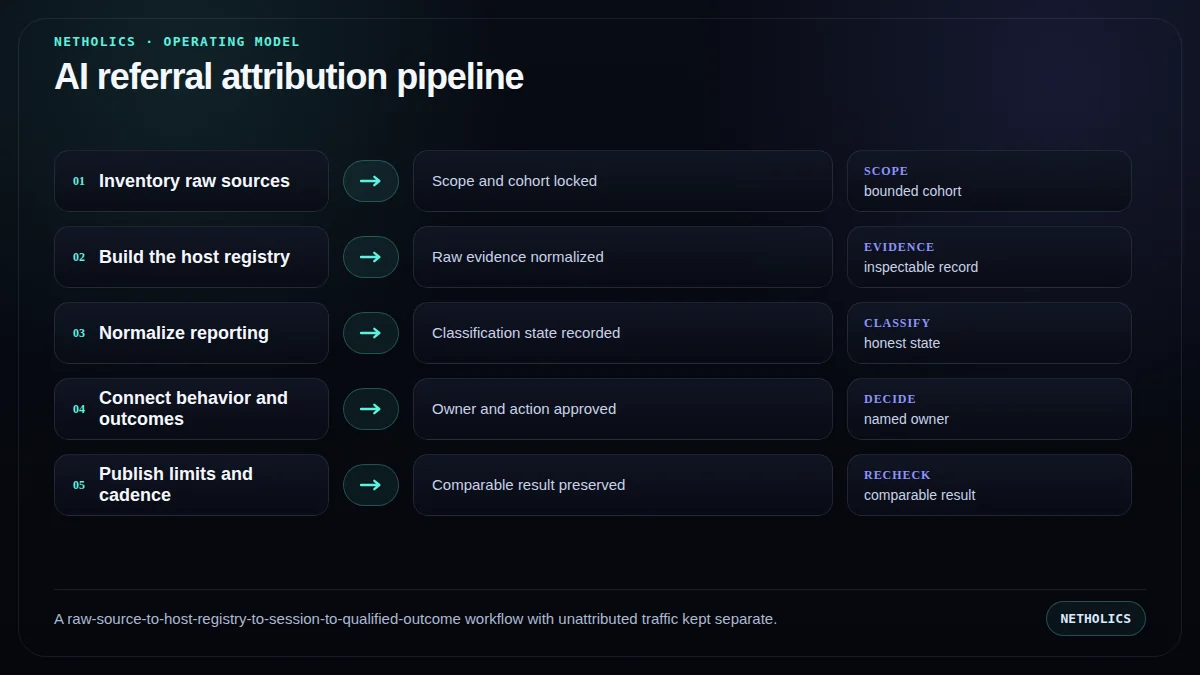
A practical launch runbook
Run the first cycle manually or in shadow mode. Automate collection only after definitions, ownership, exceptions, and review decisions produce a useful operating record.
- Preserve a baseline export. Save the raw source/medium and landing-page result before applying custom rules.
- Verify candidate hosts. Open the domain, identify the service owner, inspect real session rows, and reject substring-only matches.
- Version normalization logic. Store exact hosts, aliases, labels, exclusions, owner, and effective date in source control.
- Build a lower-bound report. Label the segment observable AI referrals and keep direct/unknown traffic separate.
- Attach meaningful events. Use qualified actions such as contact, booking, lead, or approved micro-conversion with stable definitions.
- Review monthly and annotate. Add new hosts only after evidence; record analytics, consent, routing, campaign, and site changes that affect comparability.
A staged 30–60–90 rollout
Days 1–30: establish definitions and baseline. Lock the initial scope, collect one manual evidence set, document blind spots, and compare the report with what operators already know. Do not publish a trend before the cohort and rules are stable.
Days 31–60: automate collection in shadow mode. Let the workflow normalize records and propose classifications while a named reviewer compares exceptions with raw evidence. Track disagreements and repair the definitions rather than forcing every row into a category.
Days 61–90: open one controlled action queue. Allow the report to create narrow tickets with owners, expected results, and rollback or recheck steps. Keep production changes behind approval.
After day 90: govern method changes. Version tools, rules, cohorts, and source changes. The best first workflow remains Raw GA4 source export → verified host registry → observable-referral segment → landing-page/event review.; expansion is earned by reproducibility and useful decisions.
What primary sources actually support
Netholics boundary: official documentation defines capabilities, fields, or recommended practices. It does not guarantee ranking, citation, complete attribution, or revenue. Preserve those distinctions in every report.
Implementation checklist
- Export and preserve raw session source/medium evidence.
- Verify every included host and store exact matching rules.
- Version labels, exclusions, owners, and effective dates.
- Keep direct and unknown traffic unattributed by default.
- Report landing pages, engaged sessions, qualified events, and conversions together.
- Annotate analytics, consent, routing, and site changes.
- State that identifiable referrals are a lower-bound signal.
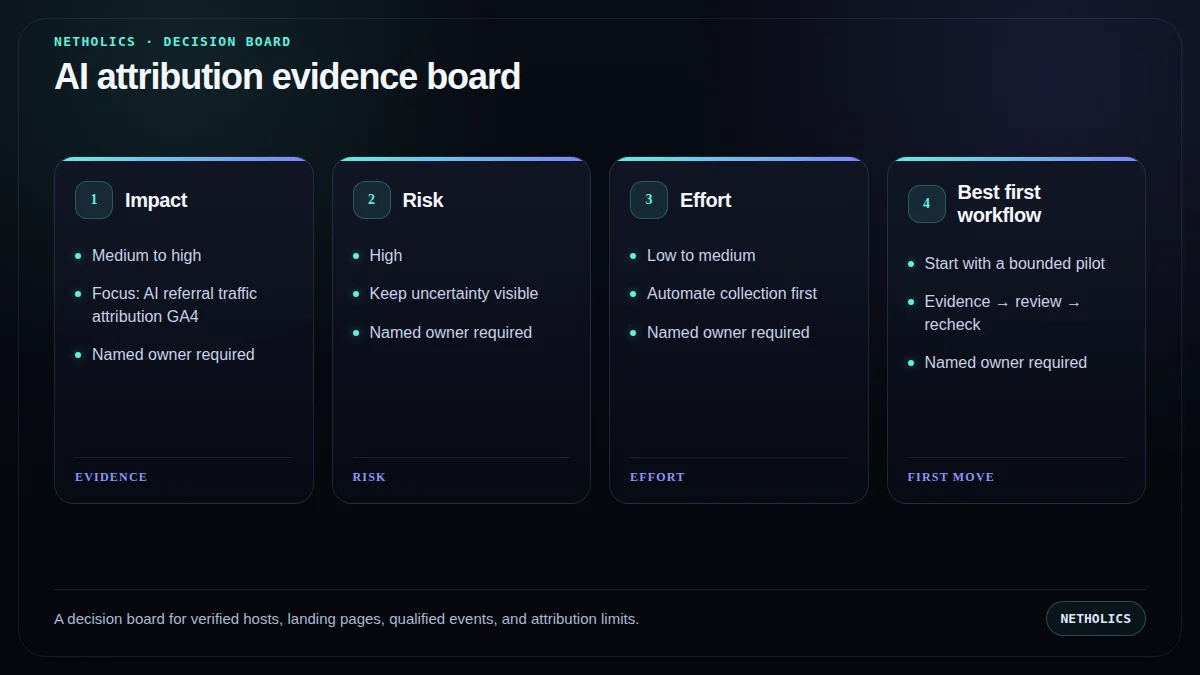
Automation readiness card
| Decision | Assessment |
|---|---|
| Impact | Medium to high when AI referrals reach commercially important pages and qualified events are reliable. |
| Risk | High if missing referrers or broad regex matches are converted into confident AI attribution. |
| Effort | Low to medium; host normalization is easy, while conversion and comparison quality depend on analytics governance. |
| Best first workflow | Raw GA4 source export → verified host registry → observable-referral segment → landing-page/event review. |
| Do not automate yet | When consent, cross-domain tracking, event definitions, or source data are unreliable. |
Frequently asked questions
Q: Can GA4 track traffic from ChatGPT and other AI tools?
GA4 can report sessions when a usable source or referrer reaches the site. Coverage varies, so the result should be described as observable AI referrals rather than all AI-influenced traffic.
Q: Should direct traffic be counted as AI traffic?
Not by default. Direct traffic includes many causes. Reclassify only when reliable first-party campaign or link evidence supports the change.
Q: Do I need a custom channel group?
A custom grouping can make recurring reporting easier, but preserve raw source and medium values plus a versioned host registry so the logic remains auditable.
Q: Which metrics matter beyond sessions?
Review engaged sessions, landing pages, qualified events, conversion counts and rates, and data-quality exceptions using stable definitions.
Q: Can UTM parameters solve AI attribution?
Only when you control the link or campaign. They cannot be imposed on independent links generated or shared by external answer systems.
Q: How does this connect to AI visibility monitoring?
Referral analytics measures identifiable visits. Answer monitoring measures mentions and citations even when no click occurs; a complete framework keeps those layers separate.
Verified sources and next steps
Continue with Generative Engine Optimization, AI Systems Audit, AI crawler log analysis, AI search measurement framework, AI answer monitoring workflow, Multi-LLM GEO testing.
Turn AI search claims into auditable operations
Netholics connects crawler evidence, entity facts, sourceable content, analytics, and accountable review into one measurable GEO system.