AI Search Measurement Framework: From Crawl to Business Outcomes
Build a layered scorecard that keeps crawl evidence, content readiness, answer visibility, citations, referral sessions, and business outcomes distinct—then use it to decide what to fix next.
The 60-second answer
- Do not collapse crawler requests, rankings, mentions, citations, clicks, and conversions into one proprietary visibility score.
- Define one evidence source, owner, cadence, and limitation for each layer of the AI search journey.
- Track a stable prompt set and answer evidence separately from Search Console and GA4 website evidence.
- Use the scorecard to open specific remediation queues: access, entity, content, citation, attribution, or conversion—not to celebrate an abstract number.
Why this needs a controlled evidence workflow
AI visibility dashboards often combine unlike signals into one index. A crawler request is not a citation, a mention is not a click, and a referral session is not revenue. When definitions are hidden, the score can move without revealing what changed or what the team should do.
A measurement framework preserves the chain of evidence. Each layer answers a different question, uses different data, and has different blind spots. Leadership receives a concise scorecard, while operators retain the underlying URLs, prompts, answers, sources, sessions, events, and decision records.
The answer-monitoring workflow supplies prompt and answer observations; crawler logs and GA4 supply other layers. This article is the governance and decision framework connecting those systems without merging their evidence.
The AI search measurement framework operating model
Use five bounded stages. Each stage produces inspectable evidence before the workflow advances, and uncertainty remains visible instead of being converted into a confident score.
- Define the decision map. List the decisions the report must support and the owner of each remediation queue.
- Separate evidence layers. Keep access, readiness, answer presence, citation, referral, and outcome records distinct.
- Set stable cohorts. Lock priority pages, entities, prompts, competitors, markets, and time windows before trend reporting.
- Calculate transparent measures. Publish numerator, denominator, source, collection date, exclusions, and known blind spots.
- Review and route action. Explain movement, open one owned fix queue, and preserve annotations for future comparisons.
Evidence controls that keep reporting honest
Keep the record small enough to operate and specific enough to audit. The table separates observations from conclusions so a dashboard cannot silently upgrade weak evidence.
| Layer | Evidence question | Primary record |
|---|---|---|
| Access | Did verified crawlers request the canonical page and receive the intended response? | Edge/origin log sample with identity and response state |
| Answer visibility | Did a stable prompt produce a brand mention or cited URL in the observed engine and market? | Prompt, engine, date, answer snapshot, mention/citation classification |
| Website acquisition | Did an identifiable source send a session to a canonical landing page? | GA4 source/medium, landing page, engagement, qualified event |
| Business outcome | Did governed leads, bookings, opportunities, or revenue follow under the chosen attribution model? | CRM/analytics event with definition, window, and caveat |
Four failure modes to design out
Technical validity is not the same as evidential validity. Review these patterns during every pilot and after any collection or methodology change.
One score hides the system failure
Access, mentions, citations, sessions, and outcomes are blended, so movement has no diagnostic meaning.
The cohort changes silently failure
Prompts, engines, pages, locations, or competitors change between periods while the chart presents a continuous trend.
Tool output becomes ground truth failure
A vendor classification is copied without raw answer, URL, timestamp, source, or exception evidence.
Reporting has no action path failure
The dashboard updates, but no owner investigates access, content, entity, attribution, or conversion failures.
Measure the layer, not the story
Choose definitions before collecting results. Preserve the numerator, denominator, dates, cohort, exclusions, and collection version so a later reviewer can reproduce the interpretation.
| Metric | Measure | Guardrail |
|---|---|---|
| Verified access rate | Priority canonical pages observed with intended responses in the governed crawler sample. | Never infer a stronger downstream result than this evidence supports. |
| Answer evidence coverage | Stable prompt observations completed with engine, market, date, answer snapshot, and classification. | Never infer a stronger downstream result than this evidence supports. |
| Citation and mention rate | Observed prompts producing the defined brand mention and/or cited canonical URL, reported separately. | Never infer a stronger downstream result than this evidence supports. |
| Qualified outcome evidence | Observable AI referrals and governed outcomes, never substituted for unobservable influence. | Never infer a stronger downstream result than this evidence supports. |
Trend movement should open a diagnostic queue, not trigger automatic copy changes or unsupported commercial claims.
A minimal evidence record
This platform-neutral record can live in a warehouse, workflow payload, spreadsheet, or repository. Store enough context to distinguish an observation from an assumption and to re-run the check.
measurement_framework:
  version: 2026-Q3
  cohorts:
    pages: 20
    prompts: 30
    markets: [US-English]
  layers:
    access: edge-log-report
    readiness: editorial-gates
    answers: prompt-observation-log
    referrals: ga4-observable-ai-segment
    outcomes: qualified-lead-event
  rules:
    composite_black_box_score: prohibited
    annotate_method_changes: required
  review_cadence: monthly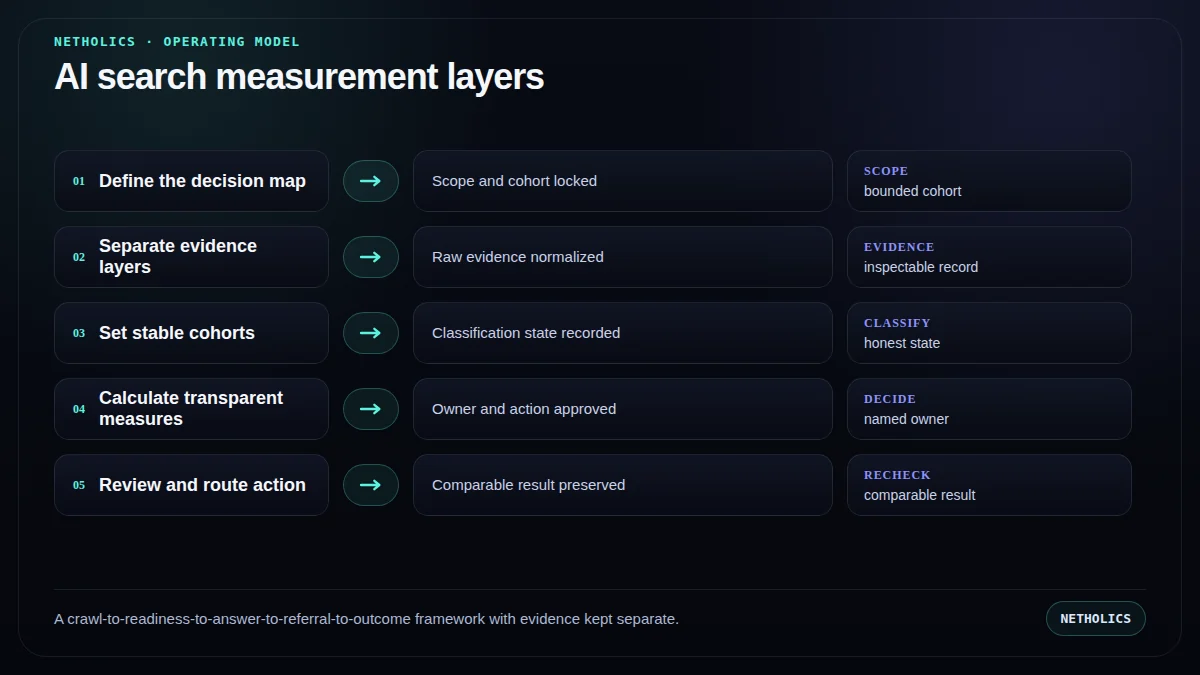
A practical launch runbook
Run the first cycle manually or in shadow mode. Automate collection only after definitions, ownership, exceptions, and review decisions produce a useful operating record.
- Write the decisions first. For each metric, state what action a good, bad, or changed result can trigger.
- Freeze the initial cohort. Choose commercially important pages, questions, engines, markets, and competitors; version later changes.
- Create evidence contracts. Define collection method, fields, owner, cadence, retention, and blind spots for each layer.
- Build transparent views. Show layer-specific counts and rates with drill-down evidence instead of one unexplained score.
- Run a monthly review. Separate collection defects from real movement, annotate changes, and assign narrow remediation.
- Rebaseline deliberately. Change prompts, pages, tools, or definitions only with a recorded version boundary and parallel comparison when possible.
A staged 30–60–90 rollout
Days 1–30: establish definitions and baseline. Lock the initial scope, collect one manual evidence set, document blind spots, and compare the report with what operators already know. Do not publish a trend before the cohort and rules are stable.
Days 31–60: automate collection in shadow mode. Let the workflow normalize records and propose classifications while a named reviewer compares exceptions with raw evidence. Track disagreements and repair the definitions rather than forcing every row into a category.
Days 61–90: open one controlled action queue. Allow the report to create narrow tickets with owners, expected results, and rollback or recheck steps. Keep production changes behind approval.
After day 90: govern method changes. Version tools, rules, cohorts, and source changes. The best first workflow remains Twenty priority pages + thirty stable prompts + one market → layered monthly evidence review.; expansion is earned by reproducibility and useful decisions.
What primary sources actually support
Netholics boundary: official documentation defines capabilities, fields, or recommended practices. It does not guarantee ranking, citation, complete attribution, or revenue. Preserve those distinctions in every report.
Implementation checklist
- Name the business and operational decisions the framework supports.
- Separate access, readiness, answer, citation, referral, and outcome layers.
- Version page, prompt, engine, market, and competitor cohorts.
- Publish metric definitions, sources, exclusions, and blind spots.
- Preserve prompt/answer evidence and raw website analytics dimensions.
- Annotate methodology, consent, site, tool, and model changes.
- Route every material movement to an owned diagnostic queue.
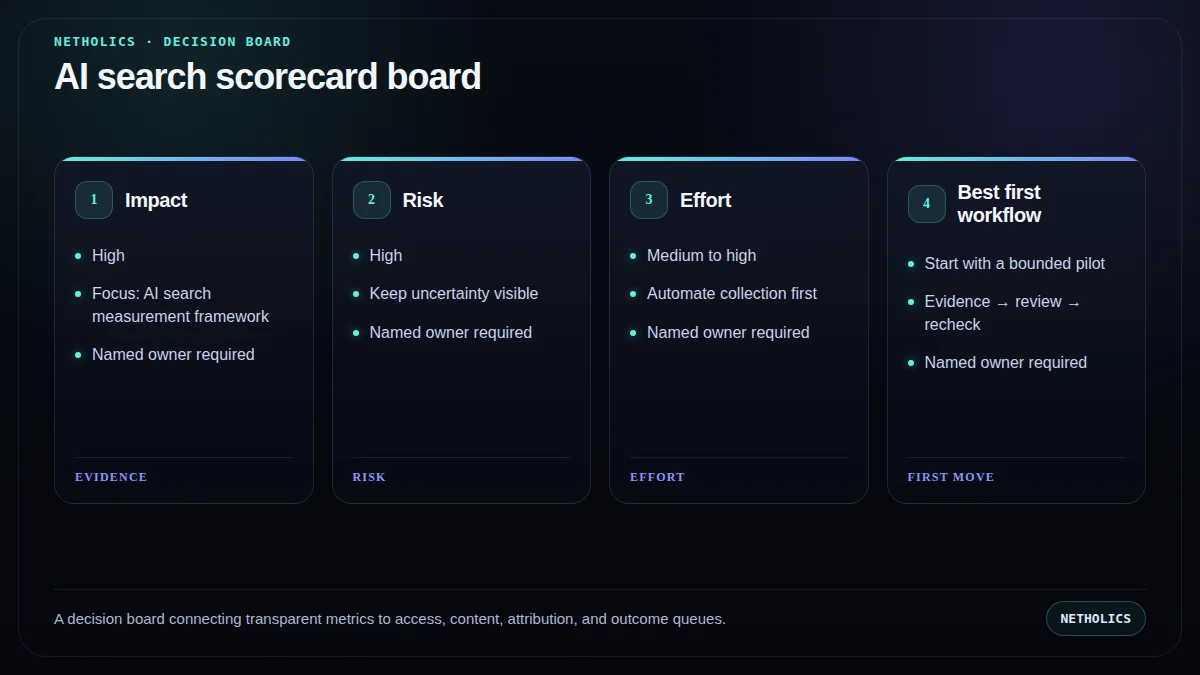
Automation readiness card
| Decision | Assessment |
|---|---|
| Impact | High when multiple teams or clients need one honest view of AI-search work and next actions. |
| Risk | High when opaque vendor scores or shifting prompts are presented as precise market share. |
| Effort | Medium to high; collection can be automated, but cohort governance and interpretation require ownership. |
| Best first workflow | Twenty priority pages + thirty stable prompts + one market → layered monthly evidence review. |
| Do not automate yet | When outcomes, page ownership, prompt cohorts, or metric definitions change every reporting cycle. |
Frequently asked questions
Q: What should an AI search measurement framework include?
It should keep crawler access, page readiness, answer mentions, citations, observable referrals, qualified events, and business outcomes as separate evidence layers with explicit definitions.
Q: Should we use one AI visibility score?
A summary indicator can aid scanning only if its components and weights are transparent. Do not let it replace layer-specific evidence and diagnosis.
Q: How often should AI visibility be measured?
Use a cadence stable enough for comparison and appropriate to business decisions. Monthly operational review is often more useful than reacting to daily answer variability.
Q: How do we compare periods when models change?
Annotate engine, model, interface, location, prompt, tool, and methodology changes. Use parallel runs or a new baseline when comparability breaks.
Q: Can Search Console show AI answer citations?
Search Console reports Google Search performance under its available dimensions and definitions. It is not a complete cross-engine citation log, so preserve separate answer observations.
Q: How is this different from answer monitoring?
Answer monitoring collects prompt and response evidence. The measurement framework connects that evidence to access, page quality, referrals, outcomes, governance, and remediation decisions.
Verified sources and next steps
Continue with Generative Engine Optimization, GEO Content Automation, AI crawler log analysis, AI referral attribution in GA4, AI citation readiness checklist, AI answer monitoring workflow, Multi-LLM GEO testing.
Turn AI search claims into auditable operations
Netholics connects crawler evidence, entity facts, sourceable content, analytics, and accountable review into one measurable GEO system.